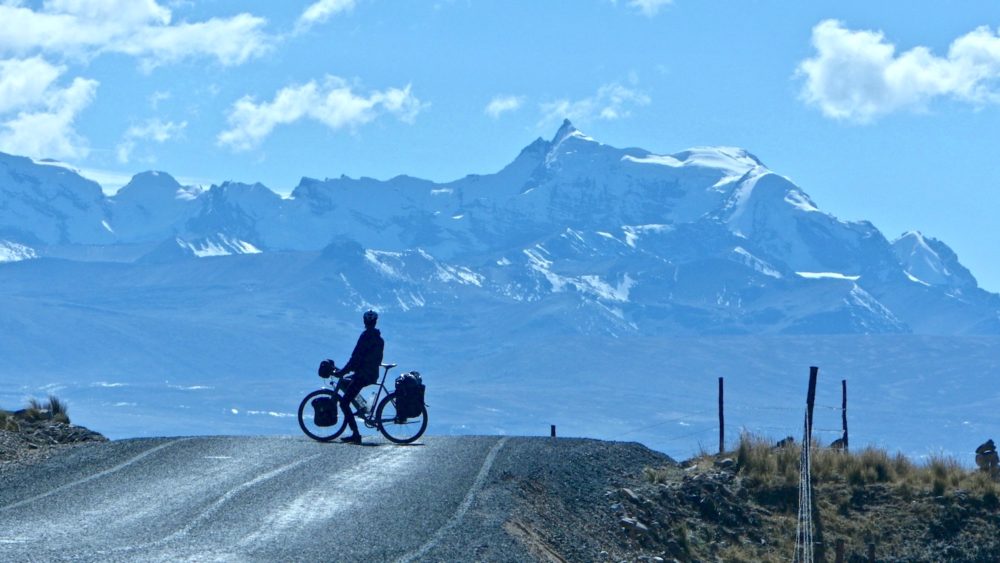
Welcome to the very first CyclingAbout Ask Me Anything article. I normally don’t get to reply to emails or comments in as much detail as I’d like, so it’s really nice to have this space where I think I can do your questions justice.
It’s a very tech-focused one this month, which is fine because that’s what I specialise in on this website. But keep in mind that you can throw whatever questions you like at me and I’ll answer them as best as possible.

How Is The Bike Holding Up?
And what do you think of the specs and what if anything you would change?
The bike seems to be pretty bombproof. So far I’ve broken one spoke in Patagonia, but other than a handful of punctures, the bike has essentially been maintenance-free. That’s one thing that I love about the Rohloff hub and belt drivetrain – it gives me extra time to relax and explore. When I travel with derailleur drivetrains I always procrastinate about cleaning and adjusting them…
On average, I think my bike is the fastest, most-practical setup for a multi-year adventure. The only thing I’d change is the fenders to a flatter/wider model so that I can fit wider tyres (29×2.15″ Schwalbe Almotion instead of 29×2.0″). I’ll definitely be making this change in the next six months. But otherwise, I’m super happy with the specs even though the bike is obviously not ideal for some of the terrain I take on.
Oh, I got some prototype handlebars made by Koga which should be heading to South America soon. Compared to the Crazy Bars they have less sweep (34 degrees) at the ends and more sweep in the centre. This will suit my lower/sportier position on the bike much better. Koga also tested them to be multiple times stiffer in their lab! I’m looking forward to getting them shipped over the Atlantic.
Have You Thought About Switching To A Plus-Bike Or A Bikepacking Setup?
Looks like you’re choosing some epic gnarly routes…
The aim of the game for me is to optimise for both on and off-road riding. Obviously, a lightweight plusbike/bikepacking setup would be most ideal for the terrain I’m currently riding. But on a multi-year trip, I still spend the majority of my time on hardpack dirt roads or sealed roads (hence the slicks).
I don’t really find the panniers too much of a hindrance, and love them for their practicality. This month they were only really a problem on the hiking trails I walked my bike on in the Huayhuash Wilderness Area. Typically I’ll see just a few kilometres of singletrack per month, and over the course of my trip, it will likely be 0.1% or less.
Here’s how I would change my setup if the percentage of off-road trails were to increase:
27.5″ Rims – The WorldTraveller frame allows for smaller diameter rims with wider tyres.
27.5 x 2.35″ Maxxis Ikon Tubeless Tyres – These don’t roll too bad and would give me more traction on trails.
or
29″ Rims – I’d use my existing Ryde 210 rims.
29 x 2.20″ Continental RaceKing Protection Tubeless Tyres – If I was expecting smoother surfaces (ie. the roads in Peru, but not the roads in SW Bolivia or Northern Argentina)
Ortlieb Gravel Panniers (4) // A bit lighter and more compact than my current panniers.
Ortlieb Rackpack Bag // 31 Litres for my food, tent poles and quick-access items.
Ortlieb Handlebar Bag // For a super-expensive camera, this is the most-protective option with the quickest access.
Tubus Logo Rear Rack // I’d use my existing rear rack of choice.
Old Man Mountain Front Rack // Less ideal for handling, but the highrider pannier location provides more ground clearance.
Front Rack Drybag – Only used for the long sections where I need to carry more than a week’s worth of food.
This setup would give me the same bag volume but with more ground clearance. The bike itself would have more traction and comfort, at the cost of a bit of speed. I tried to imagine how a bikepacking setup would look, but with the heavy-duty/comfort items I like carrying on a multi-year trip, I think panniers are the more practical and protective option for gear like my laptop.
I’ve also run the numbers on a high-volume bikepacking-ish setup though. I’d need to use a front rack (950g), front panniers (1200g), a front porteur bag (800g), a framebag (400g) and a big rear saddlebag (1200g). Plus multiple locations for water/fuel storage (500g+). This setup works out to be the same weight, just as wide, just as (un)aerodynamic, less practical for the camera, less practical for bag removal and would have a larger effect on my steering thanks to the heavier front load. I really can’t see any upside here.
That said, if I were cycling the Andes on a shorter trip, I’d definitely pack more minimally into a set of bikepacking bags and wouldn’t hesitate in bringing my ultralight equipment.

What Sort Of Rain Gear Do You Recommend?
I use my rain gear almost every day! My rain jacket doubles as a warm layer which I like in cooler climates because it’s windproof by nature. For the conditions I’ve been riding (cooler), my waterproof pants have also been indispensable. I keep them in an accessible place and throw them on over what I’m wearing as soon as the first drop hits. They’re just cheap plastic rainpants and they’re honestly fine. If I knew how much I’d use them in the Andes I’d probably have invested in something a notch or two better.
I definitely recommend a set of shoe covers to keep as much water out as possible. I’ve found that the best shoe covers are not waterproof; the waterproof models just end up filling your shoes with sweat anyway given the lack of air permeability. That said, for sub-10 degree Celsius temperatures, foot sweat probably won’t be an issue, so you’re best to go waterproof in the cooler climates.
I don’t actually think you need to spend a lot on rain gear. I’ve used cheap jackets (well, $100ish) and super expensive jackets ($400+) and don’t find any difference in performance for bike touring – they all get clammy in warmer conditions. The cut, pockets, build quality and feel (on my skin) are the far more important factors. My current Columbia jacket cost me less than $150 and I’ve been wearing it almost every day for five years. I love it! The waterproof liner is now starting to pull from the outer fabric so it will need to be replaced in the next little while. But I’m a super heavy user of gear, so this is expected.
How Are Your Brakes? How Often Do You Bleed Them?
I was a little worried about taking hydraulic disc brakes on this trip, but Koga assured me they’d been reliable for other travellers. So I took their word. My Shimano XT brakes have been fantastic! I had to bleed one of the brakes early-on as it must’ve been a bit dodgy from the factory, but otherwise, I haven’t needed to touch them. I’ve gone through two sets of brake pads so far which is pretty incredible given the terrain.

How Are You Navigating This Expedition?
I use two apps on my smartphone.
MapOut: This is the best mapping app I’ve come across. It’s all offline and the map sizes are very manageable (~130mb for all of Peru). You can trace custom routes with your finger and immediately see the elevation profile and amount of vertical metres (I use this feature for the majority of my route planning). There’s a 3D tilt feature to assess the terrain which I use all the time (you will have seen this in my Peru Divide film). You can also import and export GPX files that you or someone else has built in Komoot, RideWithGPS, Strava etc. When I’m out on the bike I use MapOut like you would a paper map. The phone screen is off unless I need to find out when the next turn is. I zoom in on the section I’m riding to see the elevation profile, distance and vertical gain. This allows me to predict how long the section will take. This app is unfortunately only available for iPhones and honestly is the only reason I stick with an Apple!
MapsMe: For points of interest, this is my favourite app. It’s 100% offline with lots of places already marked – I only use it in big cities. I normally do a little research to find the best hotels/restaurants/attractions before I arrive, marking everything in different colour pins on my map. It’s then really easy to navigate all the hectic places to find the things I’m interested in.
Where Do You Learn About The Backroads That You Travel?
If I have no information but a map to go off, I look at topographic lines and terrain and pick the smallest roads that go through the tightest valleys, or nearest to the biggest mountains. I don’t really mind adding distance or elevation if it means I can have a nicer riding experience. I’m constantly looking for what I think will be the quietest and most scenic route, and this normally uncovers some pretty wild places. My only other requirement is that the roads roughly head north. There are lots of roads here in Peru that go from east to west over the Andes which limits my backroad options.
In Bolivia and Peru, I’ve been really lucky because there are lots of mapped off-road routes on the AndesByBike.com and Bikepacking.com websites. I’ve used these well-documented routes as a rough guide since June!

How Are Your Schwalbe Almotion Tyres Holding Up?
There is quite some rough terrain in your footage… you’re not missing the extra grip? Why not use a Schwalbe Mondial?
The Almotion tyres have exceeded all expectations. They offer excellent mileage, they’re super puncture resistant (no punctures since May), they don’t seem to get any cuts and they roll super fast.
I decided to try these tyres in the Americas after looking at the rolling resistance numbers. By my calculations, I could go much faster on Almotion tyres over the Mondials I previously had. When comparing the Schwalbe Almotion and Schwalbe Mondial there is 19.2w of extra resistance overall (two tyres). This translates to about 1.49km/h (0.93mph) slower travelling speeds on the Mondials with all things being equal. That’s 5-7% slower, or the same speed penalty as using four panniers instead of more aerodynamic bikepacking bags!
With regards to how they handle rough dirt roads, they’re obviously not the best in this terrain. But they’re totally fine provided you’re careful and stick to within the capabilities of the tyre. Most dirt roads have very long and smooth corners; the wide slicks really don’t have any issues holding on there. Any tight or loose turns I take really slow and safe. Off-road trails are the least desirable place to have slicks, but by riding them with caution, I can always keep the bike upright.
So far, I haven’t ever fallen off as a result of not having enough grip (well, except that insanely slippery road in Brazil where I cracked my helmet – but I don’t think any tyre would’ve had grip on that road).
Want to Ask Me Anything For Next Month? Click HERE