


The Evil Chamois Hagar is a progressive geometry gravel bike that’s been generating plenty of buzz thanks to its radical design. It combines an unusually slack head tube angle, a long and low top tube, an ultra-short stem, and a front wheel that sits noticeably far ahead of the rider.
In this masterclass, we’ll use maths and physics to explore whether progressive geometry really makes sense for gravel bikes. We’ll dive into some advanced concepts to pinpoint exactly when the Chamois Hagar’s geometry excels, and when it falls short.
This article assumes a solid understanding of bike geometry fundamentals, so if you’re new to the topic, I recommend starting with the Basics of Frame Geometry HERE.
Note: this article was originally published in April 2020 but has been updated in Oct 2025.
What’s A Progressive Geometry Gravel Bike?

A progressive geometry gravel bike borrows design cues from modern mountain bikes to deliver a ride that’s more stable, confident, and capable on rough terrain.
Frame designers start by slackening the head tube angle. While most gravel bikes sit between 71 and 72 degrees, a progressive geometry gravel bike can go as slack as 66 to 69 degrees. This slightly slows down the steering response and pushes the front wheel further ahead of the rider.
The result is a longer front end, an extended wheelbase, and a more composed ride, especially noticeable on descents and over technical terrain. As a bonus, the extra front-centre length also increases toe clearance from the front wheel.
To achieve this stretched-out front end, designers lengthen the frame’s reach. Normally, this would place the handlebars uncomfortably far away, but progressive gravel bikes compensate with ultra-short stems, maintaining a familiar hand position.
The bottom bracket also sits a bit lower than usual, which drops your centre of mass. This subtle change helps the bike corner more intuitively and feel more planted at high speed, enhancing both stability and confidence on challenging trails.

Meanwhile, a steeper seat tube angle keeps the rider centred over the cranks, maintaining efficient power transfer when climbing. Together, these geometry tweaks create a gravel bike that behaves more like a drop-bar mountain bike—stable and forgiving when the road disappears, yet still efficient and comfortable for long days in the saddle.
Progressive geometry has a noticeable impact on how a bike feels to ride. It’s less twitchy on loose gravel, more composed at higher speeds, and easier to control when carrying bikepacking gear. Models like the BMC URS and Santa Cruz Stigmata are great examples, each putting its own spin on the concept.
Whether you’re after a well-balanced all-rounder for adventure rides or a more radical setup for technical trails, progressive geometry adds a new level of versatility to gravel biking.
It’s all sounding pretty good, so what are the drawbacks?
Front and Rear Weight Distribution

The main drawback of progressive geometry gravel bikes is that their weight distribution tends to shift more toward the rear, which can sometimes reduce front tyre grip.
When you ride, your body weight is shared between the front and rear wheels. Most riders have a centre of mass near their hips when seated – roughly above the bottom bracket area.
During acceleration, the body naturally pitches forward, which is why bikes are generally designed with a rearward weight bias to maintain balance and control. If the front end of a bike is too short and steep, it shifts too much weight forward, increasing the risk of going over the bars on descents. On the other hand, if there’s not enough weight on the front wheel, you lose front-end traction in corners, resulting in understeer.
So, how does the weight balance of the Evil Chamois Hagar stack up against a conventional gravel bike?

Weight Distribution: Cannondale Topstone
XS – 58.2% R, 41.8% F
S – 58.6% R, 41.4% F
M – 59.1% R, 40.9% F
L – 60.1% R, 39.9% F
XL – 60.8% R, 39.2% F
Average: 59.4% Rear Tyre, 40.6% Front Tyre
A good example of a typical gravel bike is the Cannondale Topstone. When riding on flat terrain in a seated position, roughly 59% of a rider’s weight rests on the rear tyre and about 41% on the front. Because of geometric limitations, shorter riders tend to have a slightly higher percentage of their weight over the front wheel compared to taller riders.
So, what about the Evil Chamois Hagar?

Weight Distribution: Evil Chamois Hagar (Rider centre of mass adjusted in accordance with the varying seat tube angles and bottom bracket heights)
Small – 61.5% R, 38.5% F
Medium – 61.8% R, 38.2% F
Large – 61.7% R, 38.3% F
XLarge – 61.6% R, 38.4% F
Average: 61.7% Rear Tyre, 38.3% Front Tyre
When seated, the Hagar shifts between 0.8% (size XL) and 3.3% (size S) of your body weight off the front tyre compared to a typical gravel bike. That might not sound like much, but even a few kilograms can noticeably affect front-end traction, especially when cornering on flat terrain or grinding up steep climbs. You can regain a bit of this grip by lowering your front tyre pressure, but ultimately, it’s the weight on the front wheel that matters most.
Taller riders will notice less of a difference in front grip between the Hagar and a conventional gravel bike. This is largely due to the Hagar’s steep 74.5-degree seat tube angle, which shifts more body weight forward to help balance things out.
When you’re out of the saddle, though, riders of all heights will find the Hagar delivers front grip similar to that of a standard gravel bike, since it’s much easier to move your body weight forward while standing on the pedals.
Alright, let’s move on to a different gravel bike concept.

Weight Distribution: Rivendell Atlantis (Rider centre of mass adjusted in accordance with the varying seat tube angles and bottom bracket heights)
47 – 56.3% R, 43.7% F
50 – 56.6% R, 43.4% F
53 – 57.2% R, 42.8% F
55 – 57.5% R, 42.5% F
59 – 57.9% R, 42.1% F
62 – 58.4% R, 41.6% F
Average: 57.3% Rear Tyre, 42.7% Front Tyre
The Rivendell Atlantis has some of the longest chainstays of any gravel bike out there, ranging from 515mm to 555mm. This gives it a wheelbase similar in length to the Hagar’s, but with the extra length placed behind the rider rather than in front.
So, what does that mean for weight distribution?
In the smaller frame sizes, the Atlantis puts about 5.2% more of your body weight on the front tyre, while in the larger sizes, that difference drops to around 3.2%. This extra front load translates to noticeably better front grip on flat ground and climbs. However, when descending, you’ll need to shift your body weight rearward (behind the saddle) to achieve the same front-to-rear grip balance that the Hagar naturally provides.
Weight Distribution and Bikepacking Bags

Alright, so we’ve established that when seated, the Hagar has a bit less front-end grip than a typical gravel bike. But this is a bike travel website, so let’s assume you’re out there loaded up with gear!
Handlebar packs, cargo cage bags, and stem bags all help add weight to the front tyre, improving traction. The question is: how much extra weight do you actually need up front to match the front tyre grip of a conventional gravel bike?
Here’s what the numbers show:
-
If you weigh 60 kg and ride a Small Chamois Hagar, you’ll need about 2.0 kg on the bars to match the front grip of a small Topstone.
-
If you weigh 80 kg and ride a Large Chamois Hagar, you’ll need around 1.3 kg up front to even things out.
-
If you weigh 100 kg and ride an XL Chamois Hagar, roughly 0.8 kg on the bars will do the trick.
The great thing about this is that most bikepacking setups naturally put weight in front of your centre of mass, your handlebar roll, feed bags, and cargo cages all help load the front tyre. The seat pack is usually the only major bag behind you.
In short, once your Hagar is fully kitted out for bikepacking, you can expect plenty of front-end grip on the trail.
Advantages of Long Front Centres on Gravel Bikes

The Hagar might give up a bit of front-end grip in certain situations, but when the road points steeply downhill, it absolutely flies.
Here’s why:
-
A longer wheelbase makes the bike more stable at speed by effectively lowering your centre of mass.
-
When you stand up, your body weight sits more evenly between the tyres, improving overall traction and control.
-
On steep descents, you don’t need to shift your weight as far rearward to stay balanced.
-
The Endo Angle is greater, meaning it takes a steeper slope before you risk pitching over the handlebars.
Wait, what exactly is the Endo Angle?
Gravel Bike Endo Angles

The Endo Angle is the measure of how far a rider can pitch forward before reaching the tipping point and going over the bars.
By increasing a bike’s front-centre length (the distance from the bottom bracket to the front axle), you increase the Endo Angle. In simple terms, a larger Endo Angle makes it harder to go over the handlebars on steep or technical terrain.
This translates to a big boost in downhill confidence, especially when your front wheel hits rocks, ruts, or debris. It’s the single most important factor that makes the Evil Chamois Hagar a far more capable descender than just about any other gravel bike out there.
Evil Chamois Endo Angles (larger angles are better)
S – 44.5 degrees
M – 41.2 degrees
L – 38.3 degrees
XL – 36.0 degrees
Average: 40 degrees (10% more than typical gravel bikes)
Cannondale Topstone Endo Angles (larger angles are better)
XS – 40.3 degrees
S – 37.9 degrees
M – 35.9 degrees
L – 34.6 degrees
XL – 33.3 degrees
Average: 36.4 degrees
Rivendell Atlantis (larger angles are better)
47 – 42.1 degrees
50 – 40.5 degrees
53 – 39.5 degrees
55 – 38.7 degrees
59 – 37.8 degrees
62 – 36.9 degrees
Average: 39.3 degrees (very similar to The Hagar)
Gravel Bike Looping Angles
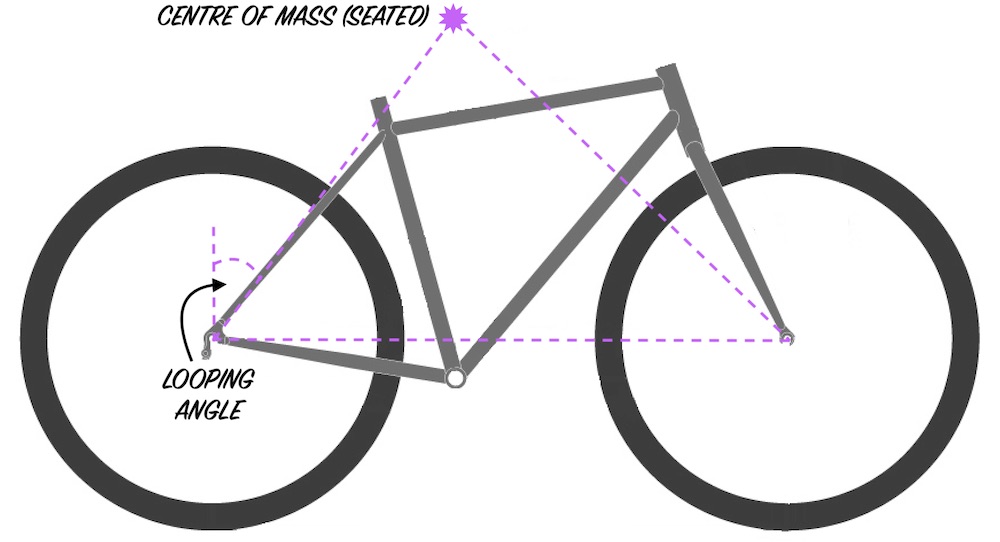
At the other end of the bike, the Looping Angle defines how far you can tip backward before reaching the point of looping out.
In practical terms, a bike with a larger Looping Angle can climb steeper terrain while keeping more weight over the front tyre, which improves traction and stability. Among gravel bikes of similar sizes, there’s usually not a huge variation here; most have comparable chainstay lengths and seat tube angles, so their Looping Angles fall within a fairly tight range.
There are two main ways to increase the Looping Angle on a gravel bike: either move the rider’s centre of mass forward by steepening the seat tube angle, or extend the chainstays to lengthen the rear centre.
As shown below, the Evil’s steep seat tube angles help it maintain traction and climb steeper gradients than average. Meanwhile, the Rivendell’s extra-long chainstays take this even further, allowing it to scale much steeper climbs while keeping ample weight on the front wheel.
Evil Chamois Looping Angles (larger angles are better):
S – 31.6 degrees
M – 28.5 degrees
L – 26.1 degrees
XL – 22.8 degrees
Average: 27.3 degrees (2% more than typical gravel bikes, thanks to steep seat tube angles)
Cannondale Topstone Endo Angles (larger angles are better):
XS – 31.4 degrees
S – 28.8 degrees
M – 26.6 degrees
L – 24.6 degrees
XL – 22.9 degrees
Average: 26.9 degrees
Rivendell Atlantis (larger angles are better):
47 – 35.0 degrees
50 – 33.2 degrees
53 – 31.6 degrees
55 – 30.6 degrees
59 – 29.4 degrees
62 – 28.1 degrees
Average: 31.3 degrees (17% more than a typical gravel bike, thanks to very long chainstays)
Gravel Bike Chainstay Lengths

Shorter chainstays are generally favoured on both mountain and road bikes because they make the bike feel more agile and responsive. This quick handling is useful for making sharp direction changes, like navigating singletrack or repositioning within a peloton. Off-road, shorter chainstays also make it easier to lift the front wheel over obstacles, which adds to a bike’s playful and reactive feel.
Longer chainstays, however, bring their own set of advantages. They help improve stability at higher speeds, and they increase the looping angle, enabling you to climb steeper gradients while keeping more weight over the front tyre.
Gravel Bike Steering Speeds
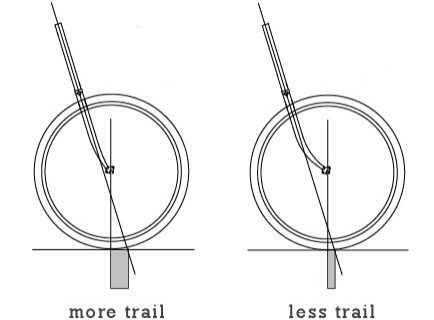
The ‘trail’, the product of a bike’s head tube angle and fork rake (or offset), is one of the best indicators of how quickly a bike will steer.
Less trail results in faster steering, which makes a bike easier to balance and more stable at low speeds, since quick steering inputs help you stay upright. However, at high speeds, that same responsiveness can make the bike feel twitchy or unstable.
More trail, on the other hand, produces slower steering, which increases stability at speed because the front wheel resists small, unintended movements. The trade-off is that bikes with higher trail can feel less stable at lower speeds due to increased wheel flop (more on that in the next section).
In short, good bike geometry finds the sweet spot between agility and stability. Too much of either can make a bike difficult to handle.
The Evil Chamois Hagar is on the higher end of the ‘trail’ spectrum, so its steering is slower than that of a typical gravel bike. But it’s not extreme by any means. In fact, popular bikepacking models like the Salsa Cutthroat (87mm of trail) and Salsa Fargo (92mm) have similar or even slower steering once you factor in their wider tyres, which increase pneumatic trail.
To counteract its slower steering, the Hagar is designed specifically around a short stem. By reducing the steering arc, the handlebars respond more directly to input, meaning less effort is needed to change direction.
If you still find the steering a bit heavy, especially when carrying gear on the front, the best fix is to increase your steering leverage. Installing a wider drop bar makes a big difference here.
For example, Curve Bicycles recommends a 600mm wide Walmer Bar (measured at the brake hoods) on their GMX bikepacking rig. If you’re running front bags and want sharp, controlled handling, a wider handlebar upgrade is a good way to go about it.
Gravel Bike Wheel Flop
We’ve established that the Hagar’s steering is on the slower side (though far from extreme), but there’s another key factor that defines how it feels at low speeds – wheel flop. This is the biggest drawback of a high-trail bike.
Wheel flop refers to the vertical drop of the front axle when the handlebars are turned 90 degrees. In practice, a bike with more wheel flop will constantly try to pull the bars to one side when riding slowly, below about 20 kph or 12 mph, requiring more effort to keep it tracking straight.
The Hagar has around 60% more wheel flop than a typical gravel bike, so you can expect it to feel a bit more demanding on slow climbs or technical sections. That said, bikes like the Salsa Cutthroat and Salsa Fargo also have about 50% more wheel flop than average, and most riders find them perfectly manageable at low speeds.
The good news? Wider handlebars are the perfect remedy. They not only counteract the Hagar’s slower steering by increasing leverage but also help offset the effects of wheel flop, making it easier to maintain balance and control when the pace drops.
Is The Evil Chamois Hagar Frame Geometry Any Good?

All things considered, the Evil Chamois Hagar is actually not as radical as it first appears.
Its front-to-rear weight distribution is tuned for descending, making it exceptionally stable at high speeds and more composed on steep backroad descents than almost any other gravel bike. On flatter corners or during steep climbs, you’ll need to shift more of your body weight forward to maintain front-tyre grip. But once you add bikepacking gear up front, the balance improves considerably.
The combination of a long front centre, slack head tube angle, and generous fork rake gives the Hagar a significantly larger endo angle than most gravel bikes. This makes it far less prone to pitching over the bars, allowing you to ride rough, steep singletrack with extra confidence. Meanwhile, its looping angle remains typical, so climbing characteristics stay well within normal gravel-bike expectations.
Steering-wise, the Hagar is on the slow side compared to a standard gravel bike. At lower speeds, the high wheel flop causes the bars to pull slightly to the sides, an effect that becomes more noticeable when you’re carrying front luggage.
The short stem helps quicken the steering response a little, but the best way to counter both the slow steering and wheel flop is to fit a wide handlebar, which adds valuable steering leverage and helps keep the bike stable and predictable in all conditions.
How Could We Improve Gravel Frame Geometry?

I know it’s early (as I haven’t ridden it yet), but from first principles of bike handling, there are a few changes that could sharpen the Evil Chamois Hagar’s steering and improve weight balance while keeping its downhill prowess intact.
-
Increase the fork offset and slacken the head tube less. Tweaking those two values can keep a long front-centre and large endo angle but yield quicker steering and reduced wheel-flop (for example, 68° head-tube + 60 mm offset → 14% faster steering / 17% less wheel-flop). See the Stooge MK4 or Jones Plus LWB for similar approaches in the wild.
-
Lengthen the chainstays on the larger sizes. Longer rear centres raise the looping angle, letting bigger frames climb steeper pitches with more weight and grip at the front.
-
Steepen the seat tube on the smaller sizes. A sharper seat tube shifts more rider mass forward, improving seated front-tyre grip in corners.
-
Reduce the reach on the smaller sizes. Shorter reach combined with a steeper seat tube would make it easier to fit wider handlebars (the most effective way to counteract slow steering) without compromising fit.
Taken together, these tweaks should preserve the Hagar’s downhill confidence while making it more forgiving and better balanced across a wider range of riding and rider sizes.
A Budget Evil Chamois Hagar

If the Evil Chamois Hagar sounds appealing but the US $4,799+ price tag doesn’t, here’s a little secret: you can build a gravel bike with very similar geometry for a fraction of the cost. In fact, I’d argue that this setup could actually handle better at typical bikepacking speeds, especially when loaded with front luggage.
Take the Salsa Journeyman Flat Bar as an example. Its overall geometry closely mirrors that of the Hagar, but the bike itself costs just US $949. Add a Curve Walmer or Ritchey Venturemax XL handlebar and a short stem (around US $170 total), then fit a pair of Claris shifters for roughly US $100, and there you have it: a budget-friendly gravel rig with Hagar-like geometry.
All up, you’re looking at about 25% of the cost of the Evil Chamois Hagar, for a comparably capable bike, and potentially even better suited to real-world bikepacking adventures.
Do Progressive Geometry Gravel Bikes Make Sense?
Progressive geometry gravel bikes are definitely a step in the right direction.
In the coming years, we’ll likely see many more gravel bikes adopting longer reaches and shorter stems for improved stability and control. While it’s doubtful we’ll see another model go as slack as the Hagar’s 66-degree head tube angle (though I might end up eating those words), off-road-oriented gravel bikes will probably settle around 68 to 69 degrees, paired with longer fork offsets to balance steering and stability.
I really appreciate that the Evil Chamois Hagar dares to break the mould. It challenges our assumptions and encourages a deeper look at what makes for truly great gravel bike geometry – not just on paper, but out on the trail.
Click HERE To See 6 Other Bikepacking Bike Trends For 2020


