


If you’re a heavier rider, carry a lot of gear, or are planning a major expedition, choosing one of the strongest touring bikes makes a real difference.
A touring bike doesn’t just have to support the combined weight of rider and luggage – it also has to endure the repeated stresses created by that weight, especially when riding over rough roads, washboard, and potholes.
Until recently, there was no mandatory safety standard to guarantee the structural integrity of touring bikes loaded beyond 136 kg (300 lb). As a result, many bikes were never formally tested for the demands of truly heavy loads.
Third-party certification to higher weight limits requires significant time, testing, and expense. Not every manufacturer is willing to go that far. But if your total system weight is approaching the upper limits, that extra validation is well worth it for long-term safety and reliability.
In this guide, I’ll explain how touring bike frames are tested and certified for strength. You’ll learn why a 180 kg-rated frame can be beneficial even if you’re carrying far less. And finally, I’ll walk you through the strongest touring bikes available for serious, fully loaded expeditions.
Let’s dive in.
Weight Ratings For Touring Bikes

When bike safety is tested, manufacturers typically rely on the globally adopted ISO 4210 bicycle standard. This standard assumes a maximum total system weight of just 100 kg (220 lb), including the bike, rider, luggage, food, water, and everything else rolling down the road.
Unless you’re a particularly light rider with a very minimalist setup, that limit is surprisingly easy to exceed.
Recognising this, many touring bike manufacturers test their bikes beyond the ISO minimum, knowing they’ll be used with luggage. The Trek 520, for example, is rated for a total system weight of 125 kg (275 lb), while the Surly Disc Trucker is approved up to 136 kg (300 lb).
On paper, those numbers sound reasonable. In real-world touring, they’re far less reassuring.
The average man in Germany and neighbouring countries weighs around 89 kg (196 lb), with American men weighing a few kilograms more. A typical touring bike weighs 15 to 17 kg, and many riders carry at least 20 kg of luggage. Add roughly 2 kg of food, 2 kg of water, 1.5 kg of clothing, 1 kg of shoes, and about 500 grams for a helmet.
Add it all together, and you’re already past 130 kg (287 lb), right at the upper limit of many touring bikes before factoring in rough roads, potholes, or long-term fatigue.
Why Are Touring Bike Weight Limits Not Higher?

Touring bike weight limits have remained relatively conservative, largely because of how strength and safety standards were originally developed.
These standards are designed to apply to all bicycles, in all countries, and ISO 4210 does not include a touring-specific category. In many parts of Asia, for example, the average male body weight is closer to 70 kg (154 lb), meaning the existing limits can be entirely appropriate for large segments of the global cycling population.
The good news is that testing standards are evolving. DIN 79010, developed by the German Institute for Standardisation, was the first standard to define testing methods and safety requirements for both electric and non-electric cargo bikes. As a result, we’re now seeing an increasing number of bicycles certified for system weights exceeding 200 kg.
A 180 kg Weight Rating For Strong Touring Bikes

Over the past five years, some touring bike manufacturers have gone far beyond the minimum ISO testing requirements. These tests are designed to verify that a bike can withstand real-world dynamic loads – not just support static weight in a laboratory setting.
Frames and forks are put through extensive test protocols involving hundreds of thousands of multi-directional load cycles, replicating the cumulative stresses a touring bike experiences over its entire service life. These fatigue tests are paired with maximum load testing to ensure the frame and fork remain safe, stable, and reliable under heavy touring conditions.
In Germany, certification bodies such as Zedler and EFBE now test and approve touring bikes for total system weights of up to 180 kg. In some cases, manufacturers carry out this testing in-house when they have the necessary expertise and facilities. KOGA, for example, doesn’t just test the frame and fork – it validates every component on the bike at its own factory.
Other Advantages of the 180kg Weight Rating

A higher weight rating doesn’t just mean the frame or fork won’t fail under normal riding conditions; it brings several other benefits as well.
One of the most noticeable is frame stiffness. A bike certified for 180 kg delivers very high torsional stiffness, which translates into excellent stability under load. Even with a full pannier setup, the bike will remain stable and precise, tracking predictably rather than flexing or wandering beneath you. This stiffness also greatly reduces the likelihood of high-speed shimmy or wobble.
Another advantage is the additional safety margin in unexpected situations. Events such as flying with a bike, hitting a deep pothole, or crashing your bike can impose forces well beyond normal riding loads. When the frame, fork, and components are all engineered and tested to higher strength thresholds, there’s a much better chance they’ll survive these incidents without damage.
How Heavy Is A Bike With A 180 kg Weight Limit?
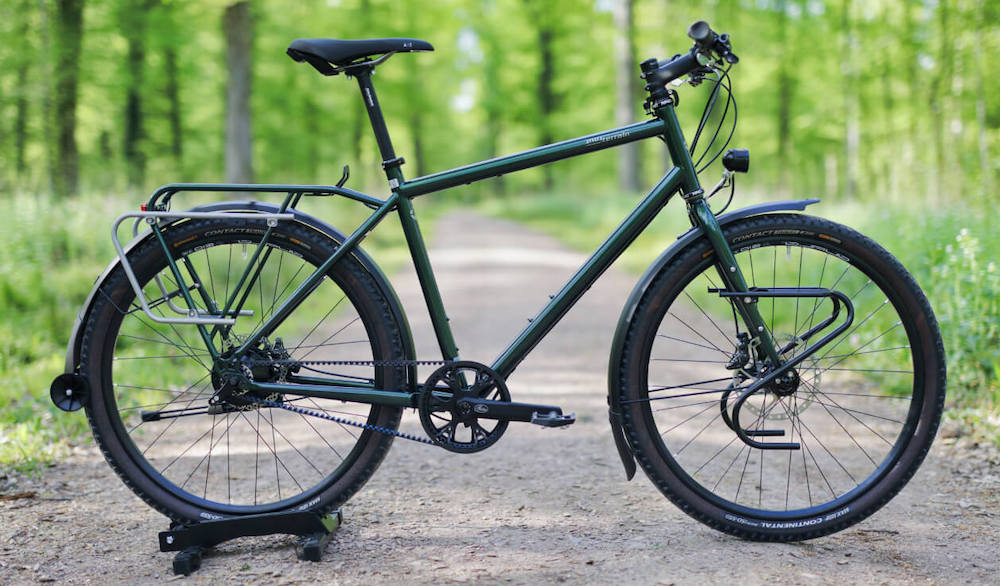
The trade-off for increased stiffness and strength is additional weight.
Frames engineered to support a 180 kg system load typically start at around 2.5 kg in aluminium or titanium, and closer to 3.5 kg in steel. Matching rigid forks usually weigh in the region of 1.5 kg.
As a result, touring bikes certified for a 180 kg total system weight generally fall between 14 and 21 kg, with most clustering around 17 to 18 kg.
Part of this added mass comes from components that need to match the strength of the frameset – most notably rims and tyres. Many of these bikes also rely on Rohloff or Pinion gear systems, which add roughly 1 to 1.5 kg compared to a conventional derailleur drivetrain.
Strong Touring Bike Components
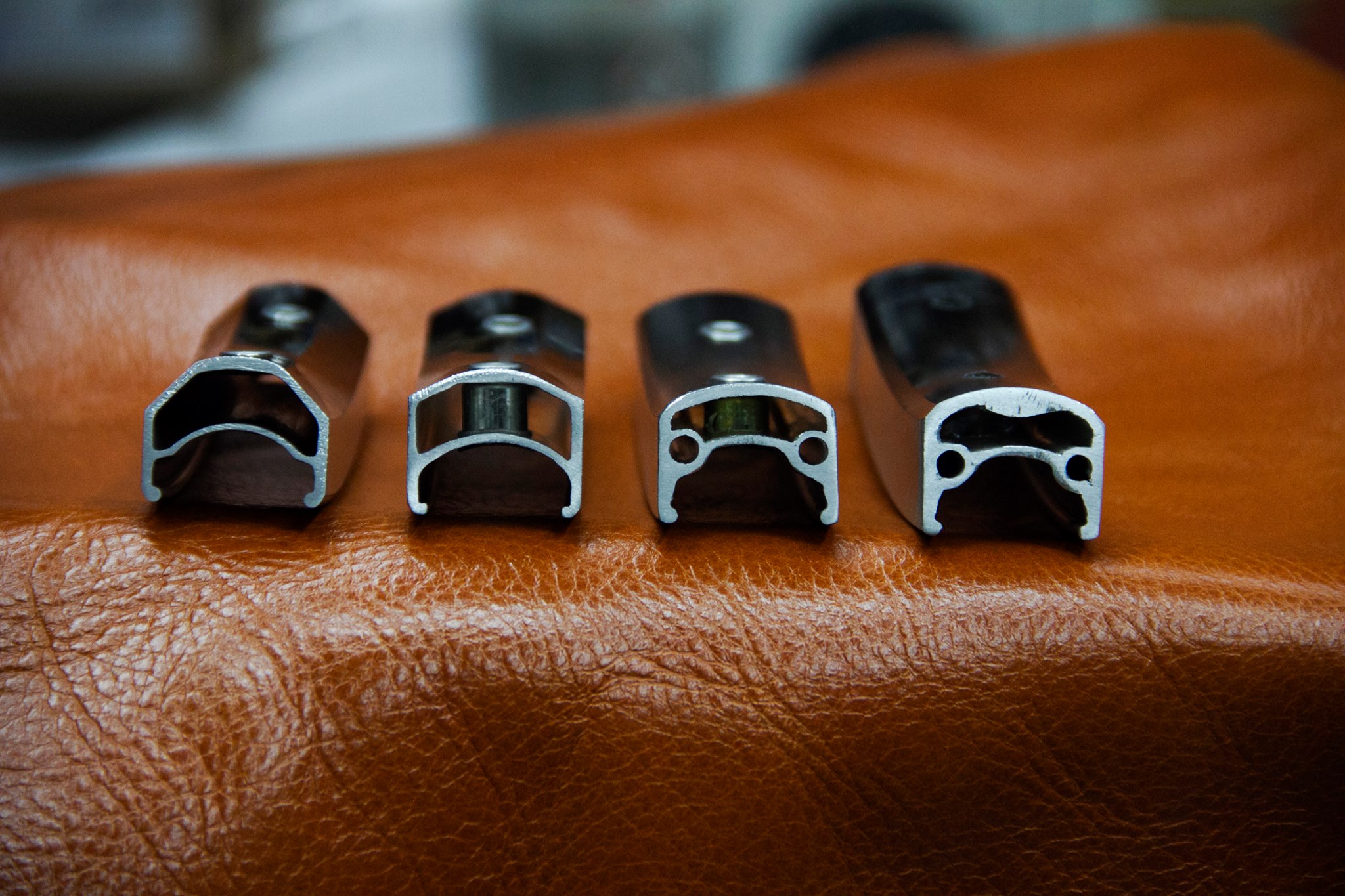
A frame and fork rated for a 180 kg load don’t automatically mean the entire bike is built to the same standard. In practice, touring bike failures most often occur elsewhere – typically at the rims, tyres, or racks. These components deserve the closest scrutiny if you’re aiming for a truly bombproof setup.
As total system weight creeps toward a bike’s upper limit, tyre choice becomes especially critical. Wider tyres absorb more impact before it reaches the frame and components, improving durability as well as comfort.
For heavily loaded touring, I generally recommend a minimum tyre width of 2.0″ (50 mm). I keep an up-to-date list of the best touring tyres HERE, and another with my favourite bicycle touring tyres from Schwalbe HERE.
Properly rated touring rims are just as important, as wheels are among the most common failure points on long-distance tours. If the rims aren’t up to the task, cracks can appear surprisingly quickly. Thankfully, strong touring rims have become much more common in the last few years, thanks to the popularity of cargo bikes and eBikes. You can find the toughest rim models HERE.
The same applies to racks: if you’re carrying heavy loads, don’t compromise on rack strength. Many panniers can quickly wear through standard racks or cause failures when ridden over rough, bumpy roads. The strongest racks available can be found HERE.
Let’s take a look at the strongest touring bikes currently available.
The Strongest Touring Bikes For Big Expeditions
KOGA WorldTraveller (20.9kg)

The KOGA WorldTraveller isn’t just certified for a 180 kg frame and fork – it’s the first touring bike whose entire component set has been rigorously tested for a 180 kg (400 lb) total system weight.
It’s the heaviest bike in this lineup, but also likely the strongest, stiffest, and most stable when fully loaded. The semi-integrated rear rack reduces side-to-side flex, so the bike remains solid under a heavy load of luggage, food, and water. I know this from experience – I’ve ridden my WorldTraveller with very heavy loads down remote desert tracks.
You can purchase the fully equipped touring model for €2,499, or create a custom build through KOGA’s Signature program. This lets you tailor everything – from wheel size, handlebar style, drivetrain, and suspension to frame type and paint colour – exactly to your preferences.
My own KOGA WorldTraveller (video HERE) features 2.8″ wide tyres, a Rohloff hub, and a belt drive.
Fakenjagd Hoplit PI Touring (16.5 kg)
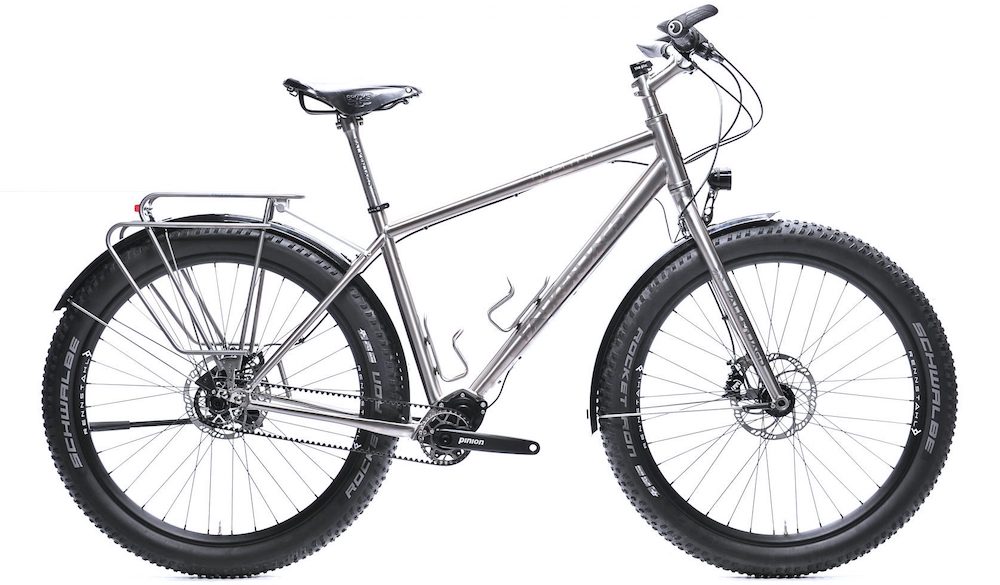
The Falkenjagd Hoplit PI Touring is a German titanium touring bike built with serious expedition ambitions. With a 185 kg system weight rating, it offers high torsional stiffness for stable and confident handling, even when fully loaded.
These bikes are on the higher end of the price spectrum, starting above €8,000, but their extensive use of titanium keeps them lighter than many other heavy-duty touring bikes. They also come equipped with a low-maintenance Pinion 18-speed gearbox and a Gates belt drive, ensuring many trouble-free kilometres on the road or off.
Hilite Pinion Adventure Titanium (16.5 kg)

Another titanium touring bike rated for 180 kg comes from Switzerland: the Hilite Pinion Adventure Titanium.
Hilite set out to create an extremely stable and durable touring bike, resulting in a frame built from oversized and ovalised titanium tubes throughout. It’s the strongest and most stable model in their lineup, giving you plenty of confidence for self-sufficient multi-day adventures in the remotest corners of the world.
The bike is built around a Pinion 18-speed gearbox and Gates belt drive, and can be configured in numerous ways to suit your needs. Prices start at €8,000.
Maxx Pacemaxx and Crossmaxx (19.0 kg)

The Maxx Pacemaxx is a new off-road touring model from this value-focused German manufacturer. This heavy-duty frame can also be configured as a hardtail mountain bike with a suspension fork, with geometry optimised for stability through a longer wheelbase and slacker head tube angle.
For riders who prefer pavement, Maxx offers the Crossmaxx Tour, a more road-oriented model with narrower tyres and geometry tuned for smoother surfaces. Prices for both models start at €2,499.
A standout feature of Maxx bikes is that they’re designed not just for heavy loads, but also for very tall riders – the largest frame accommodates cyclists up to 212 cm (7 ft).
Patria Kosmos (18.2 kg)

The Patria Kosmos is a lugged steel touring bike that combines a classic aesthetic with modern features. Despite its steel construction, it’s slightly lighter than some aluminium bikes on this list, thanks to components that prioritise weight over ultimate durability.
The Kosmos is designed primarily for a mix of dirt and road touring, with 27.5″ wheels accommodating tyres up to 2.20″. It can handle a variety of surfaces, including dirt roads and cracked pavement.
Patria also offers custom frame options, allowing adjustments to the top tube length, head tube height, or seat tube angle to fine-tune your riding position for long-distance comfort.
Raussen R2 (19.0 kg)

XXL Bikes in Germany builds custom touring bikes for big and tall riders under the Raussen (Raußen) name. These steel frames accommodate riders well over 200 cm (6 ft 7 in), with system weight limits ranging from 180 to 200 kg depending on the model.
Raussen frames feature extra reinforcement tubes running from the top tube down to the rear dropouts. The largest frames even include a “marathon” reinforcement tube extending from the head tube all the way to the rear of the bike, similar to the design of a tandem.
Notably, Raussen also offers several step-through (aka mixed or womens) frame options for riders who prefer easier mounting and dismounting.
Rennstahl 853 PI (17.5kg)

Rennstahl is the sister brand of Falkenjagd, and all Rennstahl models are constructed from steel. This adds roughly a kilogram to the overall weight compared to the same frame size and components in titanium.
Despite this, the Rennstahl 853 PI remains surprisingly light for a heavy-duty touring bike and features many clever design details throughout. Prices start at around €5,000 for the Pinion gearbox and belt-drive version – nearly a 40% saving compared to its titanium counterpart.
Schauff Sumo (19.5 kg)

Another excellent option for big and tall riders is the aptly named Schauff Sumo. Schauff was one of the first manufacturers I came across to build truly oversized touring bikes rated for a massive 200 kg system load.
Just as importantly, Schauff always paired these frames with serious braking power, fitting proper disc brakes with 203 mm rotors to ensure heavy riders can stop confidently.
The oversized aluminium Sumo frames are available in surprisingly small sizes (down to 40 cm), but Schauff also caters to extremely tall riders, offering heavy-duty touring bikes for riders over 205 cm (6 ft 9 in).
It’s also reassuring to see that every Sumo model is built with one of the toughest touring rims available: the Ryde Andra 40.
Tout Terrain Blueridge, Tanami & Silkroad (15.5 to 18kg)

Around five years ago, Tout Terrain was one of the first touring bike manufacturers to take advantage of Zedler’s new 180 kg weight certification testing.
The result is three off-road and on-road focused touring models that remain stiff, stable, and safe under heavy loads: the Silkroad, available with 26″ or 27.5″ wheels; the Tanami, built around 29″ wheels; and the Blueridge, a drop-bar tourer using 700C wheels.
I’ve documented the Silkroad in detail, including a video covering every frame feature HERE.
All three bikes are constructed from steel and use an integrated rack structure combined with a separate subframe to maximise stiffness and load stability. Prices start at around €3,500, with Pinion gearbox or Rohloff-equipped versions beginning at approximately €5,200.
Velotraum Finder (16.5kg)

Rounding out the list are the heavy-duty touring bikes from Velotraum, all certified for a 180 kg system weight.
Several frames in the Velotraum lineup are designed to handle serious loads. In the configurator, these appear under the R900, F900, VT200, VT400, VT900, and SP400 platforms. When building a bike, you can select a fork rated for a 180 kg load, and importantly, Velotraum also offers a DT Swiss rim option certified to the same weight limit.
These heavy-duty frames are constructed from aluminium, with complete builds weighing around 16.5 kg. Velotraum offers a wide range of configurations, including derailleur drivetrains or gearbox systems, as well as multiple wheel sizes. Custom builds start at approximately €3,200.
Summary
| Frame Material | Weight (kg) | System Weight Rating (kg) | Drivetrain | Wheel Size | Price | |
|---|---|---|---|---|---|---|
| KOGA WorldTraveller | Aluminium | 20.9+ | 180 | Rohloff+belt, derailleurs | Various | €2,499+ |
| Falkenjagd Hoplit PI Touring | Titanium | 16.5+ | 185 | Pinion+belt | Various | €8,000+ |
| Hilite Pinion Adventure Titanium | Titanium | 16.5+ | 180 | Pinion+belt | Various | €8,000+ |
| Maxx Pacemaxx / Crossmaxx Tour | Aluminium | 19.0+ | 180 | Pinion, Rohloff, derailleurs | Various | €2,499+ |
| Patria Kosmos | Steel | 18.2+ | 180 | Pinion, Rohloff, derailleurs | 27.5″ | €3,500+ |
| Raussen R2 | Steel | 19.0+ | 180-200 | Pinion, Rohloff, derailleurs | Various | €3,500+ |
| Rennstahl 853 PI | Steel | 17.5+ | 180 | Pinion+belt | Various | €5,000+ |
| Schauff Sumo | Aluminium | 19.5+ | 200 | Rohloff, derailleurs | Various | €3,500+ |
| Tout Terrain Silkroad / Tanami / Blueridge | Steel | 15.5+ | 180 | Pinion, Rohloff, derailleurs | Various | €3,500+ |
| Velotraum Finder | Aluminium | 16.5+ | 180 | Pinion, Rohloff, deraulleurs | Various | €3,200+ |
These are the 10 strongest touring bikes currently available, each ready to take on your next big expedition.
If you’d like to explore many more touring bikes and compare them side by side, check out my Touring Bicycle Buyer’s Guide. It covers everything you need to know about choosing the right bike – and best of all, it’s updated for free every year.


