


A gravel fork plays a major role in front-end comfort. According to Cervélo, fork blades are the second-most important bicycle component for front-end vertical compliance on a road bike, with only the tyres having a greater influence.
A fork that’s too stiff can make your bike feel harsh on gravel roads. But too much flex, particularly laterally, can compromise steering precision.
Balancing lateral stiffness with vertical compliance is no easy engineering feat. But as my vibration testing shows, it’s entirely possible!
Testing Four Carbon Forks

My personal bike uses a carbon Jamis ECO fork. ECO stands for Enhanced Compliance Offset, referring to the fork’s design, which allows the blades to flex vertically and absorb vibrations.

The Argon 18 Dark Matter fork takes a different approach. Its fork blades feature a pronounced forward bend, which is designed to increase vertical compliance without compromising overall stiffness.
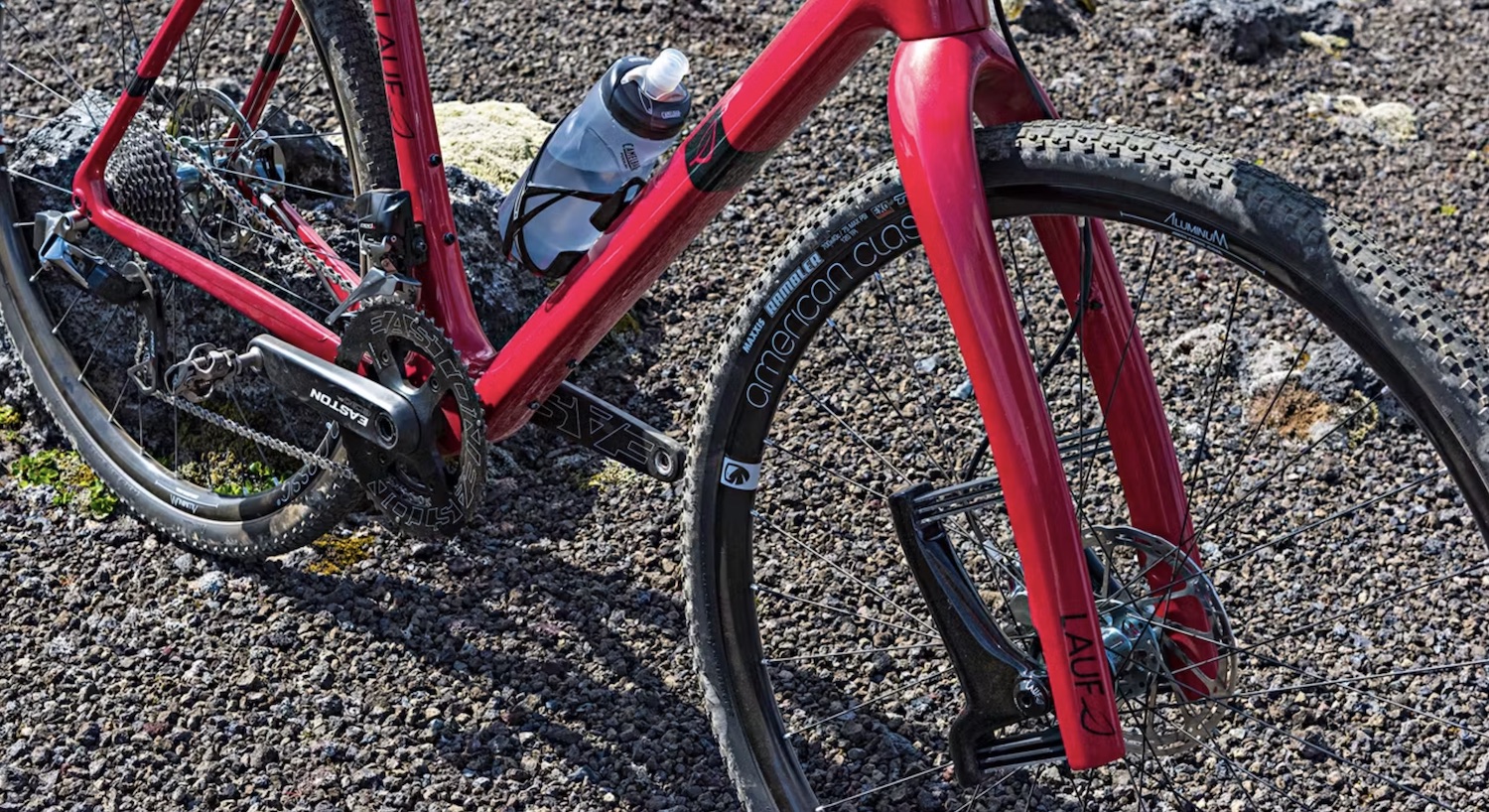
Another option is the Lauf Grit SL suspension fork. It uses three thin glass-fibre leaf springs to allow vertical wheel movement while maintaining steering precision. The main caveat is its considerable height, which can alter your bike’s geometry and, in turn, its handling characteristics.

Finally, there’s the OPEN U-Turn carbon fork. It promises impressive flex without any visible suspension mechanism, all while keeping weight low and stiffness high. On paper, it sounds like the holy grail of gravel forks. But does it actually deliver?
Bike Setup For The Carbon Fork Comfort Test
To get the most meaningful results possible, I used my Jamis Renegade with a 100 mm stem and just 20 mm of spacers below it. This put as much of my body weight over the front wheel as possible, helping the forks show what they’re capable of.
I used the same wheel and tyre combination for every test: AlexRims ATD470 rims paired with Soma Cazadero 700C x 42 mm tyres.
I set the tyre pressure to 40 psi to make the differences between forks more apparent. At my usual 25 psi, I suspect the tyres would absorb so much vibration that it would be harder to distinguish the forks’ performance. After all, tyres are your number-one form of suspension.
Finally, I conducted every test run on the same day, keeping weather and road conditions as consistent as possible across all four forks.
You can see my vibration measurement procedure & outdoor test courses HERE.
Vibration Test Results
Bumpy Forest Trail
| Fork Model | Average Vibrations (m/s²) | Vibration Difference to Jamis ECO Fork |
|---|---|---|
| Jamis ECO Carbon | 8.1 | Baseline |
| Argon18 Dark Matter Carbon | 7.9 | 2.5% Reduction |
| OPEN U-Turn Carbon | 7.8 | 3.8% Reduction |
| Lauf Grit SL Leaf-Spring | 7.7 | 5.0% Reduction |
Fast Gravel Road
| Fork Model | Average Vibrations (m/s²) | Vibration Difference to Jamis ECO Fork |
|---|---|---|
| Jamis ECO Carbon | 15.5 | Baseline |
| Argon18 Dark Matter Carbon | 14.9 | 4.0% Reduction |
| OPEN U-Turn Carbon | 14.7 | 5.2% Reduction |
| Lauf Grit SL Leaf-Spring | 15.1 | 2.5% Reduction |
In a recent review, I vibration-tested my Jamis ECO carbon fork against the Lauf Grit SL suspension fork. To my surprise, the difference in comfort between the two forks was smaller this time around.
On the bumpy forest trail, the Lauf Grit SL was just 5% more comfortable than the Jamis ECO. On the fast gravel road, which was also particularly bumpy at this time of year, the difference narrowed to just 2.5%.
The Argon 18 fork also impressed me. On the fast gravel road, it was actually 1.4% more comfortable than the Lauf Grit SL. The Lauf came out ahead on the forest trail, but by a relatively small margin of 2.5%.
The OPEN U-Turn fork was the real shocker! It delivered the best comfort on the fast gravel road, outperforming the Argon 18 fork by 1.4%. Even on the bumpy forest trail, it came remarkably close to the Lauf Grit SL, with just a 1.3% difference in vibration.
Carbon Fork Comfort Analysis

If your bike has a fork that performs as well as the OPEN U-Turn, there may be little reason to upgrade to a suspension fork like the Lauf Grit SL.
Modern carbon gravel forks have reached an impressive level of compliance, with surprisingly little difference in vibration damping between the best-performing designs.
Bike designers have often told me that fork shape is just as important as the carbon layup. Interestingly, though, the OPEN U-Turn achieves excellent comfort without any pronounced bend in its fork blades. Its straight-blade design delivers an impressive combination of lateral stiffness and vertical compliance. This makes me wonder whether the carbon material and layup have a greater influence on comfort than the overall shape of the fork.
The OPEN U-Turn’s performance becomes even more impressive when you consider its relatively short length. A longer fork can flex more easily under the same load, all else being equal.
The Lauf Grit SL measures 411 mm from axle to crown with sag included, compared to 405 mm for the Jamis ECO and just 395 mm for the OPEN U-Turn. The Argon 18 is shorter still, with an axle-to-crown measurement of 390 mm. So, perhaps the OPEN U-Turn and Argon 18 could deliver even greater vertical compliance if they were designed with a little more length.
Summary

In this test, I compared four high-end carbon forks. I would have loved to include a stiff fork with poor vibration damping, but unfortunately, I only had access to premium carbon products (the shame!). Don’t worry, though. I plan to test some less-compliant forks in the future.
For now, the results suggest that you might not need a suspension fork like the Lauf Grit SL if you mainly ride fast gravel roads. A rigid carbon fork like the OPEN U-Turn can offer comparable, or even slightly better, vibration damping on fast gravel and bumpy forest trails.


