Tag: testing

  • The 5 Best Bicycle Touring Tires For Puncture Resistance, Durability & Speed

    The 5 Best Bicycle Touring Tires For Puncture Resistance, Durability & Speed

    We ask a lot from our tires. The best bicycle touring tires need to resist punctures, last for thousands of kilometres, and roll with minimal resistance.

    The challenge is finding the right balance between efficiency and protection – tires with extreme puncture resistance are usually noticeably slower on the road.

    In this guide, we’ll find the best bicycle touring tires using scientific test data from Radfahren magazine. We’ll begin by comparing 10 different models to show what’s available, but only five truly stand out once rolling resistance, puncture protection, and price are taken into account.

    Let’s get into it!

    Why High-Quality Bicycle Touring Tires Are So Important

    I consider tires to be one of the three most important components on a trouble-free touring bike, alongside strong rims and durable racks. Once you’ve fitted these three, most of your bike touring worries practically disappear.

    Almost every rider experiences punctures on a tour, but choosing the right tires can make them virtually vanish. In fact, I wouldn’t be surprised if any of the tires recommended here end up being the best upgrade you’ve ever made on your bike!

    Beyond puncture resistance, these tires tend to outlast almost anything else you’ve used. A minimum of 10,000 km is realistic, and 20,000 km isn’t unusual.

    You may even find yourself riding faster for the same effort. That means covering more ground each day, or conserving energy for activities off the bike.

    Let’s now dive into the data behind this ranking. There’s a table below comparing the best bicycle touring tires, so don’t worry – you won’t need to commit to memory any of these numbers.

    The Data Behind The Best Bicycle Touring Tires

    Rolling Resistance Test

    Touring TireRolling ResistanceDifference Per Tire
    Schwalbe G-One Overland 36515 WattsBest Performer
    Schwalbe Green Marathon17 Watts2W More Resistance
    WTB Venture SG218 Watts3W More Resistance
    Schwalbe Marathon E-Plus19 Watts4W More Resistance
    Teravail Cannonball19 Watts4W More Resistance
    Continental Contact Plus20 Watts5W More Resistance
    CST Platinum-E23 Watts8W More Resistance
    Scalato Mondano S23 Watts8W More Resistance
    Condura Velt XR27 Watts12W More Resistance
    Michelin City Street33 Watts18W More Resistance

    The first test measured rolling resistance using a metal drum roller. Rolling resistance indicates how much of your pedalling effort is absorbed by the tires as you ride. In this test, lighter tires with less heavy-duty puncture protection typically perform the best.

    To put the rolling resistance numbers into context, most people pedal along at around 100 to 200 watts, so rolling resistance can take anywhere between 15 to 45% of your pedal power! It’s obviously in your best interest to minimise this.

    The Schwalbe G-One Overland 365 was the clear winner here, producing just 15 watts of drag per tire with the Schwalbe Green Marathon and WTB Venture GS2 not far behind.

    rolling resistance
    A drum roller is used to calculate the rolling resistance of different touring tires. Image: Bicycle Rolling Resistance

    Further down the spectrum, the Cannonball and the heavy-duty Marathon E-Plus showed a slightly higher rolling resistance, with roughly 4 watts more drag per tire than the G-One.

    The slowest tire in the test was the Michelin City Street, which consumed 18 extra watts per tire – a difference that would be very noticeable on the road and likely represent a significant share of your total power output.

    Let’s hope the slowest-rolling tires make up for their higher rolling resistance with strong puncture protection…

    Sharp Puncture Test

    Touring TireSharp Puncture ForceDifference
    Schwalbe Marathon E-Plus203 NBest Performer
    Michelin City Street200 N1% Less Force
    CST Platinum-E200 N1% Less Force
    Schwalbe Green Marathon170 N16% Less Force
    Condura Velt XR170 N16% Less Force
    Continental Contact Plus150 N26% Less Force
    Scalato Mondano S150 N26% Less Force
    Schwalbe G-One Overland 365150 N26% Less Force
    WTB Venture SG2150 N26% Less Force
    Teravail Cannonball150 N26% Less Force

    This is the first of four puncture tests. It evaluates resistance to sharp objects such as thorns, nails, and wire by forcing a 1.5 mm thick pointed metal spike through the tire tread.

    In the sharp puncture test, the slower rolling tires often proved to be the most resistant. The Marathon E-Plus led the field, closely followed by the Michelin City and Platinum-E. The Green Marathon and Velt XR ranked in the next grouping, puncturing at roughly 16% lower force.

    puncture resistance
    The sharp puncture test pushes a 1.5mm thick spike into the tire tread. Image: Bicycle Rolling Resistance

    At the lowest end of the results were five tire models, all of which all required 26% less force to puncture. It’s worth noting, however, that the G-One, Venture SG2 and Cannonball are tubeless tires that require liquid sealant. Unlike tube-type tires, the sealant can flow to the puncture site and seal the hole.

    Blunt Puncture Test

    Touring TireBlunt Puncture ForceDifference
    Schwalbe Marathon E-Plus815 NBest Performer
    Schwalbe G-One Overland 365810 N1% Less Force
    Michelin City Street760 N7% Less Force
    Scalato Mondano S730 N10% Less Force
    CST Platinum-E710 N13% Less Force
    Schwalbe Green Marathon690 N15% Less Force
    Teravail Cannonball680 N17% Less Force
    Condura Velt XR670 N18% Less Force
    WTB Venture SG2670 N18% Less Force
    Continental Contact Plus610 N25% Less Force

    The second test uses a 5 mm wide flat-tipped screwdriver to simulate impacts from sharp-edged glass shards or stones. I expected the results to closely mirror the sharp puncture test, but one tire climbed significantly in the rankings.

    Once again, the Schwalbe Marathon E-Plus came out on top…

    The blunt punture test simulates a glass shard. Image: Sebastian Böhm

    The surprise result, however, was the Schwalbe G-One Overland 365, which almost matched the E-Plus in blunt puncture resistance. This performance is likely due to its RaceGuard fabric layer and reinforced carcass, which appear to be especially effective at blocking blunt impacts.

    The Michelin City, Mondano S, Platinum-E, and Green Marathon followed in behind, requiring roughly 7 to 15% less force to puncture.

    Down at the bottom, we find some of the tubeless gravel tires, and the Continental Contact Plus, which required 25% less force to puncture.

    Sidewall Puncture Test

    Touring TireSidewall Puncture ForceDifference
    Schwalbe G-One Overland 365570 NBest Performer
    Schwalbe Marathon E-Plus510 N11% Less Force
    Michelin City Street500 N12% Less Force
    Condura Velt XR490 N16% Less Force
    Schwalbe Green Marathon430 N25% Less Force
    Teravail Cannonball430 N25% Less Force
    Continental Contact Plus420 N26% Less Force
    CST Platinum-E420 N26% Less Force
    Scalato Mondano S400 N30% Less Force
    WTB Venture SG2400 N30% Less Force

    The third test measured sidewall resistance, simulating impacts from sharp edges, large stones, or branches on the trail. Once again, I was surprised to see that the faster-rolling tires performed exceptionally well in this area, in some cases outperforming the heavy-duty models.

    The Schwalbe G-One Overland stood out with particularly robust sidewalls, followed by the Marathon E-Plus, making these two particularly difficult to slash.

    The weakest sidewall performance came from the Contact Plus, Platinum-E and Mondano S, which required 25 to 30% less force to puncture compared to the top-performing G-One Overland.

    Guillotine Puncture Test

    Touring TiresGuillotine Puncture HeightDifference
    Schwalbe Marathon E-Plus625 mmBest Performer
    Schwalbe Green Marathon590 mm6% Less Height
    Scalato Mondano S580 mm7% Less Height
    Michelin City Street570 mm9% Less Height
    CST Platinum-E570 mm9% Less Height
    Continental Contact Plus460 mm26% Less Height
    Condura Velt XR410 mm34% Less Height
    Schwalbe G-One Overland 365390 mm38% Less Height
    Teravail Cannonball380 mm38% Less Height
    WTB Venture SG2340 mm45% Less Height

    Rad Fahren also conducted a pinch-flat test, often referred to as a “snake bite” test. This simulates the blunt-edge impacts caused by obstacles such as curbs, manhole covers, or exposed roots.

    For the test, all tires were mounted on a steel rim with a 25 mm internal width and inflated to 2.5 bar for tires wider than 45 mm, and 3.0 bar for narrower tires. A 14 kg weight was then dropped onto the tire-wheel system from progressively greater heights until the tire deflated.

    The Marathon E-Plus performed exceptionally well in this test, with the Green Marathon, Mondano S, Michelin CIty and Platinum-E not far behind. With sufficiently high tire pressure, pinch flats should be largely eliminated when using any of these tires.

    The guilotine test simulates a pinch-flat. Image: Sebastian Böhm

    The G-One Overland, Cannonball and Venture SG2 performed less well in this scenario. However, they are also tubeless tires, so the sealant inside them should help prevent pinch flats from occurring in real-world riding.

    Ok, let’s now take out five underperforming tires and compare the best bicycle touring tires side-by-side.

    The Best Bicycle Touring Tires

    Rolling ResistanceGuillotine PunctureSharp PunctureBlunt PunctureSidewall Puncture
    Schwalbe Marathon E-Plus4W More ResistanceMost ResistantMost ResistantMost Resistant11% Less Force
    Schwalbe Green Marathon2W More Resistance6% Less Height16% Less Force15% Less Force26% Less Force
    CST Platinum E8W More Resistance9% Less Height1% Less Force13% Less Force26% Less Force
    Continental Contact Plus5W More Resistance26% Less Height26% Less Force25% Less Force26% Less Force
    Schwalbe G-One Overland 365Fastest38% Less
    Height
    27% Less
    Force
    1% Less
    Force
    Most Resistant

    I’ve now narrowed the list to the top five bicycle touring tires based on the scientific data. You can now easily compare them in the table above.

    These tires combine outstanding puncture resistance with very low rolling resistance. Four out of five have rolling resistance of 20 watts or less (a level considered excellent), which means they’ll keep you moving quickly.

    From here, it’s a matter of deciding whether you’re willing to trade a bit of puncture protection for slightly more speed. Or compromising on both to save a bit of money.

    Schwalbe Marathon E-Plus

    best bicycle touring tires

    The Schwalbe Marathon E-Plus ($60 on Amazon) is the best bicycle touring tire for puncture resistance.

    In laboratory testing, these tube tires required the highest puncture force in almost every test, finishing second in the only test it didn’t top. Fit a tire like this and your touring bike will be about as close to puncture-proof as it gets.

    What’s most surprising is how well it rolls. At just four extra watts per tire, the Marathon E-Plus ranks among the fastest options here, proving that extreme puncture protection doesn’t have to come with a major speed penalty.

    The trade-off is weight. It’s the heaviest tire in this group – roughly twice the mass of the G-One. But if avoiding punctures is your top priority, this is the touring tire to choose.

    One important thing to note is that you can get the equivalent tire to this with knobs if you need off-road traction. The model is called the Schwalbe Marathon Plus MTB, and it uses the same puncture protection layers.

    You can find the Schwalbe Marathon E-Plus on Amazon in different widths:
    700C x 37 mm HERE, 40 mm HERE, and 50 mm HERE

    Schwalbe Green Marathon

    best bicycle touring tires

    The Schwalbe Green Marathon ($43 on Amazon) is the best bicycle touring tire for speed.

    For many riders, it’s an easy trade-off to give up roughly 5 to 15% of puncture protection in exchange for about 2 watts lower rolling resistance and a 300-gram weight saving per tire (compared with the Marathon E-Plus).

    Thanks to its Greenguard protection layer, reinforced by two additional layers of RaceGuard fabric, the Green Marathon delivers impressive puncture resistance relative to both its weight and rolling speed.

    These tires have outperformed much of the competition for years, and Schwalbe claims performance has improved further since introducing recycled rubber in the Green Marathon version.

    For riders running tubes and who care about speed, this is by far the best choice.

    You can find the Schwalbe Green Marathon on Amazon in different widths:
    700C x 38 mm HERE, 42 mm HERE, and 45 mm HERE
    26″ x 1.25″ HERE, 1.50″ HERE, 1.75″ HERE, and 2.00″ HERE
    27.5″ x 1.65″ HERE, 2.15″ HERE, and 2.35″ HERE

    CST Platinum-E

    The CST Platinum-E (€24) is the best budget-friendly bicycle touring tire, often 30–50% cheaper than other top touring options.

    Despite the low price, they sacrifice very little in puncture protection. In testing, they typically came within 10% of the Marathon E-Plus for puncture resistance and frequently outperformed the Green Marathon across multiple tests.

    The main drawback is rolling resistance. The Platinum-E is around 6 watts slower than the Green Marathon and about 4 watts slower than the superb Marathon E-Plus.

    Even so, several other touring tires were noticeably slower while offering only marginally better puncture protection, meaning the CST Platinum-E still offers excellent performance, especially when its price is taken into account.

    Continental Contact Plus

    best bicycle touring tires

    The Continental Contact Plus ($61 on Amazon) is the best bicycle touring tire for availability. While it doesn’t lead in puncture resistance or rolling efficiency, it performs consistently well across the board.

    What really makes it a great choice is availability. I’ve seen the Contact Plus in bike shops across many countries, whereas brands like Schwalbe and CST can be difficult to find outside higher-income regions.

    If you’re touring and need a reliable replacement on the road, this is a fast-rolling, reasonably puncture-resistant option that’s a bit easier to source around the world.

    You can find the Continental Contact Plus on Amazon in different widths:
    700C x 35 mm HERE, 40mm HERE, 42 mm HERE, and 47 mm HERE
    26″ x 1.75″ HERE
    27.5″: 1.65″ HERE

    Schwalbe G-One Overland 365

    best bicycle touring tires

    The Schwalbe G-One Overland 365 ($63 on Amazon) is the best bicycle touring tire for speed.

    These tubeless-ready tires use a lightweight construction to bring the weight down to just 600 grams – far lighter than the 900 to 1200 grams common for touring tires.

    What’s especially impressive is its puncture resistance relative to its weight. It performed strongly in blunt puncture testing and even topped the rankings for sidewall protection!

    It’s also important to remember that this is a tubeless tire. When paired with liquid sealant, punctures are often sealed instantly as the sealant flows to the hole. That alone arguably makes it one of the most puncture-resistant options here, provided you’re happy to refresh the sealant every four months or so.

    The compromise comes in durability. You can expect a lifespan of roughly 7,000 to 8,000 km, compared with 10,000 to 15,000 km for the heavy-duty touring tires that use tubes listed above.

    You can find the Schwalbe G-One Overland 365 on Amazon in different widths:
    700C x 40 mm HERE, 45 mm HERE, and 50 mm HERE

    Summary

    The Schwalbe Marathon E-Plus is the most puncture-resistant touring tire for use with tubes. And despite having top-tier puncture protection, it’s 19-watt rolling resistance is very reasonable, especially when you compare it to other tires with similar levels of protection.

    The Schwalbe Green Marathon sacrifices a small amount of puncture resistance in exchange for lower rolling resistance. A pair is roughly 600 grams lighter than the E-Plus and typically costs less too. This will be the touring tire of choice for those chasing a bit more speed.

    If you’re on a tighter budget, the CST Platinum-E is a strong alternative. It delivers puncture resistance similar to the Green Marathon, with the trade-off being higher rolling resistance – around a 6-watt penalty per tire.

    If you need to source a replacement while travelling, the Continental Contact Plus is worth seeking out. It’s more widely available globally than Schwalbe or CST and still offers a fast rolling speed and decent puncture protection.

    Finally, the Schwalbe G-One Overland 365 is the fastest-rolling tire in this group. With a tubeless setup, it’s highly puncture-resistant, exceptionally lightweight, and features the most puncture-resistant sidewalls of all the tires tested.

  • Drivetrain Efficiency: What’s The Difference In Speed Between 1X and 2X?

    Drivetrain Efficiency: What’s The Difference In Speed Between 1X and 2X?

    The most efficient bicycle drivetrain is usually one where the chain runs in a perfectly straight line – a singlespeed setup can achieve around 97% efficiency. In other words, 97% of the power you apply to the pedals goes directly into turning the rear wheel.

    Once derailleur gears are introduced, however, the chain must bend and articulate as it moves across the cassette cogs, increasing friction and reducing overall drivetrain efficiency.

    The introduction of wide-range rear cassettes (e.g. 10–42T or 10–52T) has allowed riders to eliminate the front derailleur while keeping a similar total gear range. 1X drivetrains help reduce bike weight, simplify maintenance, and give frame designers more freedom to increase tyre clearance by removing the need to accommodate a front derailleur.

    Jason from CeramicSpeed is dialling in the test rig with the 1X drivetrain. Image: VeloNews

    That said, one of the main drawbacks of 1X systems is the sharper chain angles required to reach the largest and smallest cogs. This results in greater chain wear and higher frictional losses. By contrast, a 2X drivetrain maintains a straighter chainline, since the smaller chainring can be used with the larger cassette cogs and the larger chainring with the smaller cogs.

    So, how much more friction does a 1X drivetrain actually produce compared to a traditional 2X setup?

    In May 2019, VeloNews partnered with CeramicSpeed to measure the frictional differences between 1X and 2X drivetrains. In the following sections, we’ll examine their testing protocol, review the results, and then crunch some numbers to see how these frictional losses actually translate into real-world cycling speed.

    Note: This article was originally published in June 2019 but has been updated in October 2025 with more recent information.

    The Test

    drivetrain efficiency
    The CeramicSpeed test machine is set up with the 1X drivetrain. Image: VeloNews

    VeloNews and CeramicSpeed compared two drivetrain configurations to quantify the frictional differences between 1X and 2X systems:

    • 1X drivetrain: SRAM Force 1 rear derailleur, 48-tooth narrow-wide chainring, PC-1170 chain, and a 10–42T cassette
    • 2X drivetrain: Shimano Ultegra rear derailleur, 53/39T chainrings, HG701 chain, and an 11–34T cassette

    These setups were chosen because they provide nearly identical gear ranges, allowing for a direct comparison of frictional losses at equivalent ratios. Both drivetrains were mounted on a test machine capable of precisely measuring drivetrain losses across all gear combinations. The rig simulated a 250-watt rider output at a cadence of 95 RPM.

    To ensure fairness, the chainlines were matched as follows:

    • The 1X drivetrain had a straight chainline in the 5th smallest cassette cog.
    • The 2X drivetrain was aligned from the 53T chainring to the 5th smallest cog, and from the 39T chainring to the 8th smallest cog.

    CeramicSpeed also standardised the lubrication procedure by removing the factory lubricants and applying the same mineral oil to both chains. Each drivetrain was run for the same test duration.

    Note: Previous CeramicSpeed testing found no additional friction when using 1x narrow-wide chainrings compared to standard 2x chainrings, and no measurable difference between derailleur pulley systems.

    The Results

    The 1X vs 2X drivetrain friction test results. Image: VeloNews

    The VeloNews/CeramicSpeed testing revealed several key insights into how drivetrain configuration affects efficiency:

    • Frictional losses generally increase as you move up through the gear ratios (toward smaller cassette cogs).
    • The 2X drivetrain proved to be more efficient in every gear, assuming the rider shifts to the large chainring after reaching 39x21T.
    • The difference in frictional loss ranged from as little as 1 watt (48x21T vs. 53x23T) to as much as 6 watts (48x10T vs. 53x11T).
    • Even with a perfect chainline, the 1x drivetrain (48x18T) exhibited more frictional loss than the 2x setup (53x19T).
    • The 1x drivetrain efficiency ranged from 96.0% (best case) to 92.4% (worst case), averaging 95.1% efficiency overall.
    • The 2x drivetrain efficiency ranged from 96.8% (best case) to 94.8% (worst case), averaging 96.2% efficiency overall.

    CeramicSpeed calculated the average drivetrain friction by summing the power losses across all usable gears and dividing by the number of gears tested.

    • The 1X drivetrain averaged 12.24 watts of frictional loss (across 11 gears).
    • The 2X drivetrain averaged 9.45 watts of frictional loss (across 15 optimal gears).

    That’s an average difference of roughly 2.8 watts, with the 2X drivetrain maintaining a measurable efficiency advantage across the entire gear range.

    Why Is 1X Less Efficient Than 2X?

    There are four main sources of drivetrain friction, and together they explain why a 1X system is inherently less efficient than a 2X.

    1. Chain Bend Angle
      This is the most obvious factor. When the chain runs at an angle, it has to twist slightly as it engages the cassette cogs and chainring. The side plates rub harder against the teeth, increasing friction and wear.
    2. Chain Tension
      Chain tension depends on the size of the chainring and cassette cog in use. Smaller chainrings and smaller cogs create higher chain tension, which means the chain presses harder against the teeth — again, increasing frictional losses.
    3. Chain Link Articulation
      Every link in the chain has to pivot slightly at the pins as it wraps around each cog. On smaller cogs, the chain bends more sharply, requiring greater articulation and producing more internal friction at each pin interface.
    4. Chain Speed
      The smaller the cog, the faster the chain must travel to maintain the same wheel speed. This raises the number of tooth engagements per minute, which in turn increases overall friction.

    Because of these factors, a 1X drivetrain suffers multiple disadvantages: it can’t maintain a perfectly straight chainline across its gear range, it operates under higher tension due to smaller chainrings, it forces greater articulation over smaller cogs, and the chain must run faster on those cogs.

    This also explains why the 1X drivetrain consumes about 2 watts more than the 2X, even in the gear with a straight chainline. And interestingly, the 48x21T gear on the 1X setup showed the lowest friction, despite not being perfectly straight, because the benefits of reduced articulation and slower chain speed outweighed the losses from the slightly angled chainline.

    What Is The Speed Difference Between Drivetrains?

    Now, the fun part. We can translate those watts into real-world speed.

    Using BikeCalc, I computed the speeds at 95 RPM on a 700C × 44 mm tyre, then fed the resulting power (which varies by gear from 231–242 W) plus rider+bike mass (85 kg) into Bike Calculator to see how the friction differences affect speed and time over 100 km.

    Smallest Efficiency Gap (48×21T vs. 53×23T)

    • Speed at 95 RPM: 29.12 km/h
    • Power difference: 1 W in favour of the 2x setup
    • Speed advantage: 0.06 km/h to the 2x drivetrain
    • Time over 100 km: the 1x drivetrain is 25 seconds slower (~0.2%).

    Highest Gear (48×10T vs. 53×11T)

    • Speed at 95 RPM: 61.28 km/h
    • Power difference: 6 W in favour of the 2x setup
    • Speed advantage: 0.14 km/h to the 2x drivetrain
    • Time over 100 km: the 1x drivetrain is 14 seconds slower (~0.3%).

    Smallest Gear (48×42T vs. 39×34T):

    • Speed at 95 RPM: 14.49 km/h
    • Power difference: 2.5 W in favour of the 2x setup
    • Speed advantage: 0.15 km/h to the 2x drivetrain
    • Time over 100 km: the 1x drivetrain is 3 minutes 50 seconds slower (~0.9%).

    Note: Based on my weight-testing, Bike Calculator gives results that line up closely with real-world experience.

    How Do Derailleur Drivetrains Compare To Gearboxes?

    pinion gearbox

    We have efficiency data for several gearboxes – it’s not a perfect apples-to-apples comparison because the gearbox tests were run at 200 W while the derailleur data was at 250 W. If we conservatively assume derailleur efficiencies are the same at 200 W, we can get a reasonable picture of the real-world speed differences.

    Average Efficiencies (assumed at 200 W)

    • 2X Shimano Ultegra: 96.2%
    • 1X SRAM Force 1: 95.1%
    • Rohloff (14-speed hub): 94.5%
    • Pinion (18-speed gearbox): 90.5%

    Flat 100 km Route (0% gradient)

    • 2x Shimano Ultegra: 31.13 km/h (baseline)
    • 1X SRAM Force 1: 31.00 km/h – 52 seconds slower (~0.5%)
    • Rohloff 14-speed: 30.92 km/h – 1 min 20 s slower (~0.7%)
    • Pinion 18-speed: 30.41 km/h – 4 min 35 s slower (~2.3%)

    Hilly 100 km route (five repeats of 10 km up / 10 km down at ~2% average gradient)

    • 2x Shimano Ultegra: 28.8 km/h (baseline)
    • 1X SRAM Force 1: 28.6 km/h – 1 min 10 s slower (~0.6%)
    • Rohloff 14-speed: 28.5 km/h – 1 min 49 s slower (~0.9%)
    • Pinion 18-speed: 27.9 km/h – 6 min 20 s slower (~2.9%)

    Caveat: the gearbox tests showed efficiency improving with higher input power. If the gearboxes had been tested at 250 W, their efficiencies (particularly the Rohloff) would likely be higher – it’s plausible that the Rohloff could outperform the 1X SRAM Force 1 in the upper gears when tested at the same power.

    Update: Shimano 105 12-Speed Test

    To ensure our data aligns with the 2019 findings, I’ve gathered results from a recent drivetrain efficiency test conducted by CeramicSpeed and GCN at 250 watts. Their test primarily compared frictional losses between clean and dirty chains (1 W difference) and measured the added resistance from water (0.2 W) and sand (4 W).

    They were surprised to discover that frictional losses varied far more between different gear ratios than between clean and dirty chains – or even with the added resistance of water or sand.

    Their test setup featured a Shimano Ultegra 52T chainring, an 11–34T 12-speed cassette, a Shimano 105 Di2 rear derailleur, and a CeramicSpeed lower pulley and cage. I’ve estimated the efficiency values from the data shown in the video, so the numbers aren’t exact – but they should be close enough to provide a reliable comparison.

    Of course, these results aren’t directly comparable to the VeloNews test, given the differences in test rig, chain lubricant, and drivetrain components. They should still reveal whether the overall efficiency trends remain consistent.

    The frictional losses display a similar overall pattern to the earlier tests, with rear sprocket size remaining the primary factor influencing drivetrain friction. On average, the drivetrain experienced 8.9 watts of frictional loss, corresponding to a 96.4% drivetrain efficiency at a 250-watt power output.

    At 7 watts, the losses in the smallest gear (52x34T) are slightly lower than those recorded in previous drivetrain tests – a difference that could easily be attributed to the type of lubricant used or the CeramicSpeed pulley and cage. Conversely, losses are a bit higher in the largest gear (52x11T), perhaps due to the slightly smaller front chainring in this setup.

    Overall, these findings support the reliability of the drivetrain resistance data from the VeloNews test.

    Does Drivetrain Efficiency Really Matter?

    In short, only a little.

    To put the 0.3–0.9% slower speeds of a 1X drivetrain into perspective, here’s how that compares to other common cycling variables:

    If you spend most of your time in low gears, the efficiency gap is most noticeable. In the smallest gear, the 1X drivetrain is roughly 0.9% slower, adding about 3 minutes and 50 seconds over a 100 km ride.

    At higher speeds, air resistance dominates, making drivetrain friction far less important. In the highest gear, the 1X system is just 0.3% slower, or about 14 seconds over 100 km – barely measurable in real-world conditions.

    And when the chainline is nearly straight, drivetrain efficiency between 1X and 2X differs by only 1 watt, translating to a mere 0.2% speed gap – about 25 seconds over 100 km.

    In other words, while 2X drivetrains are technically more efficient, the difference on the road is almost negligible compared to the impact of tyres, luggage, or aerodynamics.

    Click HERE To Check Out My Weight Testing, HERE For The Tyre Resistance Testing and HERE To See My Aero Testing

  • Dynamo Hub Power and Drag Testing: SON vs Shutter Precision vs Shimano

    Dynamo Hub Power and Drag Testing: SON vs Shutter Precision vs Shimano

    I’ve written extensively about dynamo hubs over the years, but new data from the Skjegg Blogspot has uncovered a remarkable depth of insight into the real-world performance of these hubs, especially when it comes to output power and drag.

    This latest round of testing pairs four popular dynamo hubs with a variety of dynamo lights and USB chargers, with power and drag measurements taken from 0 to 30 km/h. And the results? Surprisingly varied. It turns out that even a standard 6-volt, 3-watt dynamo hub can behave very differently depending on how it’s used.

    The results in these tests reveal some very important information about how to best pair dynamo hubs with different dynamo lights and USB chargers. So if you’re curious about how to get the most light or charge for the least effort, this one’s worth sticking with.

    This is going to be a technical deep dive, but if data isn’t your thing, feel free to scroll down to the conclusions – they’ll give you the most important takeaways for optimising your hub dynamo setup.

    This article was originally published in April 2020 but has been updated in June 2025.

    Dynamo Hubs Tested

    SON 28 Classic (Pic 1): The SON 28 Classic has long set the benchmark for dynamo hub efficiency and reliability. Hand-built in Germany and using high-grade SKF bearings, it’s engineered to last tens of thousands of kilometres with minimal maintenance. At over US $280, it’s the most expensive hub in this test, so the question is, does its real-world performance justify the price?

    Shimano DH-UR700 (Pic 2): Shimano’s latest premium dynamo hub, the UR700, is a big step forward. A new alloy axle keeps the weight down to just 477 grams, making it the lightest Shimano dynamo hub to date. It also delivers excellent low-speed power, which could be a game-changer for off-road riders.

    Shimano DH-3D32 (Pic 3): The 3D32 is Shimano’s older and more affordable hub, so affordable that you could buy nearly three of them for the price of a SON 28. But all that value comes with a catch: it weighs a hefty 685 grams, making it the heaviest hub in this test. Still, it has a strong reputation for durability. Let’s see if it can punch above its weight when it comes to performance.

    Shutter Precision PD-8 (Pic 4): The SP PD-8 has gained a loyal following thanks to its competitive price (US $133) and class-leading low weight of 410 grams. That makes it the lightest hub in this group. It’s also one of the more compact options and is available in a wide range of axle standards. But how does it perform in terms of drag and power output?

    You can learn everything I know about dynamo hubs HERE.

    Dynamo Lights Tested

    kLite Bikepacker Ultra V2 (Pic 1): The kLite Ultra is the brightest dynamo light currently available, pumping out an impressive 1300 lumens at 25 km/h. It comes in two beam patterns: a long, narrow beam ideal for road riding, and a short, wide beam for off-road trails. Handmade and ultra-durable, it’s a staple in the ultra-endurance scene. At around US $330, it’s not cheap – but it’s proven, powerful, and built to last.

    Busch & Müller IQ-X (Pic 2): With a 300 lumen output and a crisp, road-legal StVZO beam pattern, the IQ-X is one of the best dynamo lights for on-road use. Its beam is wide, bright, and shaped to avoid dazzling oncoming traffic, making it ideal for urban and rural roads alike. It’s less suited to technical trails but is hard to beat for road cycling. At US $129, it’s a premium light with a very polished performance.

    Supernova E3 PURE 3 (Pic 3): Beautifully crafted in Germany, the Supernova E3 PURE 3 delivers 170 lumens in a compact, waterproof (even submersible!) housing. Weighing just 90 grams, it’s a minimalist’s dream. It meets StVZO regulations and comes with a five-year warranty. Note that this model doesn’t include a switch – for that, check out the E3 PRO 2.

    Spanninga Nomad (Pic 4): The Spanninga Nomad is a budget-friendly city light that outputs around 100 lumens, roughly a third of what the IQ-X produces. Its beam is short and modest, making it best suited to slower speeds in well-lit urban environments. It won’t light up dark trails, but for city commuting, it gets the job done at a fraction of the cost.

    You can read everything about the best dynamo lights for bicycle travel HERE.

    Dynamo USB Chargers Tested

    kLite USB (Pic 1): Designed specifically for backcountry use, the kLite USB prioritises reliability over raw power. Its minimalist design features thick internal wiring, full waterproofing, and smoothing capacitors that deliver an ultra-consistent power supply to your devices, even in challenging conditions.

    Igaro D1 (Pic 2): The Igaro D1 is a compact, discontinued USB charger made in the UK. Housed in a lightweight titanium body with IP69-rated waterproofing, it’s built for rugged use in an ultralight package.

    B&M USB Werk (Pic 3): One of the earliest and most well-known USB dynamo chargers, the USB Werk includes a small built-in buffer battery. This battery helps maintain a steady charge, briefly topping up your device while you coast downhill or stop at lights.

    Spanninga Nomad (Pic 4): The Spanninga Nomad is a dynamo headlight with a twist: it includes an integrated USB charger. While it’s one of the most affordable and compact all-in-one solutions, we’ll soon see whether it can deliver a practical charge on the road.

    You can read my detailed resource covering the best dynamo USB chargers HERE.

    The Lab Test

    Skjegg’s test rig consists of a dynamo front wheel mounted in a fork, which is clamped onto a heavy steel plate. Instead of a disc rotor, a cog is attached to the hub and connected via a chain to an electric motor also mounted on the plate.

    This motor is powered by a laboratory-grade DC power supply, allowing precise control over wheel speed by adjusting the voltage. Speed is tracked with a bike computer, while voltage is measured with a multimeter. By multiplying voltage and current, the power required to spin the wheel at each speed can be accurately calculated.

    Power outputs from dynamo lights and USB chargers were measured to a resolution of 0.1 W, with speed measured to 0.1 km/h.

    Drag was not measured directly at the hub, but indirectly via the electric motor. To isolate the drag produced by each dynamo hub, Skjegg first established a baseline by testing a standard, non-dynamo hub, allowing him to subtract the system drag (including chain, cog, and bearing losses) from each measurement.

    Given small variations in chain tension between tests, drag figures are accurate to within ±1 watt.

    It’s worth noting that this test used quick-release hubs only. Results may differ for thru-axle or fat bike dynamo hubs, as these often use different magnet configurations.

    If you would like to read more about how Skjegg conducted his test, please go to part three of his original article HERE.

    Dynamo Drag: Lights vs Resistors

    The FahrradZukunft dynamo test I previously analysed used an electrical load resistor (rather than an actual light or USB charger) to measure drag across different hubs. While this method provides a general benchmark, Skjegg points out that it doesn’t reflect real-world conditions accurately.

    As shown in the graph above, a dynamo light and a resistor can draw the same amount of power, yet produce very different levels of drag. That’s why the drag values presented here are more meaningful – they’re based on actual dynamo lights and USB chargers, not simulated loads.

    Maximum Power Point Tracking (MPPT)

    Another interesting insight from Skjegg was the maximum power available at different speeds from the Shimano UR700 hub. While dynamo hubs can technically produce more power, this data shows the maximum power output with the minimum possible drag – essentially, the hub’s most efficient operating point.

    Using a rheostat, Skjegg manually adjusted the resistance to pinpoint the Maximum Power Point (MPP) at various speeds. The results highlight a significant gap between the output of the Igaro D1 USB charger and the hub’s MPPT, often showing up to 50% more power available from the hub than what the charger is actually drawing.

    MPPT of a UR700 Hub vs. Forumslader V6 USB Charger
    5 km/h – 1.5W (MPPT) and 0.5W (Forumslader V6)
    10 km/h – 2.6W (MPPT) and 2.0W (Forumslader V6)
    15 km/h – 4.2W (MPPT) and 2.8W (Forumslader V6)
    20 km/h – 6.0W (MPPT) and 4.7W (Forumslader V6)
    25 km/h – 7.7W (MPPT) and 7.1W (Forumslader V6)
    30 km/h – 9.1W (MPPT) and 7.0W (Forumslader V6)

    Right now, the greatest potential for improvement in charging lies at lower speeds, particularly between 5 and 10 km/h, where we’re only extracting 17–65% of the hub’s available power.

    In contrast, once speeds exceed 15 km/h, most charging setups are already achieving 80% or more of the hub’s maximum potential output.

    MPPT vs Drag

    Skjegg also identified the Maximum Power Point Tracking (MPPT) for all four hubs. The results show that the Shimano hubs (both the UR700 and the 3D32) deliver the highest output power, followed by the SON 28 and then the SP PD-8.

    When he plotted MPPT against hub drag, an interesting trend emerged: the Shimano UR700, despite generating more potential power than the 3D32, can actually run with slightly less drag – a welcome improvement.

    The SON 28 showed the smallest gap between output power and drag, making it the most efficient hub overall. On the other end, the SP PD-8 produced the least power and exhibited relatively high drag, especially above 20 km/h.

    Dynamo Hub Drag: No Electronics

    Light/USB Switched Off @ 10 to 30km/h
    SON 28 — 1.4 to 1.9w drag
    SP Dynamo — 1.9 to 5.2w drag
    Shimano UR700 — 1.4 to 4.5w drag
    Shimano 3D32 — 1.9 to 4.3w drag

    This test measures the additional resistance (drag) your dynamo hub creates when nothing is connected.

    Between 5 and 10 km/h, all hubs perform similarly, with drag differences within 0.5 watts. But by 15 km/h, performance starts to diverge: the SON 28 already shows 1.1 watts less drag than the SP, the least efficient hub.

    As speed increases, so do the differences. At 30 km/h, the SON 28 runs with 3.3 watts less resistance than the SP, and 2.5 watts less than the Shimano hubs – a significant margin for riders aiming to maximise efficiency.

    Results: Hub Dynamos With Lights

    kLite Bikepacker Ultra V2

    The Shimano UR700 hub produces the most light between 5 and 18 km/h, reaching peak brightness at 20 km/h. From 17.5 to 22 km/h, the SON 28 and 3D32 take the lead, each maxing out at around 20 km/h. Above 22 km/h, the SP PD-8 becomes the most powerful hub, eventually delivering 35% more output than the SON 28.

    While the SON 28 has the lowest drag at maximum power (18 watts), the difference isn’t dramatic. However, the UR700 shows significantly higher drag at low speeds, but in return, you get 10 to 25% more light in that range. The SP PD-8, on the other hand, demands serious effort at full brightness, with drag reaching a whopping 24.5 watts. If you want a blazing light, you’ll have to push hard for it.

    Looking at average lighting efficiency between 10 and 30 km/h:

    • SON 28: 42.6%

    • Shimano 3D32: 38.2%

    • SP PD-8: 32.7%

    • Shimano UR700: 31.3%

    Busch & Muller IQ-X

    Once again, the UR700 delivers the most light output up to 12.5 km/h — but it comes with a cost: drag is significantly higher, reaching 14.5 watts at just 15 km/h. In contrast, the 3D32 performs exceptionally well at 15 km/h and maintains relatively low drag at higher speeds, making it a solid all-rounder.

    The PD-8 produces the least light until around 18 km/h, but then takes the lead above 20 km/h. However, this comes with notably high drag. At speeds over 20 km/h, the SON 28 runs with 3 to 4 watts less drag than both the PD-8 and UR700 hubs, despite the PD-8 only delivering about 10% more light in that range.

    Looking at average lighting efficiency between 10 and 30 km/h:

    • SON 28: 42.1%

    • Shimano 3D32: 39.2%

    • SP PD-8: 34.0%

    • Shimano UR700: 30.8%

    Supernova E3 Pure 3

    This light is clearly optimised for speeds above 25 km/h, as it produces relatively low power at slower speeds. The upside is that drag remains minimal at low speeds due to the reduced power output.

    Among the hubs, the Shimano UR700 extracts the most from the light across all speeds, maximizing brightness even when others fall short. However, between 25 and 30 km/h, the SON 28 and 3D32 offer the best overall performance when balancing both brightness and drag.

    Average lighting efficiency between 10 and 30 km/h:

    • SON 28: 43.6%

    • Shimano 3D32: 39.7%

    • Shimano UR700: 33.0%

    • SP PD-8: 32.2%

    Spanninga Nomad

    The output power of this light is quite low – just 40% of what the B&M IQ-X delivers. It’s clearly optimised for city riding, with peak brightness reached around 10 km/h on all hubs tested. While it doesn’t suit high-speed touring, it’s efficient where it matters for urban use.

    When comparing hubs at equal brightness, the SON 28 consistently runs with 30–50% less drag than the others, making it the most efficient choice by far.

    Average lighting efficiency between 10 and 30 km/h:

    • SON 28: 45.9%

    • Shimano 3D32: 31.5%

    • SP PD-8: 26.7%

    • Shimano UR700: 24.4%

    Results: Hub Dynamos With USB Chargers

    kLite Bikepacker

    The Shimano UR700 performs well at lower speeds, delivering 1-2 watts more charging power than the SON 28. However, the SP PD-8 requires a relatively high average speed (around 18 km/h) just to meet the minimum smartphone charging threshold of 2.5 watts. Notably, the Shimano hubs are the only ones capable of charging a device with the kLite system below 10 km/h.

    Despite this, the SON 28 stands out with significantly lower drag than the SP PD-8 while still producing more power overall – a rare combination of efficiency and performance.

    Average charging efficiency between 15 and 30 km/h:

    • SON 28: 60.2%

    • Shimano 3D32: 44.5%

    • Shimano UR700: 39.8%

    • SP PD-8: 31.9%

    Igaro D1

    The power and drag curves for most hubs are a bit unusual, except for the SP PD-8, which behaves more predictably. The D1 USB charger pairs especially well with the SON 28, achieving an impressive 84% charging efficiency at 20 km/h.

    To reach the minimum smartphone charging threshold of 2.5 watts, you’ll need to maintain at least 13 km/h with the UR700, and up to 17 km/h with the SP PD-8. The Shimano UR700 can output 2–3 additional watts at 30 km/h, though this comes with significantly more drag.

    Average charging efficiency between 15 and 30 km/h:

    • SON 28: 59.9%

    • Shimano 3D32: 43.9%

    • Shimano UR700: 40.5%

    • SP PD-8: 33.5%

    B&M USB Werk

    The USB Werk requires speeds of 13 km/h (with the Shimano 3D32) to 17.5 km/h (with the SP PD-8) to reach the smartphone charging threshold of 2.5 watts.

    While maximum power output at 30 km/h is fairly consistent across hubs, the SON 28 stands out with around 40% less drag compared to the others. It’s clear that the USB Werk has been optimised with the SON 28 in mind, offering a solid balance of moderate power and minimal drag.

    Average charging efficiency between 15 and 30 km/h:

    • SON 28: 48.5%

    • Shimano 3D32: 39.3%

    • SP PD-8: 31.7%

    Spanninga Nomad

    This charger isn’t particularly useful until you’re riding at 17 to 21 km/h, where it finally reaches the smartphone charging threshold of 2.5 watts. However, between 20 and 30 km/h, it performs impressively, delivering more power than most competing options.

    That said, pairing it with the Shimano UR700 results in disproportionately high drag relative to the power output. If you’re choosing between Shimano hubs, the 3D32 is clearly the better option in this case.

    Average charging efficiency between 15 and 30 km/h:

    • SON 28: 56.9%

    • Shimano 3D32: 43.6%

    • Shimano UR700: 38.6%

    • SP PD-8: 34.4%

    Which Dynamo Hub Is The Best?

    SON 28

    I use SON 28 dynamo hubs on all of my bikes.

    The SON 28 stands out as the most efficient dynamo hub across the board, earning its reputation as the undisputed king in this category. It consistently delivers the second- or third-highest power output in all tests, all while running with the lowest drag. With a charging efficiency of around 57%, it’s in a league of its own.

    On top of that, SON hubs are known for their exceptional reliability, featuring premium SKF sealed bearings that help them run smoothly for over 50,000 km. While they come with a premium price tag, I believe they offer excellent value given their class-leading performance.

    Shimano UR700

    The Shimano UR700 will deliver the most light or power at lower speeds.

    The Shimano UR700 consistently delivers the highest power output at speeds between 5 and 15 KPH (3–9 MPH), making it a strong contender for off-road or mountainous routes where you’re often riding slowly. It’s also one of the best hubs for charging devices, especially at lower speeds.

    The trade-off, however, is drag – while it’s powerful, it’s not the most efficient. In fact, the SON 28 often runs with around 50% less drag, which can make a noticeable difference on long rides.

    Shimano UR700 Quick Release – US $152 (Amazon Special HERE)
    Shimano UR705 12mm Thru Axle – US $164 (Amazon Special HERE)

    Shimano 3D32

    Other Shimano hubs offer the best performance-to-price ratio.

    The Shimano 3D32 offers outstanding performance for its price. When you balance both power output and drag, this budget-friendly hub ranks second only to the SON 28 in most scenarios, with a respectable charging efficiency of around 44%.

    If you’re deciding between Shimano hubs, the DH-3D32 is the one to go for, provided your average speed is above 18 KPH and you’re not concerned about the extra 200+ grams of weight.

    Shimano S501 Quick Release (same internal unit & performance) – US $131 on Amazon HERE)

    SP Dynamo Hubs

    SP dynamo hubs showed poor results in this test; however, they are typically affordable and reliable.

    The SP PD-8 performs best at high speeds, delivering the most power when paired with lights like the kLite Bikepacker Ultra and B&M IQ-X. However, its overall results are less impressive, particularly when used with a USB charger, where it produces the least power of all the tested hubs and averages just ~34% charging efficiency.

    That said, power and drag are only part of the story. SP hubs still have a lot going for them: they’re known for being reliable, lightweight, and significantly more affordable. The 15 mm thru-axle version, for instance, costs about half as much as a SON 28 ($190 vs $420).

    SP SD-8 Quick ReleaseUS $133 on Amazon
    SP PL-8X 15mmUS $190 on Amazon 

    Note: You can support this website by purchasing dynamo hubs through Amazon. I make a small commission on any sales, at no cost to you!

    Summary

    This data really illuminates (pun intended) the differences between dynamo hubs. I’m genuinely surprised by the results – I hadn’t realised just how much variation there is in both drag and power output across different hubs.

    Until now, the differences between dynamo hubs have remained somewhat unclear. That’s largely because most lab tests have used the SON 28 exclusively for power generation. On top of that, earlier dynamo light tests typically used electrical load resistors to simulate power draw, rather than testing with real-world lighting setups. But as Skjegg Blogspot has demonstrated, hub drag increases significantly when an actual light is connected.

    It turns out Shimano and SP hubs produce more drag than I previously thought. I’ve often said dynamo hubs operate at around 50–60% charging efficiency, but this new data reveals that only the SON 28 reaches that level, clocking in at 57%. In contrast, Shimano hubs range from just 39 to 44%, and the SP hub comes in even lower at 34%.

    To put it into perspective: if you’re generating 4 watts of USB power, using an SP PD-8 instead of a SON 28 could result in over 5 watts of additional hub drag. That’s quite substantial.

  • I Went On A Quest To Find The Most Comfortable Bar Tape

    I Went On A Quest To Find The Most Comfortable Bar Tape

    I have tested different handlebars, suspension stems, and carbon forks to find the best possible front-end comfort. But there’s another key component that can boost front-end comfort – bar tape!

    For this field test, I installed eight high-performance bar tapes on my bike to evaluate their grip, comfort, durability, and value. Now, it’s time to reveal which one came out on top for comfort.

    Note: This article was originally published in June 2023 but has been updated in May 2025.

    My Comfortable Bar Tape Criteria

    Comfort

    Comfort is my top priority when it comes to gravel bikes, so I tend to look for bar tapes that include vibration-damping foam and are slightly thicker than average. The tapes I’ve tested all fall within the 2.5 to 3.75 mm thickness range. Ideally, you want to get the best possible comfort from whatever thickness you choose.

    The highest comfort ratings consistently go to tapes that are 3 mm+. In my experience, thinner tapes, while they might feel nice in hand, simply can’t compete in overall comfort. That’s regardless of any claims manufacturers make about their advanced laminated foams.

    Grip and Feel

    The grip or tackiness of bar tape plays a big role in performance, especially for those who ride without gloves. A tacky tape will provide solid control even in wet and muddy conditions or when your hands are sweaty.

    That said, some brands can push the stickiness to the extreme, which can lead to an overly tacky feel that’s not only uncomfortable but also tends to attract dirt.

    Durability

    Since bar tape is particularly prone to wear and damage, it’s important to consider its abrasion resistance and overall durability. This is especially the case for off-road riding, where minor spills are far more common than on pavement.

    Some tapes use a soft-touch surface to enhance grip and feel, but in my experience, these materials often wear down more quickly over time. Check out my durability ratings below to see which bar tapes offer the best long-term toughness.

    Price

    Price is a key factor when choosing any bike component and should be balanced against the product’s performance. For context, the eight bar tapes reviewed here come in at an average price of US $42.

    Along with the value, you will need to consider the bar tape’s durability and whether it can be reused on multiple handlebars. Higher-priced bar tapes that last longer and can be rewrapped on different bikes may actually offer better value in the long term.

    Gel Pads For Comfort

    Before we look at the best bar tapes, it’s important to understand the role of gel pads.

    My first gravel bike originally came with Fizik bar tape, which I found surprisingly comfortable. What I didn’t realise at the time was that hidden beneath the tape were gel pads – quietly doing most of the work when it came to comfort!

    No matter how thick or premium your bar tape is, I’ve found that nothing enhances comfort quite like a quality set of gel pads.

    You can find the Fizik Gel Handlebar Pads on Amazon HERE.

    The Most Comfortable Bar Tape

    ComfortGrip & FeelDurabilityPrice
    Silca9.59.56$50
    SQLab997$65
    Ergon96.57$40
    Lizard DSP8.58.58$45
    Cinelli887.5$20
    Supercaz876$45
    Fizik685$30
    Deda58.57$40

    Supacaz Super Sticky Kush

    Grip & Feel – 7
    Comfort – 8
    Durability – 6
    Price – 7
    TOTAL: 28 (5th)

    Let’s kick things off with the Supacaz Super Sticky Kush, a bar tape that’s often praised as one of the most comfortable options out there. It’s a relatively thin tape at 2.5 mm and includes a layer of foam designed to absorb vibrations and boost comfort.

    While many riders love its super sticky outer layer, I’m personally not a fan. It feels overly tacky to me and tends to attract a lot of dirt. That said, it performs well without gloves, offering excellent grip and control even in wet conditions or with sweaty hands.

    Another downside is how it wraps. This tape is quite stiff and doesn’t offer much stretch, which makes clean wrapping a bit tricky. For a bar tape that costs around $45, the edges don’t look especially tidy once installed.

    That being said, this is the only 2.5 mm thick bar tape to earn an 8/10 comfort rating in my tests. If you want a thin tape with excellent grip, this is the one to choose!

    You can find the Supercaz Super Sticky Kush bar tape on Amazon HERE.

    Cinelli Cork Gel Bar Tape

    Grip & Feel – 8
    Comfort – 8
    Durability – 7.5
    Price – 9
    TOTAL: 32.5 (1st)

    The Cinelli Cork Gel tape was a revelation! At 3 mm thick and featuring Vibra Absorb foam, it offers impressive comfort, on par with Supacaz, but with a more refined, tactile grip and feel. That said, its wet-weather grip doesn’t quite match the stickiness of the Supacaz.

    Wrapping the Cinelli tape is effortless, and its clean edges give it a tidy, polished look. It holds up well even after multiple rewraps, and its abrasion resistance is impressive – definitely among the best I encountered during testing.

    What rocketed this bar tape to the top of my list is the budget-friendly price of just $20. It’s a great example of how you don’t have to spend a fortune to get top-notch performance.

    You can find the Cinelli Cork Gel bar tape on Amazon HERE.

    SQLab 714 Gravel Bar Tape

    comfortable bar tape

    Grip & Feel – 9
    Comfort – 9
    Durability – 7
    Price – 5
    TOTAL: 30 (4th)

    SQLab is well-known for its emphasis on ride comfort, and that same philosophy is reflected in their bar tape lineup. I had quite high expectations for this product as I’ve been impressed by the brand’s saddles in the past.

    Luckily, the SQLab 714 not only met those expectations but exceeded them! It easily ranks as one of the best handlebar tapes I’ve ever tested.

    Measuring 3 mm thick with its ‘buffer material’ hidden below, it offers excellent cushioning. If you want an even plusher feel, the extra-long length lets you wrap it tighter, simulating the comfort of double-wrapping.

    The grip is exceptional, and with a generous 250 cm length, it’s perfect for wider or ergonomically shaped handlebars. It feels great in the hand and can be rewrapped without any problems.

    The only downsides are the price (US $65), and its stiffness during installation, which requires extra pressure for a clean, smooth finish. But if you’re after one of the grippiest, best feeling and most comfortable tapes available, you’ll love the SQLab 714 Gravel.

    You can find the SQLab 714 Gravel bar tape on SQLab HERE.

    Lizard Skins DSP 3.2

    Grip & Feel – 8
    Comfort – 8.5
    Durability – 8
    Price – 6
    TOTAL: 30.5 (3rd)

    Another high-grip, high-comfort option is the Lizard Skins DSP 3.2.

    This one certainly delivers on looks and tactile feel. The surface is smooth and pleasant to the touch in all weather conditions. I found it to be noticeably less sticky than the Supacaz, but not quite as grippy as the SQLab. It’s also probably the only tape you could keep looking fresh in any colour – even white.

    At 3.2 mm thick, it offers a very comfortable ride, though I’d say it falls just short of the plushness provided by top-performing models. That said, you can find a thicker 4.6 mm model, but note that some find this simply too thick, especially if you have smaller hands.

    Wrapping isn’t overly challenging with the DSP, but it’s not quite as effortless as with Cinelli. A good thing is that it’s forgiving enough to be rewrapped once or twice if needed.

    Ultimately, I can see why so many riders are drawn to the Lizard Skins DSP 3.2. With its sleek look, easy cleaning, and premium feel, it’s a high-quality product that lasts the distance.

    You can find the Lizard Skins DSP 3.2 bar tape on Amazon HERE.

    Fizik Vento Solocush Tacky

    Comfortable drop bars

    Grip & Feel – 8
    Comfort – 6
    Durability – 5
    Price – 8
    TOTAL: 27 (7th)

    At 2.7 mm thick, the Fizik Vento Solocush Tacky is one of the thinnest bar tapes I tested. The Fizik Solocush proprietary material has a slightly rubbery, tacky feel that offers a secure and comfortable grip.

    Due to its thinner profile, the outright comfort doesn’t quite match that of thicker tapes. However, the generous length makes it possible to wrap more tightly, which helps enhance the cushioning.

    Wrapping this tape can be a bit tricky. It requires steady tension and careful handling to achieve a clean, even finish. That said, it’s forgiving enough to be rewrapped if needed.

    The main downside is its durability; the tape tends to wear out relatively quickly, and lighter colours (like the orange I tested) show dirt almost immediately.

    Still, for riders who prioritise grip and want reasonable comfort from a thinner tape, it’s a solid option. And at US $28, it’s reasonably priced too.

    You can find the Fizik Solocush Tacky bar tape on Amazon HERE.

    Ergon BT Gravel

    Grip & Feel – 6.5
    Comfort – 9
    Durability – 7
    Price – 7
    TOTAL: 29.5 (4th)

    Ergon is well-known for its comfort-focused products, so I had high expectations for its gravel-specific bar tape. In terms of cushioning, this 3.5 mm thick tape definitely delivers!

    The comfort is excellent and easily on par with the best tapes I’ve tested. Plus, its generous width and 230 cm length make it a great match for wider handlebars.

    However, my experience with it was somewhat mixed. While the grip is great, the surface texture isn’t particularly pleasant to the touch. The material felt quite stiff and hard in my hands, which detracts from the overall feel.

    It’s this same stiffness that makes wrapping more demanding – you’ll need to apply a fair bit of pressure to achieve a clean finish. It’s not a tape I’d recommend for rewrapping.

    Still, it could be a suitable choice for riders who place comfort above all else.

    You can find the Ergon BT Gravel bar tape on Amazon HERE.

    Deda Elementi Loop

    Grip & Feel – 8.5
    Comfort – 5
    Durability – 7
    Price – 7
    TOTAL: 27.5 (6th)

    With its striking two-tone design, the Deda Elementi Loop stands out as one of the most visually distinctive bar tapes available.

    It has a premium feel and delivers a secure, confidence-boosting grip. Wrapping it is straightforward, requiring little effort to achieve a smooth, clean finish.

    At 2.5 mm thick, the comfort is decent, though it doesn’t quite reach the plushness of thicker alternatives. To bring it closer to my preferred comfort level, I’d recommend either adding gel pads underneath or layering it over an existing wrap.

    The main drawback is the tape’s soft material, which seems to compromise long-term durability. It also tends to trap dirt, making it difficult to keep clean once it starts to show wear.

    You can find the Deda Elementi Loop bar tape on Amazon HERE.

    Silca Nastro Cuscino

    Grip & Feel – 9.5
    Comfort – 9.5
    Durability – 6
    Price – 6
    TOTAL: 31 (2nd)

    The Silca Nastro Cuscino bar tape incorporates the same high-performance foam used in the running shoes that helped break the 2-hour marathon barrier.

    Designed with comfort in mind, it offers a generous 3.75 mm of cushioning. In my testing, it ranks among the most comfortable bar tapes I’ve ever fitted.

    Beyond comfort, the Nastro Cuscino delivers an outstanding tactile experience with a secure grip that feels great in hand. The tape retained its tackiness and performance even in wet conditions, after repeated washes, or when riding with sweaty hands.

    The main drawbacks are its high price and the tricky installation. Wrapping requires significant tension and precision to avoid creasing, and it’s not very forgiving if you need to rewrap.

    Still, if you’re seeking a bar tape that combines exceptional comfort, grip, and feel, the Nastro Cuscino is probably top of the list.

    You can find the Silca Nastro Cuscino bar tape on Amazon HERE.

    What’s the Most Comfortable Bar Tape?

    ComfortGrip & FeelDurabilityPrice
    Silca9.59.56$50
    SQLab997$65
    Ergon96.57$40
    Lizard DSP8.58.58$45
    Cinelli887.5$20
    Supercaz876$45
    Fizik685$30
    Deda58.57$40

    For pure comfort, grip, and feel, the Silca Nastro Cuscino stands out as the clear leader. It topped my comfort tests, with the Silca delivering the most refined tactile experience overall. That said, this level of performance comes at a premium – this is one of the most expensive bar tapes in the lineup.

    When you take price into account, the Cinelli Gel Cork tape clearly stands out. It proves that you don’t have to spend a fortune to achieve excellent comfort. This tape strikes a great balance of cushioning, tactile feel, and reliable grip. It’s also easy to install and impressively tough, with strong tear resistance adding to its durability.

    For a more durable option that does well in terms of grip and comfort, check out the Lizard Skins DSP. It holds up well to wear and can be rewrapped once or twice without issue. Cleaning is simple, and it likely remains the best-looking option even after extended use.

    You can support the CyclingAbout Comfort Lab by purchasing your bar tape on Amazon. Simply click HERE for the Cinelli Cork Gel tape, HERE for the Silca Nastro Cuscino tape, and HERE for the Lizard Skins tape – and a small commission will come our way.

  • The Best Gravel Handlebars Compared For Comfort: Deda Gera vs Lauf Smoothie

    The Best Gravel Handlebars Compared For Comfort: Deda Gera vs Lauf Smoothie

    If you’re after the best gravel handlebars with a high degree of comfort, you’ve come to the right place.

    I’ve been on a quest to find the best gravel handlebars for a long time, and have gleaned many insights from testing different models for their shape, material, and vibration-damping qualities.

    In my most recent handlebar test, I directly compared carbon and aluminium handlebars to see if there was a difference in terms of vibration absorption.

    This time, I’m comparing two highly unique gravel handlebars:
    – The Deda Gera Carbon with its unusual bar shape, and
    – The Lauf Smoothie with added glass fibre for greater vibration absorption

    So, will the glass fibre of the Smoothie yield more comfort, or will the bar shape of the Gera win out? Let’s find out.

    Deda Gera Carbon Gravel Handlebars

    I’ve wrapped the Deda Gera Carbon with Fizik Solocush bar tape.

    Material: Carbon
    Reach: 40 mm
    Flare: 16 degrees
    Backsweep: 12 Degrees

    Width (Levers): 440, 460 or 480 mm
    Width (Drops): 520, 540 or 560 mm
    Weight: 220 grams (7.8 oz)
    Price: US $301 on Amazon

    The Deda Gera is a handlebar designed specifically for gravel, and it has a very distinctive look. Most notable are the bar tops that sweep forward and up (7mm rise) from the stem, and then gently flow back down to level at a 12-degree angle.

    To inform this design, Deda took inspiration from the natural posture of the hands and wrists and how they naturally extend onto the bar tops. This shape is said to provide a more ergonomic wrist angle for all-day comfort. The bar tops also help bring your elbows in closer to your sides, which might improve your aerodynamics.

    I’m actually quite familiar with this shape as it closely resembles the Coefficient Wave handlebar I’ve previously tested (and found to be very comfortable).

    In addition to the unique bar tops, these bars have a very short reach (40 mm) and a compact drop (100 mm). With such short distances between hand positions, it makes moving your hands about the bars very quick.

    The Deda Gera Carbon also features 16-degrees of flare (outsweep) down to the drops. This increases the width of the bars at the drops by 80 mm, providing additional steering leverage to take on rougher terrain. Your handling confidence can be enhanced further thanks to the notably wide widths available (440 to 480 mm).

    You can get the Deda Gera in carbon fibre or a comparatively affordable aluminium version (US $126). If you so desire, aero bars can be installed next to the stem or on the 7mm high raised bar tops. The latter achieves a taller ride position for your elbow pads, however, it will also render the bar tops unusable.

    Lauf Smoothie Gravel Handlebars

    I’ve wrapped the Lauf Smoothie with Ergon bar tape.

    Material: Carbon & Glass Fibre
    Reach: 80 mm
    Flare: 16 degrees
    Backsweep: 3 Degrees

    Width (Levers): 400, 420 or 440 mm
    Width (Drops): 470, 490 or 510 mm
    Weight: 250 grams (8.8 oz)
    Price: US $290

    The Lauf Smoothie features a much more classic shape than the Gera making it great for a mix of road and gravel riding.

    The key selling point of the Lauf Smoothie is the addition of glass fibre to the carbon layout. According to Lauf, this helps damp vibrations and gives the handlebar “almost double the compliance” of a normal carbon handlebar.

    More vibration attenuation should make the Smoothie ideal for road and gravel riding, so does the glass fibre actually improve comfort?

    I’ll be answering that shortly, but let’s first discuss the handlebar shape.

    The Smoothie features flattened bar tops with a moderate three-degree back sweep. These flattened bar tops create a bit more surface area for your palms, which can both increase comfort and provide additional grip.

    The Smoothie is available in 400, 420 and 440 mm wide variants. Like the Gera, there is a 16-degree flare down to the drops, and this adds 70 mm of additional width in the drops for extra control over your bike.

    The reach (80mm) is twice as long as the Gera and the bar drop is bigger too (125 mm vs 100mm). The Smoothie’s design much closer resembles the geometry we see on road bike handlebars.

    Installing These Comfortable Gravel Handlebars

    The Lauf Smoothie was a breeze to install.

    The Lauf Smoothie is the most straightforward handlebar to install as you cannot route your cables inside the handlebar, perhaps as a result of the added glass fibre. Instead, the cables flow underneath the bar tops.

    When it comes to cable routing, the Deda Gera is much trickier as a result of its shape. You can route the cables internally, but it’s a tough challenge to get around the bend and requires a lot of patience.

    I found that adjusting the bar tilt is somewhat limiting on the Smoothie as the flattened bar tops only feel comfortable within a very short tilt range.

    In comparison, the Deda Gera allows for quite a broad range of tilt and brake hood placement. This allowed me to tinker with bar ergonomics and get the height of the brake hoods in a location that worked perfectly for me.

    Gravel Handlebars With Short or Long Reach?

    The Deda Gera Carbon has a shorter reach than most gravel handlebars (40 mm).

    Bar reach is the distance that the brake levers attach forward of the stem. A road or gravel bike handlebar will usually have a reach of between 70 and 80 mm.

    The Lauf Smoothie falls within this reach range (80mm), however, the Deda Gera is significantly shorter (40 mm). This is a big difference should you be swapping between these two specific bars like I did – it’s the equivalent of changing your stem length by 40mm.

    The difference in reach translated to my hands being closer to my body while using the Gera.

    It’s possible to increase your stem length to accommodate this difference in bar reach. However, if you currently use a stem longer than 100 mm, the Gera might not suit your needs. This is because stems that exceed 140 mm in length are exceedingly rare.

    I ended up fitting a 20mm longer stem with the Gera. I also removed 25mm of headset spacers (as the bar drop is shallow), and I mounted the brake hoods a touch lower than usual. These interventions changed the effective bar reach enough for me to get super comfortable.

    Another option is that you can move your saddle backward on the rails to achieve a longer distance to the handlebar. However, I’d only recommend this if you’ve been wanting to adjust your saddle position anyway.

    But keep in mind that when you fit wider handlebars, you need a shorter bar reach (or shorter stem) to maintain your position. This is because the brake hoods get further away from your torso as the bars get wider. I suspect that Deda opted for so little bar reach because they expect their customers will be upgrading to wider gravel handlebars (which is a growing trend).

    What Are These Gravel Handlebars Like To Ride?

    The Deda Gera has some quirks but is ultimately very comfortable. Image: Deda Elementi

    The Lauf Smoothie is a rock-solid, confidence-inspiring handlebar. In terms of handling, I liked it the most. With its longer reach and bigger drop, it allowed me to put more of my body weight on the front wheel. This helped gain additional front tyre traction in fast corners.

    In comparison, the Deda Gera, with its short reach and moderate drop, made my front tyre feel a bit more vague when cornering. I found it demanded a bit more attention on looser gravel road surfaces. To get my bike handling well, it became clear that I needed to increase my stem length to accommodate for the shorter reach of the Gera.

    Where the Deda Gera Carbon handlebar shines is the shape of the bar tops. The additional rise and back sweep translate into a very comfortable hand position, and the pressure across my palms feels perfectly distributed. I’ve now completed multiple 200 km (120 mi) rides on the Deda Gera handlebar and have experienced no hand pain or numbness whatsoever.

    The bar tops on the Lauf Smoothie are simply not as comfortable. I noticed they introduced a bit of pressure on my palms, causing minor pain and discomfort. This was most apparent after an hour or two of cycling.

    In terms of ride comfort, the Gera is the clear winner for me.

    What About Vertical Compliance?

    Both the Deda Gera and Lauf Smoothie offer little perceptible flex in the hoods or drops.

    There will be enough flex to mitigate some of the energy coming from a big hit. But when it comes to a simple weighted test, these handlebars are not in the same league as other handlebars I’ve tested. In fact, both the Ritchey WCS Carbon Venturemax and Coefficient Wave handlebars offered noticeable flex in the drops.

    If the Gera and Smoothie are not super compliant after bigger hits, perhaps we will see an improvement over road and gravel chatter…

    My Test Bike and Vibration Measurement Procedure

    The comfortable gravel handlebars were tested on my Mondraker Dusty gravel bike.

    I conducted my vibration tests on a Mondraker Dusty gravel bike with a 70 mm rigid stem and Challenge Gravine 40 mm tyres. The air pressure was set to 45 PSI (3.1 Bar). The HiRide Sterra suspension fork was hydraulically locked and didn’t play any major role in this test.

    My vibration measurement procedure was modified for this test. I mounted my accelerometer closer to the brake hoods, right at the curve between the bar tops and the hoods. This location gives us the most accurate vibration reading from the bar itself. I also took these measurements without any bar tape wrapped underneath.

    I had two test scenarios: a smooth asphalt road test, and a high-frequency chatter test that simulates riding on a bumpy gravel road. Both tests were conducted at 25 kph (15 mph).

    Vibration Test Results

    Smooth Asphalt Road Test

    Average Acceleration (g)Vibration Difference
    Lauf Smoothie Handlebar 0.1625.3% Fewer Vibrations
    Deda Gera Carbon Handlebar0.171

    In the fast asphalt road test, the results showed the Lauf Smoothie was consistently 5.3% more effective at damping vibrations than the Deda Gera Carbon. This is a surprisingly large difference and one that suggests that the glass fibre is effective at mitigating vibrations.

    High-Frequency Chatter Test

    Average Acceleration (g)Vibration Difference
    Lauf Smoothie Handlebar1.742.3% Fewer Vibrations
    Deda Gera Carbon Handlebar1.78

    In the high-frequency chatter test, the Lauf Smoothie again showed a reduction in vibrations. However, for this test with larger bumps, the vibration difference had more than halved (2.3%).

    Vibration Test Discussion

    The interesting thing about these tests is that I did not perceive any reduction in vibrations, and was even surprised that my accelerometer showed some disparity.

    I suspect you too won’t notice an appreciatable comfort difference between handlebars with such a small vibration difference. This will especially be the case should you use the appropriate tyre pressure for your body weight, and any of the comfortable bar tapes I recommend.

    The Best Gravel Handlebars For Comfort

    The glass fibre inside the Lauf Smoothie bars damps more vibration than the Deda Gera Carbon.

    Both the Lauf Smoothie and Deda Gera are examples of comfortable gravel handlebars, yet they go about executing comfort using different approaches.

    The Lauf Smoothie, with its added glass fibre, has been verified by my testing to damp more vibrations than the Deda Gera Carbon. However, I don’t think the vibration reduction will be enough for you to notice.

    That means this test really comes down to your preferred bar shape.

    If you like a more classic gravel handlebar shape, the Lauf Smoothie is an excellent product. It’s light, stiff, and responsive, and has an edge over other carbon handlebars in terms of vibration damping. The reach is also similar to most road handlebars so it’s unlikely you will need to change your stem length.

    The Deda Gera is my pick for the best gravel handlebar! Image: Deda Elementi

    That said, if you’ve previously experienced pain, numbness or tingling in your hands, I think you should try the Deda Gera.

    The Gera bar tops are the perfect ergonomics for me and might be for you too. This handlebar is compact and easy to move around, and most importantly – still wonderfully comfortable after six or seven hours of riding.

    The Deda Gera Aluminium is under half the price of the Gera Carbon and would be a great option if the carbon model was out of your price range. It could also be a better way to test if the bar top shape works for you.

    Where Can You Buy The Deda Gera?

    Note: We may earn a commission when you purchase Deda Gera handlebars through our links. This directly supports CYCLINGABOUT.com and allows us to continue to provide high-quality cycling information to you.

  • How Much Does A Dirty Bicycle Chain Slow You Down? (Drive Efficiency Test)

    How Much Does A Dirty Bicycle Chain Slow You Down? (Drive Efficiency Test)

    A bicycle chain articulates roughly 40,000 times per minute as it weaves through the derailleur and around the sprockets. Each of these tiny link movements generates friction – energy lost that would otherwise propel you forward.

    A well-maintained derailleur drivetrain typically operates at over 97% efficiency, meaning about 97% of your pedalling power reaches the rear wheel, while the remaining 3% is consumed by frictional losses.

    This efficiency depends on a wide range of factors: the lubricant type, drivetrain quality, component wear, sprocket sizes, chainline angle, chainring and link geometry, the rear derailleur’s clutch mechanism, jockey wheel size, as well as the rider’s power output and cadence, and more. The interplay of these variables explains why 1X and 2X drivetrains exhibit measurable differences in frictional losses.

    Cannondale Slate Review
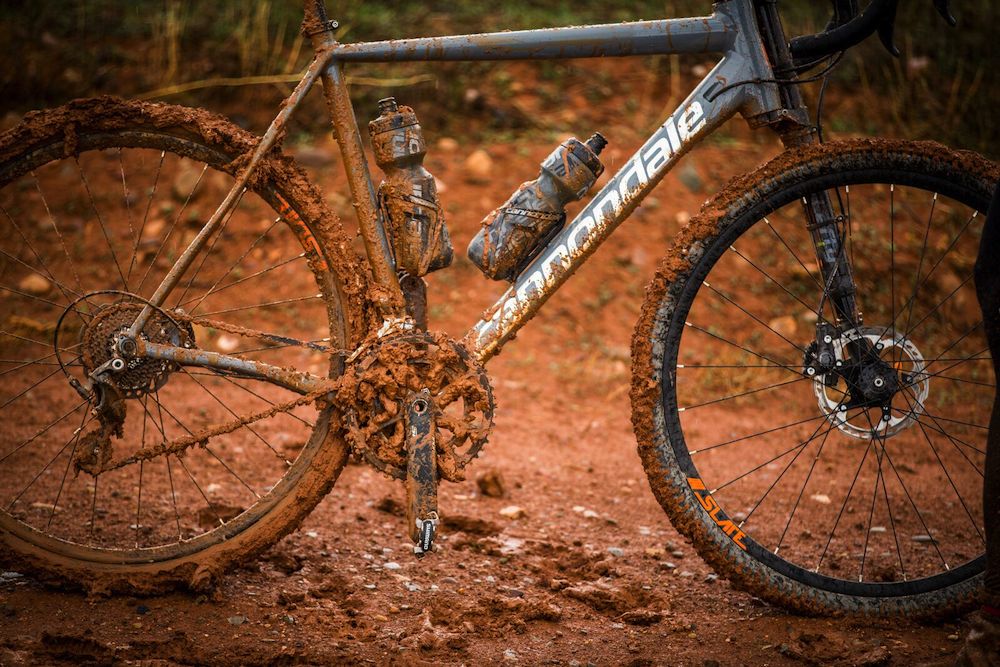
    Photo: This image, taken by Tim Bardsley-Smith, is from my ride along the Mawson Trail.

    Chain cleanliness is another major factor. The type and quantity of grit, along with how much lubricant remains, can significantly alter drivetrain efficiency.

    Given all these variables, it’s nearly impossible to quantify exactly how much a dirty chain slows you down – but the data below should offer a solid approximation.

    How Drivetrain Efficiency Is Measured

    The drivetrain efficiency data discussed here originates from Friction Facts, an independent test laboratory that conducted these experiments roughly a decade ago. I’ve previously analysed their findings in my articles comparing belt drivetrains and 1X vs. 2X drivetrains.

    All tests were performed using a custom-built test rig designed to replicate real-world riding conditions. Chain tension was set to simulate a 250-watt power output at a cadence of 90 RPM. Each chain underwent a five-minute run, with efficiency data recorded at the end of that period. To ensure consistency, every chain was installed in the same orientation each time it was mounted or removed.

    The test rig itself is highly precise, accurate to within ±0.02 watts, and the minor energy losses from its four ceramic bearings were subtracted from the final results to isolate drivetrain performance.

    Dirty Bicycle Chain Efficiency Test #1

    EfficiencyDecrease in Efficiency vs Clean and Lubed
    Clean and Lubed Chain97.6%
    Wet Chain94.8%-2.8%
    Muddy and Wet Chain94.4%-3.2%
    Muddy and Dry Chain92.8%-4.8%

    In this first experiment, a clean chain lubricated with a light oil-based lubricant achieved a drive efficiency of 97.6%.

    After exposure to rain*, efficiency dropped by 2.8%, and with wet mud contamination, it declined by 3.2%. Once the mud had dried, efficiency fell further to 92.8% – meaning nearly 5% more of your pedalling power was being lost to drivetrain friction.

    *Unfortunately, the test documentation did not specify the exact duration or environmental conditions of the “rain” test period.

    Dirty Bicycle Chain Efficiency Test #2

    In a second experiment, Friction Facts tested drivetrain efficiency under real-world race conditions. Six participants took part in a cyclocross race in Boulder, USA, with their chains measured for efficiency both before and after the one-hour event to assess the impact of grit and contamination.

    Three riders used CeramicSpeed UFO V1–treated chains, which feature an immersion wax coating that hardens onto the chain to provide lubrication. The remaining three used light oil-lubricated chains, representing a more typical setup.

    Efficiency While CleanEfficiency Post RaceDecrease In Efficiency
    Waxed Chain #197.6%96.8%-0.8%
    Waxed Chain #297.2%96.8%-0.4%
    Waxed Chain #397.2%96.4%-0.8%
    Efficiency While CleanEfficiency Post RaceDecrease In Efficiency
    Oiled Chain #198.0%96.0%-2.0%
    Oiled Chain #297.4%96.8%-0.6%
    Oiled Chain #397.2%94.8%-2.4%

    Following the race, results showed that the wax-treated chains experienced an average efficiency loss of just 0.7%, while the oil-treated chains lost about 1.7%. The difference is likely due to the wax coating’s ability to repel grit and act as a physical barrier, preventing contaminants from working their way into the chain’s moving parts.

    The Efficiency of an Unlubricated Drivetrain

    The sound of a noisy chain is often your first clue that friction levels are rising. Since each chain link involves metal-on-metal contact, lubrication is essential to keep things running smoothly and efficiently.

    So what actually happens when there’s no lubricant left on your chain?

    Efficiency When Clean and LubedEfficiency When StrippedDecrease in Efficiency
    Chain #197.6%92.0%-5.6%
    Chain #297.2%92.0%-5.2%
    Chain #397.2%92.0%-5.2%
    Chain #497.6%89.6%-8.0%
    Chain #597.2%90.4%-6.8%
    Chain #697.2%92.0%-5.2%

    In this test, six chains were thoroughly cleaned and lubricated with a light oil-based lube. When placed on the test rig, each achieved over 97% drive efficiency.

    The same six chains were then completely degreased using an ultrasonic cleaner, removing every trace of lubrication. When retested, their efficiencies dropped to between 89.6% and 92.0%.

    On average, this means that around 6% of your pedalling power is lost when riding with a completely dry chain. Even a muddy chain with a hint of lubricant performs better than one that’s entirely unlubricated.

    So, the next time your chain starts to squeak, take it as a clear signal – your drivetrain is begging for some lube.

    How Much Does A Dirty Chain Slow You Down?

    best chain lube

    Using Bike Calculator, we can simulate how chain contamination affects riding speed by comparing a perfectly clean, well-lubricated chain with chains of varying “dirtiness.” The friction inputs are based on Friction Facts’ first test and the averaged data from the unlubricated-chain experiment.

    Let’s assume our rider, bike, and gear together weigh 85 kg (187 lb), and the rider is on a gravel bike with their hands on the brake hoods.

    Simulated Average Speed On Flat Gravel Terrain (250W)

    Clean and Lubed – 31.38km/h
    Rainy and Lubed – 30.99km/h – 1.2% Slower
    Wet, Muddy and Lubed – 30.94km/h – 1.4% Slower
    Dry, Muddy and Lubed – 30.71km/h – 2.1% Slower
    No Lubricant – 30.53km/h – 2.7% Slower

    Interestingly, the differences in cycling speed are not as dramatic as many might expect. This is because aerodynamic drag and tyre rolling resistance are typically the two dominant forces acting against a cyclist, while drivetrain losses are relatively minor in comparison.

    Depending on the chain’s level of contamination, the reduction in cycling speed is between 1.2% and 2.1%, while using a completely unlubricated chain slows the bike by nearly 3%.

    However, because the Friction Facts test was conducted at a relatively high 250-watt power output, I also ran a simulation at a more realistic 150 watts to better reflect the performance of an average cyclist.

    Simulated Average Speed On Flat Gravel Terrain (150W)

    Clean and Lubed – 24.75km/h
    Rainy and Lubed – 24.36km/h – 1.6% Slower
    Wet, Muddy, and Lubed – 24.30km/h – 1.8% Slower
    Dry, Muddy, and Lubed – 24.07km/h – 2.7% Slower
    No Lube or Contamination – 23.88km/h – 3.5% Slower

    Drivetrain friction decreases roughly linearly with power, according to data from recent belt drive efficiency tests. Applying this trend suggests a 31% reduction in frictional losses when power drops from 250 to 150 watts. With this lower output, wind resistance also becomes less dominant, which slightly increases the relative effect of drivetrain friction.

    Under these conditions, we see a speed reduction of around 1.6% to 2.7%, depending on how dirty the chain is, and up to 3.5% slower if the chain has no lubrication at all.

    Summary

    The data shows that a dirty bicycle chain operates at around 92.8% to 96.8% efficiency, depending on the level of contamination. This translates to a 1 to 3% reduction in cycling speed.

    While these differences are smaller than the performance impact of aerodynamic luggage setups or tyre rolling resistance, maintaining a clean and lubricated chain is simple and worthwhile. A smooth-running drivetrain not only helps you ride faster, but also keeps your bike quieter and reduces wear on components – ultimately saving you money in the long run.

  • Why My Approach To Testing Bike Vibrations Has Changed Over Time

    Why My Approach To Testing Bike Vibrations Has Changed Over Time

    At the core of the CyclingAbout Comfort Lab is vibration measurement. My aim is to have comparable data that can clearly indicate the effectiveness of different comfort-improving bikes and components.

    In this article, I will explain how my approach to testing bike vibrations has changed over the years, and how I’m conducting my vibration tests going forward.

    Measuring Vibration Outdoors With A Smartphone App

    Most of my vibration tests have been conducted using a smartphone and a vibration-measuring app.

    For front vibration measurement, the smartphone was mounted on my wrist, and for rear vibration measurement, the smartphone was mounted on my back.

    I took the vibrations on two different routes and at two different speeds. One was a bumpy forest trail (pictured above) to see how bikes and components attenuated vibrations coming from bigger hits (15 km/h). The other was a fast gravel road to see how bikes and components attenuated high-frequency vibrations (35 km/h).

    Like any outdoor test, it’s really hard to control the variables. My vibration results were never directly comparable because the routes simply yielded different results in hot, cold, dry, or wet conditions.

    I also used a long measurement duration of ~10 seconds for the fast gravel road and ~60 seconds for the bumpy forest trail. As a result, the vibration levels were often reduced significantly after I averaged the data.

    Additionally, I was measuring vibrations at my wrist and back, and the human body itself dampens a lot of vibration before it hits the accelerometer.

    You can read more about my outdoor vibration testing HERE.

    Measuring Vibration Indoors With A Treadmill

    I wanted to have something more scientific, so I started experimenting with a Woodway treadmill. This allowed me to better control both the environment and speed.

    I mounted different slats on the treadmill to simulate both big hits and high-frequency, gravel chatter. I had to experiment with the placement and frequency of these slats to achieve results consistent with my bumpy forest trail and fast gravel road tests.

    A big improvement here was using a dedicated accelerometer. With help from the developer of Vibration Analysis, I was able to configure the Arduino Nano BLE 33 exactly for my needs. I could also collect very detailed data, in fact, this was 5 to 10 times more data than my smartphone could collect (the measurement frequency was now 500 Hz).

    I took measurements both under the saddle and under the brake hoods. At these locations, I could exclude the damping effect of the body.

    But the treadmill was far from perfect. Trying to make a bike ride by itself on the treadmill was a chore. Also, figuring out how to achieve realistic weight distribution for the rider proved to be very tricky. Ultimately, this methodology brought a few too many challenges.

    You can read more about my treadmill vibration testing HERE.

    Measuring Vibration Outdoors With Consistent Results

    Going forward, I will be conducting vibration tests that combine elements from the outdoor and treadmill tests.

    I am using the same Arduino Nano BLE 33 accelerometer as my treadmill test. It’s mounted under the brake hoods (front of the bike) and under the saddle (back of the bike).

    I will again be using my benchmark bike as a point of comparison between different bikes and components.

    My Rene Herse Umtanum Ridge 650B x 55 mm tires will be inflated to a rather high 45 PSI air pressure. This high pressure ensures the tires are not impacting the vibration results too much.

    And if I’m using tires of different widths I will calculate the appropriate tire pressure using Laplace’s law. This allows me to maintain the same tire casing tension for all tests. You can read a bit more about how I use Laplace’s Law HERE.

    To determine how a bike or component handles bigger hits, I am laying a single wooden block that’s 50mm long and 30mm high on a smooth, flat asphalt road. I run over it at the speed of 25 km/h and then can measure one very clear bump event.

    To determine how a bike or component handles fast gravel roads, I am using an obstacle almost 300cm/118″ long with a lot of different wooden slats mounted at random (as gravel is random in terms of bump frequency). I run over this obstacle at a speed of 25 km/h. The bump frequency is high enough to properly simulate the high-frequency chatter of a gravel road.

    This 300cm test can also be considered an overall performance test because it also contains two bigger hits – at the beginning and at the end (when riding on and off the obstacle).

    I conduct exactly nine test runs in each scenario. I exclude the two highest and two lowest measurements to ensure that slight speed fluctuations are not impacting the results in any significant way. I then calculate the average vibrations of the five remaining test runs.

    Summary

    My latest approach to vibration testing yields results consistent with my outdoor comfort tests. But this time, the results are repeatable – no matter the weather conditions.

    Unlike the treadmill test, I’m actually on the bike and moving at typical gravel cycling speeds (25 km/h) so the vibration measurements are even closer to real-life scenarios.

    And with the high-resolution vibration data being measured at the brake hoods and saddle, we take out the damping effect of the human body. This will hopefully highlight bigger comfort differences between bikes and components.

    If you have any questions about how I conduct my tests, feel free to ask in the comments section below.

  • How We Test Bike Comfort Using Controlled Obstacles

    How We Test Bike Comfort Using Controlled Obstacles

    For years, I’ve been on a mission to understand what truly makes a bike feel comfortable. To keep things objective, I’ve been collecting vibration data to evaluate bikes and components more accurately.

    Initially, I used a smartphone with a vibration app to measure how bumpy different bikes felt on various trails. That worked surprisingly well, but I’ve now upgraded to a much more precise system.

    My New Vibration Measurement Procedure

    I now use controlled obstacles combined with a high-resolution accelerometer to measure vibrations directly on the bike. This approach delivers results that are:

    • Consistent regardless of weather (hot, cold, dry, or wet)
    • Easy to compare across different days, making benchmarking more reliable
    • Measured directly on the bike, removing the rider’s body as a damping factor
    • Collected at real-world gravel riding speeds (20–25 km/h)

    Best of all, these results align closely with my earlier outdoor and treadmill tests, confirming their reliability.

    Front and Rear Vibration Measurements

    I use an Arduino Nano BLE 33 accelerometer, powered by USB, to collect detailed vibration data at 500 Hz. With help from the developer of this Vibration Analysis app, I’ve fine-tuned the setup for comfort testing.

    The sensor is mounted under the brake hoods and saddle, so we measure the bike itself – not the rider. This gives a clear picture of front and rear comfort without the body absorbing or masking vibrations.

    Single Hit Test

    To evaluate a bike or component on a single large impact, I place a wooden block (50 mm long, 30 mm high) on smooth asphalt. Riding over it at 20 km/h while seated (no pedalling) captures one clean bump event.

    Fast Gravel Road Test

    To simulate fast gravel chatter, I use a 3 metre long obstacle with 34 wooden slats spaced randomly. This creates a short series of bumps that mimics a real gravel road.

    I ride over it at 25 km/h, staying seated and not pedalling, while recording vibration data.

    This test also includes a larger impact right at the start (when I first roll onto the obstacle), so it doubles as a broader performance test. I skip the data from the end of the obstacle since the drop-off isn’t consistent across runs.

    Multiple Test Runs

    Each obstacle is tested nine times. To reduce the effect of minor speed variations, I discard the two highest and two lowest readings, averaging the remaining five runs – the data you see in the results.

    Summary

    Our controlled obstacle results align closely with actual gravel road and singletrack data, giving confidence in the consistency of this approach.

    The data is easy to collect, repeat, and compare at real-world riding speeds, providing a clear picture of how different bikes and components affect comfort on a gravel bike.

  • Redshift ShockStop Endurance Suspension Seatpost Review: Insane Comfort!

    Redshift ShockStop Endurance Suspension Seatpost Review: Insane Comfort!

    With so many suspension seatposts on the market today, each offering a different take on comfort and ride quality, it takes something special to stand out.

    So when Redshift announced its own version, I was keen to see how it would perform. Their ShockStop suspension stem has long been a go-to upgrade on my main test bike, consistently delivering noticeable comfort gains.

    The new ShockStop seatpost looks promising on paper and comes with bold performance claims.

    But I don’t take marketing at face value, so it’s time to put it through a proper (and bumpy) test.

    Suspension Seatpost Designs

    When choosing a suspension seatpost, you’ll typically be deciding between a few distinct types:
    – Carbon leaf spring seatposts like the Ergon Allroad Pro
    – Coil spring seatposts like the Kinekt XR
    – Elastomer spring seatposts like Cane Creek eeSilk
    – Air spring suspension seatposts like the PNW Coast

    The Redshift ShockStop Endurance uses metal coil springs, and as you might expect, springs tend to be, well… springy. The key challenge with this design is reducing that bounce while still delivering effective suspension.

    I recently tested the Kinekt XR, and while it was undoubtedly comfortable, I couldn’t shake the overly springy feel, regardless of how I set it up.

    That got me wondering: can Redshift do it better? The short answer is… yes!

    Redshift ShockStop Endurance: First Rides

    I began testing with the recommended spring setup for an 80kg rider (I weigh 84kg). Right off the bat, it felt too soft. I was bottoming it out and bouncing far too much. So I returned home and increased the firmness.

    I added an extra spring, adjusted the preload to level 2 (for 90kg riders), and headed back out. Big improvement! No more bottoming out, and the overall ride feel was much more controlled.

    Still, on bigger bumps, I noticed a bit too much saddle movement. So I cranked it up to level 3 (for 100kg riders). That ride felt even better – much smoother, with the suspension working silently under me. No perceptible bounce, even during hard pedalling.

    Curious about going even firmer, I pushed the preload to level 4. That test ride was… revealing.
    On big hits, the spring action became too aggressive, almost launching me from the saddle like a mini catapult!

    So for me, level 3 is the sweet spot. But each rider will need to fine-tune their setup to match their weight and riding style.

    One upside: adjusting preload doesn’t reduce the post’s 35mm of available travel. Redshift aimed for a one-size-fits-most solution, and it mostly works. Though I wonder if slightly less travel would tame the springiness further.

    Vibration Testing The Redshift ShockStop Endurance

    For testing, I used my Argon 18 Dark Matter gravel bike, fitted with Challenge GravelGrinder 700C x 42 mm tires.

    To isolate the seatpost’s performance, I used a firm Prologo Scratch RS saddle, skipped padded shorts, and ran 40 psi tire pressure – firm enough to highlight suspension differences.

    You can see my vibration measurement procedure & outdoor test courses HERE.

    Vibration Test Results

    Bumpy Forest Road

     Average Acceleration (g)Vibrations When Compared to the FSA Seatpost
    FSA K-Force Carbon2.9
    Ergon CF3 Pro Carbon2.610.3% Fewer Vibrations
    Redshift ShockStop2.224.1% Fewer Vibrations

    Fast Gravel Road

     Average Acceleration (g)Vibrations When Compared to the FSA Seatpost
    FSA K-Force Carbon3.8
    Ergon CF3 Pro Carbon3.313.2% Fewer Vibrations
    Redshift ShockStop3.021.1% Fewer Vibrations

    The results were crystal clear. At firmness level 3, the Redshift seatpost significantly outperformed both the Ergon Allroad Pro and the FSA K-Force carbon seatposts.

    On the bumpy forest trails, it reduced vibrations by 24% compared to the FSA and by 15% compared to the Ergon. Even on fast gravel roads, where the differences tend to be less dramatic, the Redshift still offered a 21% comfort boost over the FSA and 9% over the Ergon.

    These are substantial improvements, and while the Redshift clearly excelled on rough terrain, I found it particularly well-suited to fast gravel roads where high-frequency vibrations dominate.

    It works so quietly and smoothly that you barely notice the suspension in action; there’s no bounce, just a consistent sense of calm under you.

    What surprised me most was the gap between the Redshift and the Ergon Allroad Pro. I had expected the difference to be minor. However, there is one important factor to consider: the Argon 18 frame I used for testing has less exposed seatpost than my usual benchmark bike, the Jamis Renegade. That reduced seatpost extension likely limited the Ergon’s ability to flex.

    Still, even with an extra 30mm of post exposed, I don’t believe the Ergon could match the Redshift in overall comfort.

    A Few Practical Notes

    Saddle installation can be fiddly, and the access to the bolts is tight. Even with two different wrenches, I struggled and ended up scratching the post near the clamp. Choose your tools carefully here.

    Preload adjustment, however, is easy. Just pull out the post, turn the adjustment cup, and reinsert. Thanks to the numbered markings, it’s quick to restore your saddle height.

    Long-Term Reliability?

    Alee tested the Redshift ShockStop seatpost on his touring bike for 18 months.

    The Redshift ShockStop seatpost has more moving parts than most, which raises the question of durability.

    But after 18 months of real-world touring through a dozen countries, Alee reported zero reliability issues.
    In my two weeks of hard use, the post has also been rock-solid – no noises, no problems. I’ll have more to report after more winter testing.

    Summary

    redshift shockstop endurance

    The ShockStop Endurance will save your back and butt on long rides! It’s comfortable, adjustable, reliable, and looks great too.

    US $229 (MSRP)

    If you’re chasing one of the best suspension seatposts out there, the Redshift ShockStop Endurance is one of them.

    It’s not perfect: you’ll need to spend time fine-tuning preload, and installation could be more user-friendly. Plus, being a coil spring design, it still moves a bit on bigger hits.

    But what matters most is everyday ride comfort, and here, the Redshift delivers in spades.

  • Cushcore Tire Inserts Review: A Shocking Result On Gravel Roads

    Cushcore Tire Inserts Review: A Shocking Result On Gravel Roads

    On a gravel bike, tires often serve as the primary form of suspension. To get the most comfort out of them, you usually need to run relatively low air pressures.

    However, this can compromise cornering, as the tire sidewalls may flex or fold under high loads. Lower pressures also increase the risk of damaging your rims.

    Cushcore tire inserts claim to address these issues, offering a safer, more comfortable, and potentially faster ride, at least in theory.

    So, does Cushcore actually live up to the hype?

    What Are Cushcore Tire Inserts?

    Cushcore inserts were originally developed for downhill mountain bikes, where every bit of suspension and traction can make a huge difference on fast descents. They later expanded to trail bikes, and now the brand is aiming at the gravel market.

    The concept behind Cushcore is straightforward: a specialized foam insert sits inside your tire, protecting your rim from hard impacts that are common when running low tire pressures.

    Cushcore also enhances overall comfort by stabilizing the sidewalls, reducing the tire’s tendency to feel bouncy.

    Finally, it improves handling in tight corners by limiting unwanted tire movement, giving you more confidence and allowing you to carry speed through turns.

    The Installation… Is Not Effortless

    Cushcore only works with a tubeless setup, so you need both tubeless-ready rims and tubeless-ready tires to use the system. You also have to use the Cushcore-specific valves, as standard tubeless valves won’t work.

    I assumed installation would be straightforward; after all, I’ve been setting up tubeless tires for years.

    I couldn’t have been more wrong. My setup was 650B × 50 mm Panaracer GravelKing SK tires with Cushcore XC inserts. These tires are already a snug fit on my DT Swiss M1900 Spline wheels, and adding the Cushcore foam only made the process more challenging.

    The process begins by placing the inserts onto the rim, which is fairly straightforward thanks to the ridges that match the rim’s inner dimensions.

    Things get much trickier when it’s time to seat the tire beads. You need significantly more force than usual, along with plenty of soapy water to help the tire settle. The most difficult part is using two tire levers and applying serious pressure to get the last section of the bead over the rim.

    With practice, the process becomes easier, but it will always take longer than a standard tubeless tire installation.

    My Benchmark Bike Setup

    I equipped my Jamis Renegade benchmark bike with a rigid carbon fork, rigid FSA stem, Ergon Allroad Pro carbon seatpost, DT Swiss M1900 650B wheels, and Panaracer GravelKing SK 50mm tires.

    I then experimented with different tire pressures on both the front and rear wheels, testing each setup with and without the Cushcore inserts.

    Vibration Test Results

    You can see my vibration measurement procedure & outdoor test courses HERE.

    Remarkably, adding Cushcore inserts resulted in a noticeable comfort boost across the board, both subjectively and in my measurements.

    At the same tire pressure, comfort improved by 14% on the fast gravel road, a level of improvement that few component changes can match. The rear saw a smaller, but still perceptible, 3.9% gain.

    On a bumpy forest trail, the difference was slightly less pronounced. I measured an 8% improvement at the front at the same tire pressure, which increased to 12.3% when the tire pressure was lowered to 15 psi.

    Cushcore Comfort Analysis

    Cushcore truly delivers a more comfortable ride, surprisingly, without any noticeable drawbacks.

    I expected tires with Cushcore inserts to feel strange, especially in corners, but the opposite was true. My tires cornered better and rolled more smoothly on rough roads.

    I was even able to run my 650B × 50 mm tires at 15 psi. Normally, that pressure would be unusable at this width, but on the front, it was predictable and cornered confidently without noticeable roll.

    The rear tire occasionally showed signs of too-low pressure at 15 psi, particularly during fast cornering, but the effect was mild, and in any case, you don’t really need such low pressure at the back.

    Interestingly, my front-end measurements at 15 psi showed no real comfort gain on fast gravel compared to 20 psi. On the bumpy forest trail, however, vibration was reduced by a notable 5.3%.

    After all my testing, I’ve found that 15 psi front and 18 psi rear is the sweet spot for my 650B × 50 mm setup with Cushcore, at least for my body weight and the Panaracer GravelKing SK tires.

    But I can’t help but wonder if I can achieve even better comfort when using a more supple 650B tire like the Soma Cazadero. Perhaps, I’ll have to find out…

    Is Cushcore A Must-Have for Gravel Riding?

    If you’ve already experimented with low tire pressures and enjoy the added comfort, Cushcore inserts are an excellent upgrade. They make riding at low pressures more comfortable, predictable, and enjoyable.

    However, if you typically run higher tire pressures, the benefits of Cushcore will be much harder to notice, and the added weight, cost, and effort may not be worth it. The 650B Cushcore inserts add roughly 140 g per wheel.

    At €150, Cushcore might seem pricey for what is essentially foam. Yet it’s a surprisingly affordable way to boost comfort—especially when compared to a Lauf Grit SL suspension fork (€990) or an Ergon Allroad Pro seatpost (€250).

    It becomes an even better value when you consider that, unlike a fork or seatpost, Cushcore adds comfort to both the front and rear of your bike.

    You can support the CyclingAbout Comfort Lab by purchasing Cushcore Tire Inserts on Amazon. Simply click HERE to make your purchase, and a small commission will come our way.