


Modern bicycle gears have a problem: as we keep adding more gears to the rear cassette, the chain angles have to become increasingly extreme in the smallest and largest sprockets. This cross-chaining not only increases drivetrain friction, but it also accelerates wear and generates more noise.
The Orient chainring takes an unusual approach to solving this problem. Instead of relying on a single chainline, it uses two, and it even automatically transitions between them to keep the chain better aligned with different sections of the cassette.
In this article, I’ll show you how the Orient chainring works, explore its potential, and later, I’ll even crunch the numbers to find out whether cross-chain efficiency is really a problem that needs solving.
But let’s start with how it works.
Marginal Gain Orient
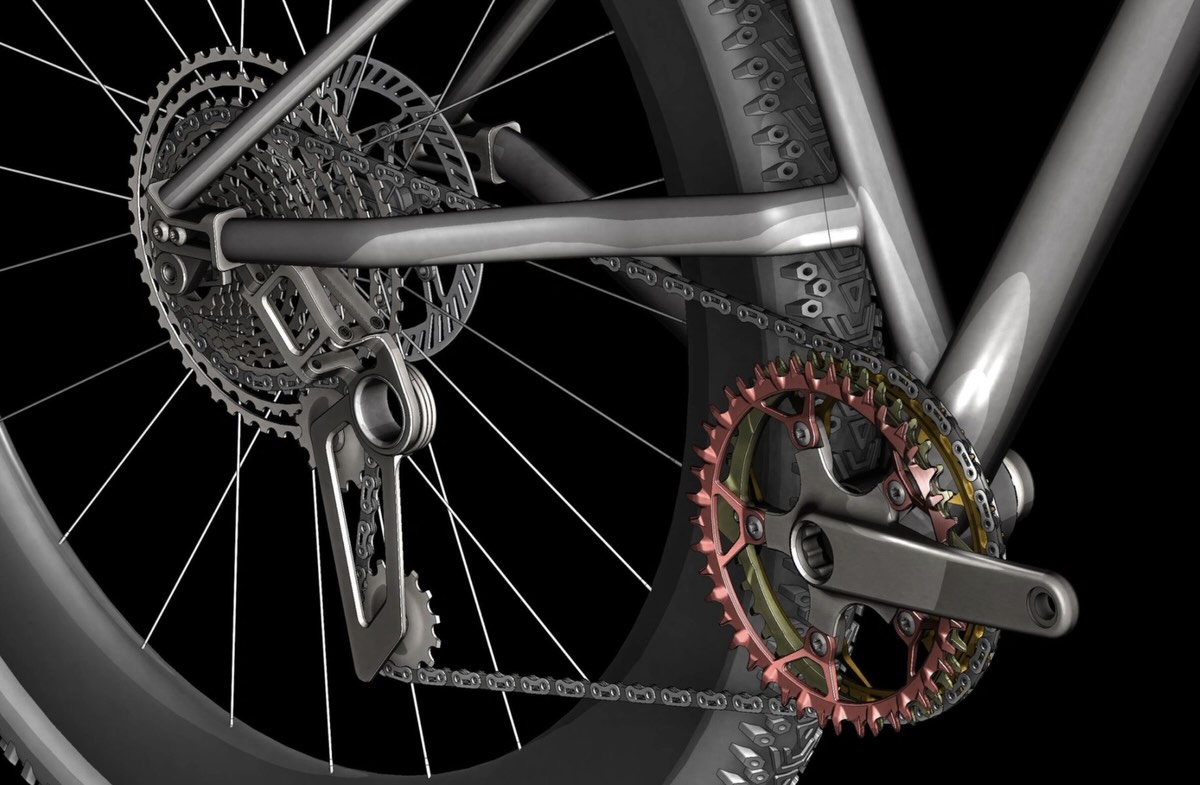
Although it uses three front chainrings, the Orient functions as a 1X drivetrain, with two main chainrings that are identical in size. The difference is that there are two chainlines, which are each optimised for different halves of the cassette. One chainline serves the smaller sprockets, while the other serves the larger ones.
What’s particularly clever is how Orient uses the chain’s lateral angle to trigger the transition between chainrings. This happens roughly halfway through the cassette, where the middle helix ring catches the chain using its specially shaped teeth, with small guards keeping the chain securely engaged throughout the process. You can see the shifting process in my video linked above.
By improving chain alignment across both halves of the cassette, the system aims to reduce drivetrain noise and wear while improving efficiency. Sharing the workload between two chainrings should also distribute wear more evenly, potentially extending their service life.
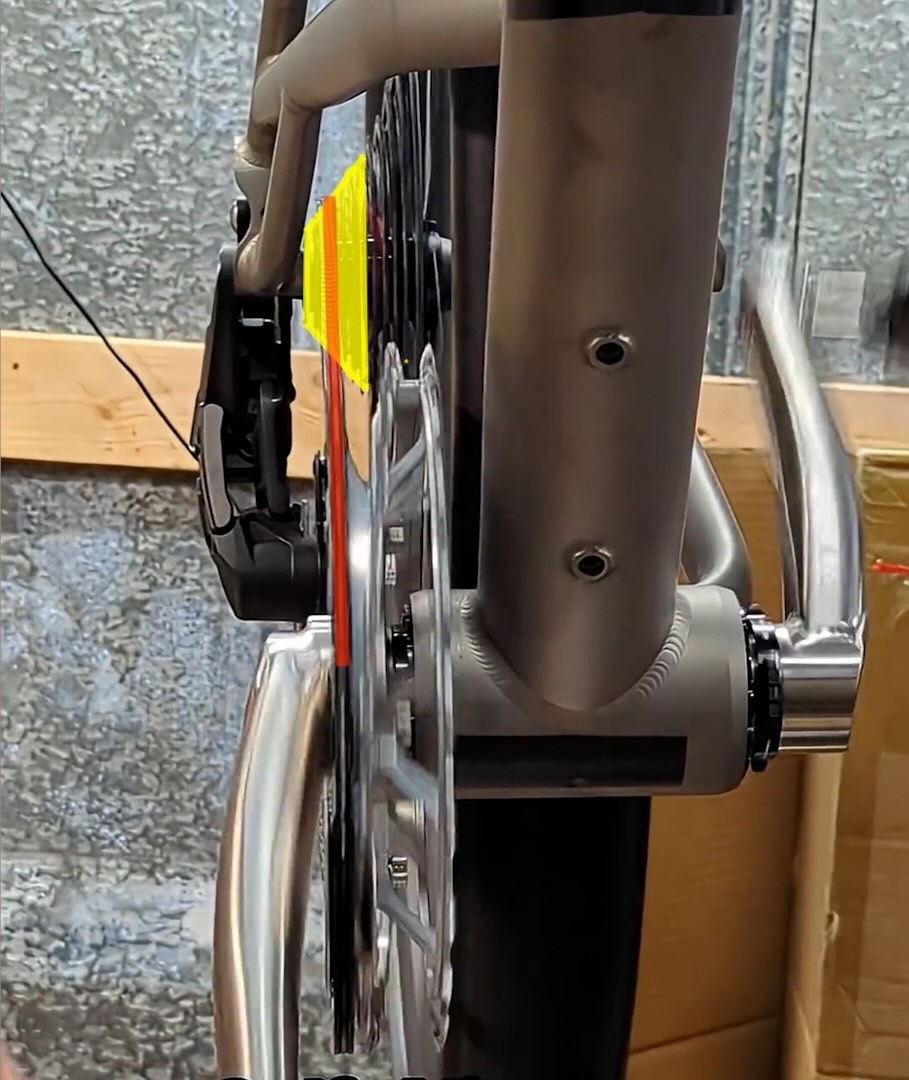
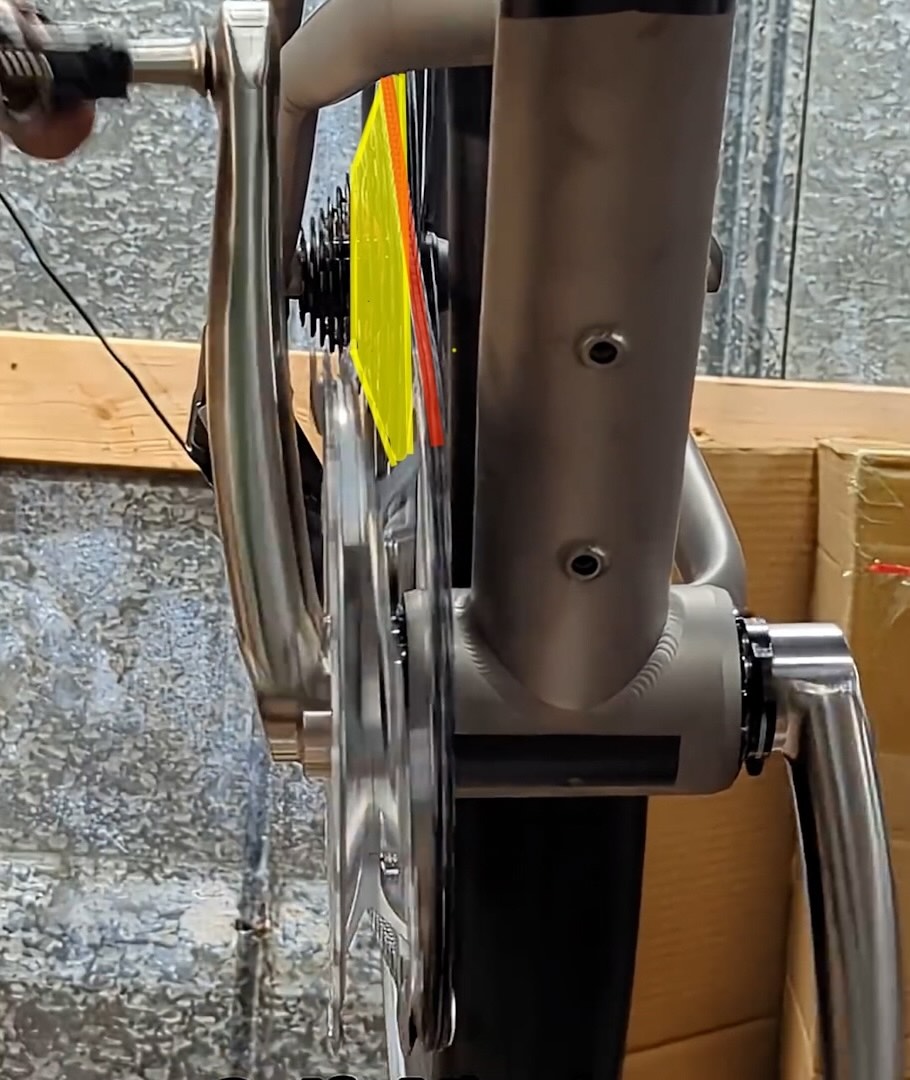
The two chainlines are spaced 25 mm apart. However, accommodating the three-chainring arrangement requires additional clearance, meaning the system won’t fit a conventional frame. Instead, it needs a specially designed frame with elevated chainstays to provide the necessary space.
A narrower 12 mm version is also in development. This should accommodate more conventional chainstay designs, although the reduced spacing will limit the chainline benefits compared with the wider version.
Despite the additional chainrings, Orient is designed to weigh roughly the same as comparable 1X drivetrains on the market.
Let’s now compare the Orient chainring with other self-aligning chainring designs to see how it stacks up.
Self-Aligning Front Chainrings
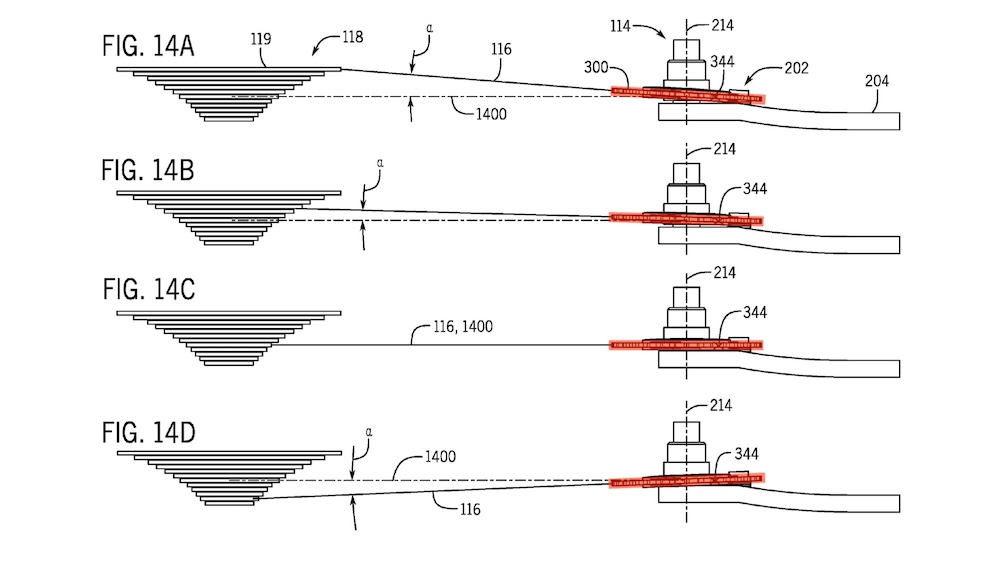
The earliest patent I found dates back to 1998. This design uses multiple hinge joints in the crank spider, allowing the chainring to move laterally in response to the chain’s sideways pull. It’s a clever concept, but the exposed mechanism looks vulnerable to dirt and debris. Another patent describes a floating chainring, but that too would deal poorly with contamination.
SRAM threw their hat into the ring with two approaches. One divides the chainring into interconnected segments that can move sideways relative to one another. The other uses a chainring that pivots in place, allowing it to partially align with the selected cassette sprocket.
However, contamination remains a potential concern with all of these designs too.
Then Shimano came along with a design that houses much of the mechanism inside the crank axle. Better protection, sure, but more complexity and potential maintenance.
That’s where Orient comes in. By avoiding moving mechanisms altogether, it aims to reduce maintenance and make the system less susceptible to contamination.
A New 16 Speed Drivetrain
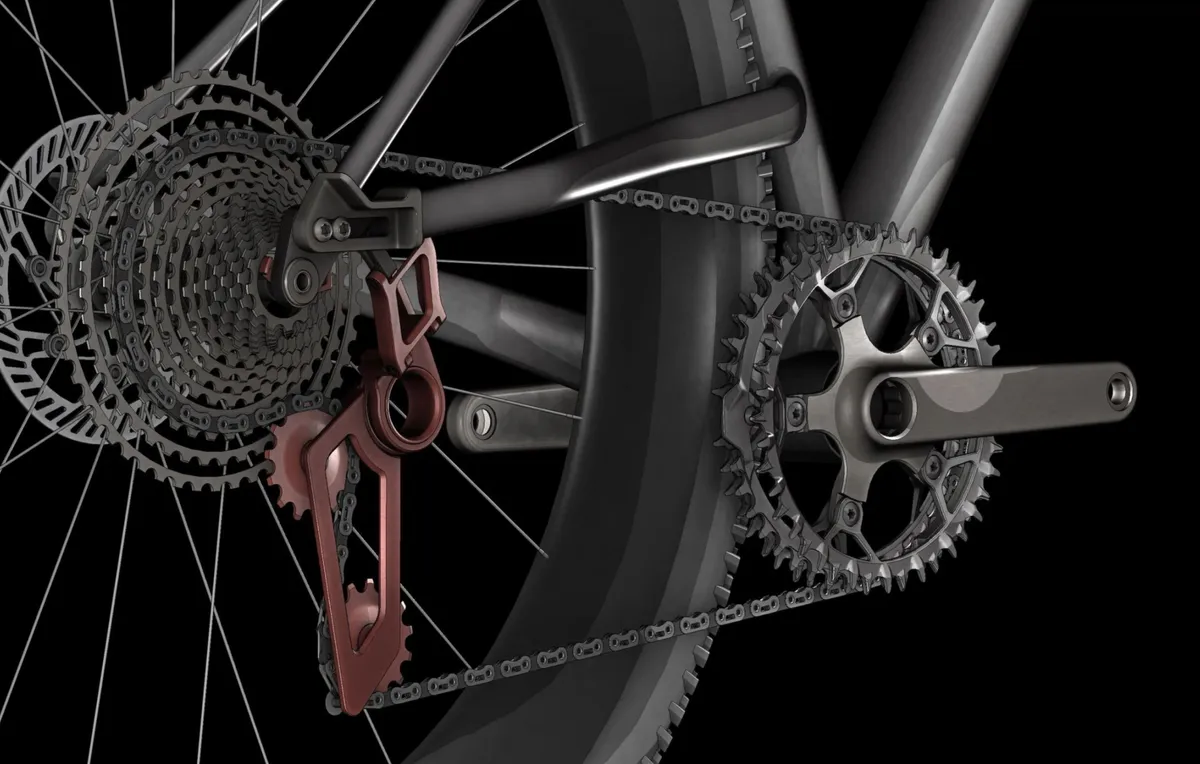
Marginal Gain sees its dual-chainline design as a particularly promising solution for a 16-speed cassette. Yes, 16 gears.
Here’s how the proposed setup works. It uses a 142 mm rear hub in a frame designed for a 148 mm hub. A 6 mm spacer on the drive side makes up the difference in hub spacing while creating additional room for a 16-speed cassette.
But why would you want 16 gears in the first place?
The main advantage is smaller jumps between gears across a given range, allowing you to fine-tune your cadence and speed. You get closely spaced ratios for maintaining a comfortable rhythm on flat terrain, without giving up the low climbing gears needed for steep mountain roads. In other words, you get the best of both worlds.
So far, it’s all sounding pretty promising. But what does the data actually tell us about chainline efficiency?
Chainline Efficiency: The Data

In 2015, CeramicSpeed conducted a study investigating how lateral chain misalignment affects drivetrain efficiency.
Using a test rig, they measured drivetrain losses across every gear combination on a road-bike drivetrain fitted with 53/39T chainrings and an 11–28T cassette. The tests were conducted at a power output of 250 watts and a cadence of 95 RPM.
Across the range of gears, total drivetrain losses were between 7 and 10 watts.
Only two gear combinations had a perfectly straight chainline: the 39T chainring with the 17T cog, and the 53T chainring with the 14T cog. In all the other combinations, the chain ran at an angle.
This matters because drivetrain losses come from several sources. The chain and sprockets generate friction even when perfectly aligned, but most gear combinations also suffer additional losses from lateral chain misalignment.
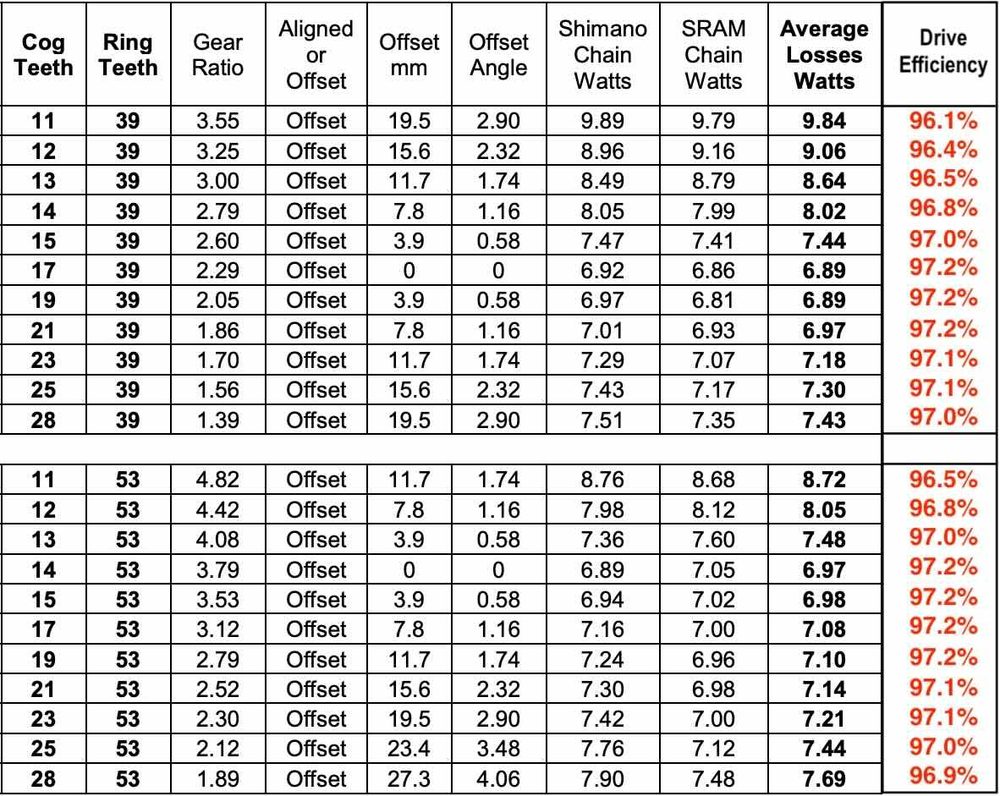
CeramicSpeed wanted to isolate that additional friction, so they conducted a second set of tests in which every gear combination was perfectly aligned.
For example, instead of the chain running from the 53T chainring to the 28T cog at an angle of around 4 degrees, the test setup kept it straight at 0 degrees. The same was done for the 39T chainring and 11T cog, which would otherwise have a chain angle of around 3 degrees.
By comparing the losses in the normal misaligned setup with those in the perfectly aligned setup, CeramicSpeed could estimate how much resistance was caused specifically by lateral chain misalignment.
The result? Perfect alignment reduced drivetrain losses by an average of just 0.73 watts with the small chainring and 0.82 watts with the large chainring. Yes, less than one watt on average.
Based on this study, chain misalignment appears to be a relatively small contributor to overall drivetrain losses.
CeramicSpeed also provided a way to estimate the effect of misalignment in individual gears. Their data suggests that each gear step away from the ideal chainline adds 0.29 watts of resistance on average. So, if you’re seven cogs away from the ideal chainline, the additional loss from lateral misalignment could exceed 2 watts.
Of course, these results come from a particular road-bike drivetrain tested under specific conditions. Losses could be greater with contamination, and wider-range mountain-bike cassettes might be more affected by lateral misalignment.
Still, from an efficiency perspective, the Orient twin-chainline drivetrain may offer only a marginal gain.
Estimating the Advantage of Marginal Gain Orient
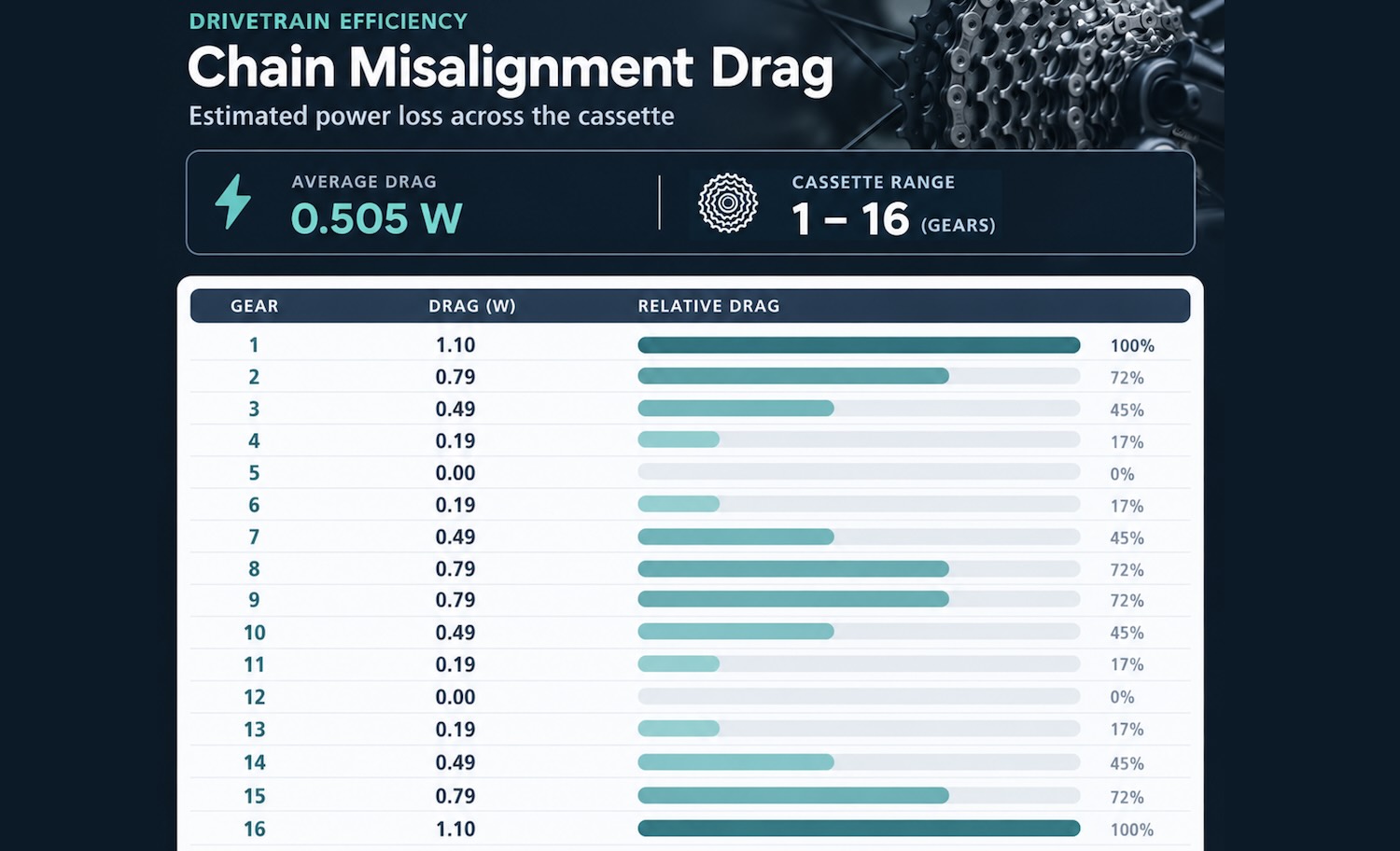
Let’s now estimate how much Orient could reduce chain-misalignment losses using CeramicSpeed’s data. I haven’t tested the Orient system myself, so this is only a theoretical estimate, but it gives us a useful starting point.
Applying the CeramicSpeed lateral-misalignment data to a 16-speed drivetrain with a single front chainring, I can estimate average chain-misalignment losses of around 1.1 watts. Running the same calculation for Orient, with its two chainlines, brings that figure down to around 0.5 watts.
That suggests a reduction of approximately 0.6 watts in average chain-misalignment losses, which is a relatively small saving. We’ll have to wait for real-world testing to find out how much power the system actually saves overall.
Cassette Cog Sizes Matter More
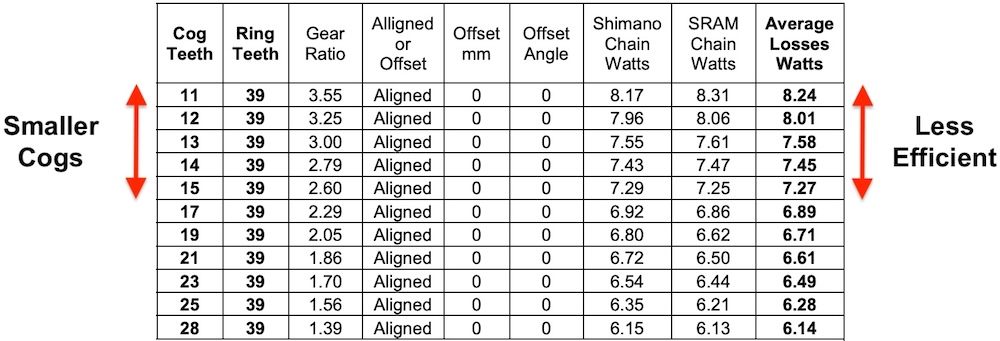
The bigger elephant in the room is cog size, particularly the really small cog at the end of a cassette. You’ll notice that even when CeramicSpeed tested a perfectly aligned chain, the larger cogs were always more efficient than the smaller ones.
There are several reasons for this, but two are particularly important.
First, the chain has to articulate more sharply when it runs around a smaller cog. This increases the relative sliding motion at the chain’s pins and other contact surfaces, creating additional friction.
Second, smaller cogs generally require higher chain tension to transmit the same power at the same wheel speed. This can increase friction where the chain links bend and where the chain engages with the cog.
So, how much efficiency do you lose by using the smallest cog? It turns out, quite a lot.
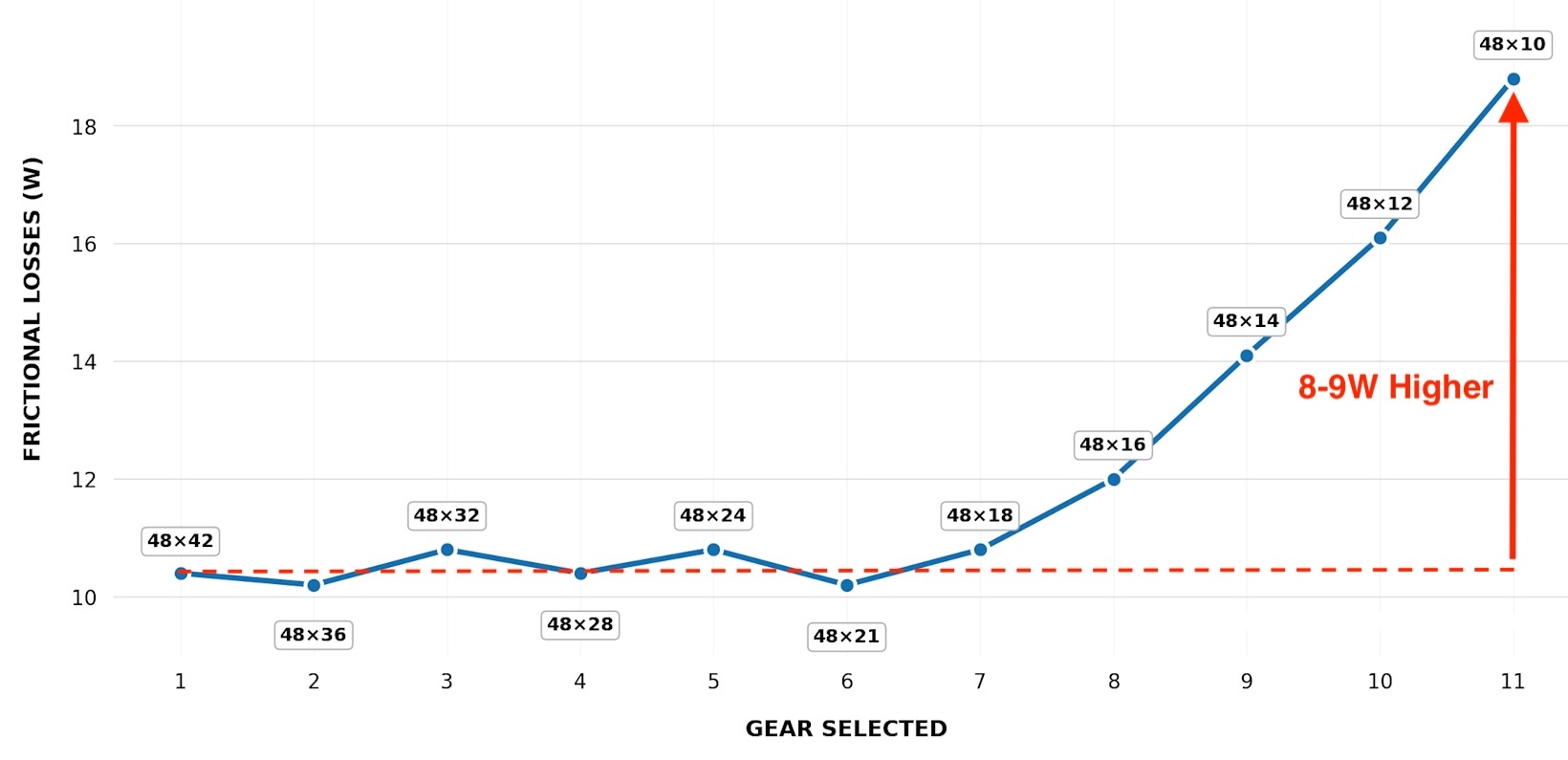
VeloNews tested a 1X SRAM drivetrain and found that the largest seven cogs produced between 10 and 11 watts of drivetrain resistance. But losses jumped to around 12 watts on the 16T cog, 14 watts on the 14T cog, 16 watts on the 12T cog, and almost 19 watts on the 10T cog!
If we account for some of the chain-misalignment losses using CeramicSpeed’s data, cog size alone could be contributing around 5 to 7 watts of additional resistance in the 12- and 10-tooth cogs.
Other tests I’ve found report smaller losses, but the overall pattern is similar. Using an 11T or 13T cog can result in around 3–4 watts of additional friction compared with a larger cog (with chain-misalignment losses subtracted), depending on the drivetrain and test conditions.
If the smallest cogs contribute substantially more friction than chain misalignment, is Orient focusing on the wrong problem here? Should we just be making cassettes bigger rather than just making the chain run straighter?
Personally, I’d love to see cassettes ditch the 9T and 10T cogs and make the larger cogs, such as the 52T, bigger instead.
My Take
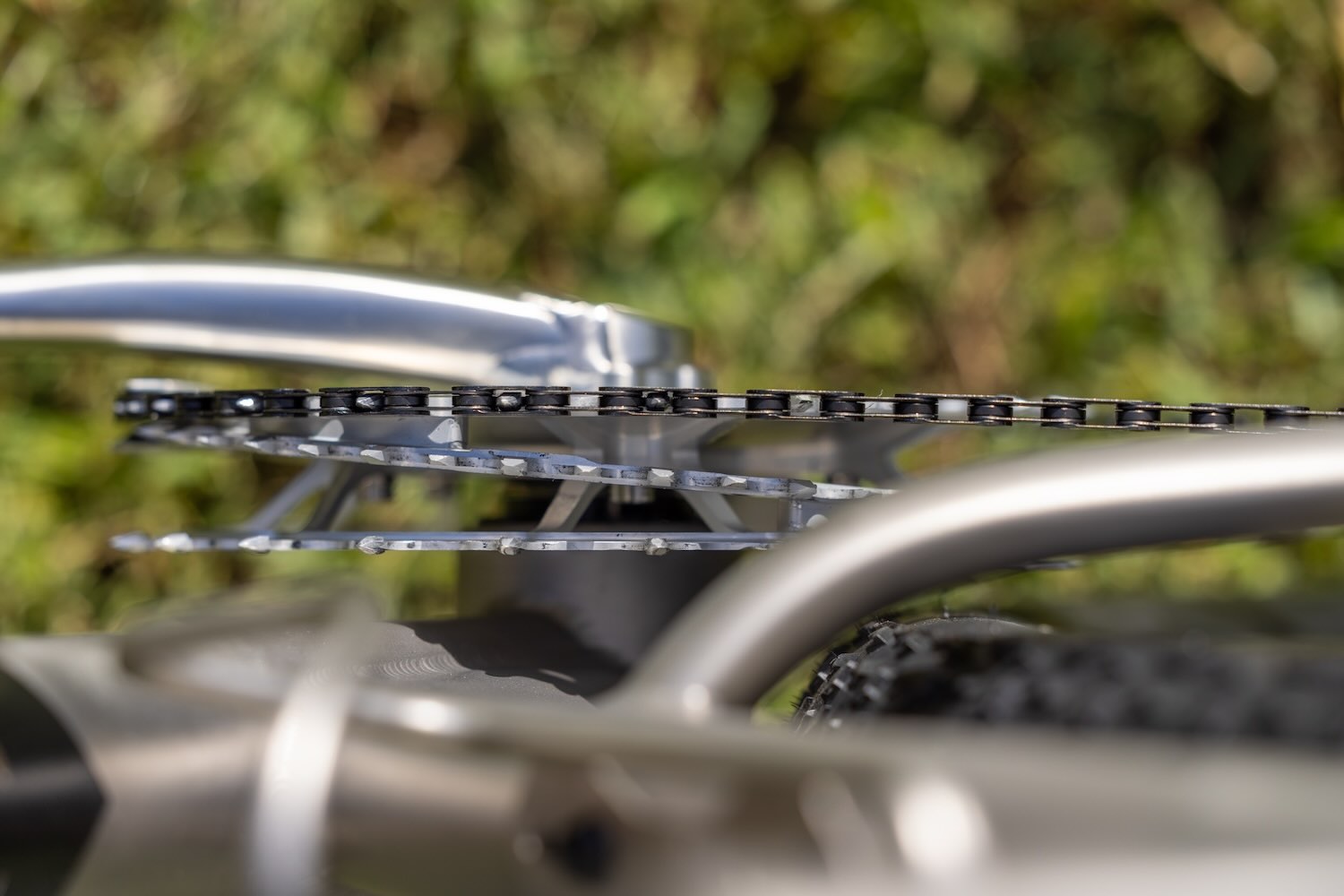
I think Marginal Gain Orient is a genuinely cool concept, and I think it’s worth developing further, particularly if we’re going to see cassettes get wider again.
I especially like that the system switches between chainlines without needing a mechanism or battery. I can also see potential benefits for sprocket longevity and noise.
That said, the efficiency gains appear minimal, and there’s an added risk of the chain dropping between the chainrings. The biggest hurdle, however, is the need for a purpose-built frame.
Supre Drive is another drivetrain that requires a dedicated frame. Having tested it myself, I can confirm there are genuine performance benefits. But its limited adoption shows just how difficult it is to convince people to commit to an entirely new bike design.
Basically, the performance benefits need to really stack up to justify the compromises. I’m not sure this is the case here, but I’d love to be proven wrong.


