


Belts are already used in some extremely demanding applications, from driving blowers on 10,000-horsepower racing engines to powering 150-horsepower motorcycles. And more recently, they’ve made their way into bicycle drivetrains.
I’ve personally been using belt drivetrains on my bikes for around 12 years now, covering more than 135,000 km (about 88,000 miles) on what is essentially a chainless setup.
Over that time, I’ve taken belt-driven bikes across some of the most varied terrain imaginable: the world’s highest roads, dry deserts, dense jungles, exposed coastal routes, vast salt flats, and even snowy mountain landscapes.
In this article, I’ll explain why a belt drive can be a better option than a chain drive for many cycling applications. I’ll then look at why belt drives aren’t more widely used, and finally address the most common questions I’ve been asked about these drivetrains.
Throughout the article, I’m referring specifically to my experience with the Gates Carbon Drive CDX system. This is not a sponsored piece, and I have no affiliation with Gates. If I come across as enthusiastic, it’s simply because I’m a satisfied user.
Let’s start by looking at the key characteristics of bicycle belt drivetrains.
What is Bicycle Belt Drive?
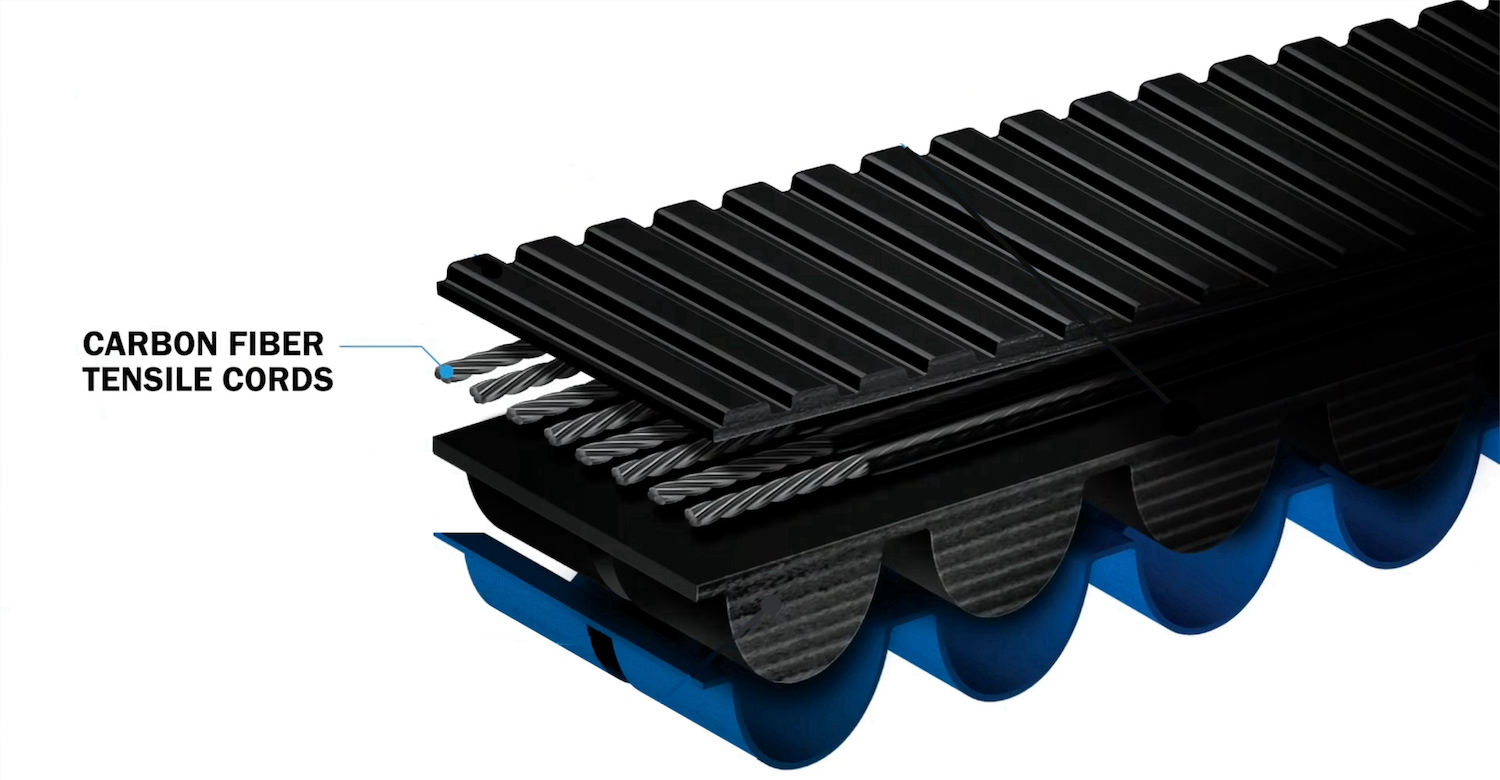
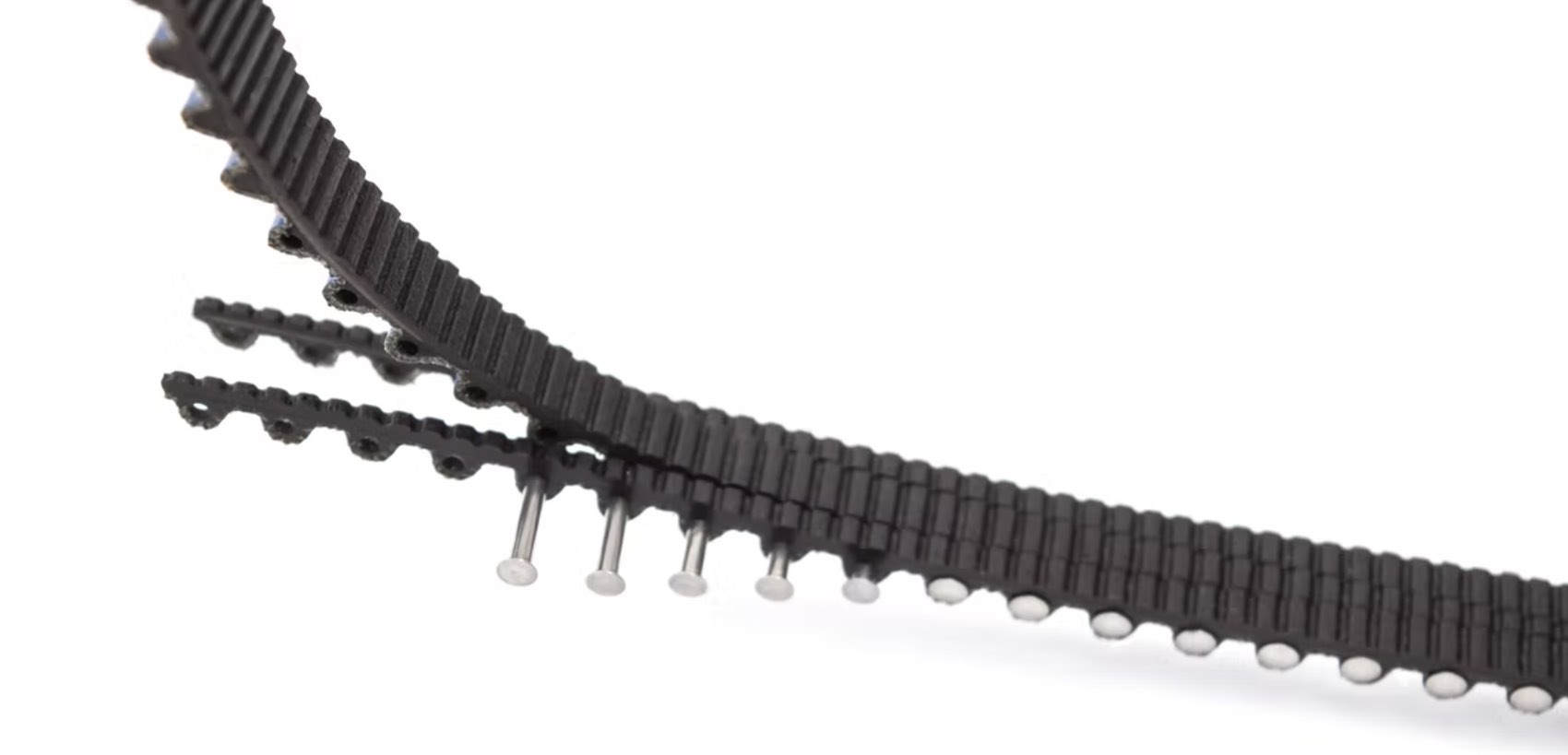
A bicycle belt is unlike most conventional belts. It is constructed from a polymer body reinforced with multiple carbon fibre tensile cords running along its length.
These tensile cords are what give the system its high strength and stiffness. In fact, Rob Rast of FLX Bike has demonstrated that a bicycle belt can even lift the rear of a van without failing under tension.
In typical setups, belt drives are paired with steel rear sprockets and alloy front sprockets. They can be used in single-speed configurations or combined with a gearbox or internal gear hub to enable multiple gears while maintaining a clean, enclosed drivetrain system.
Why Are Belt Drive Bikes Better Than Chain Drive Bikes?
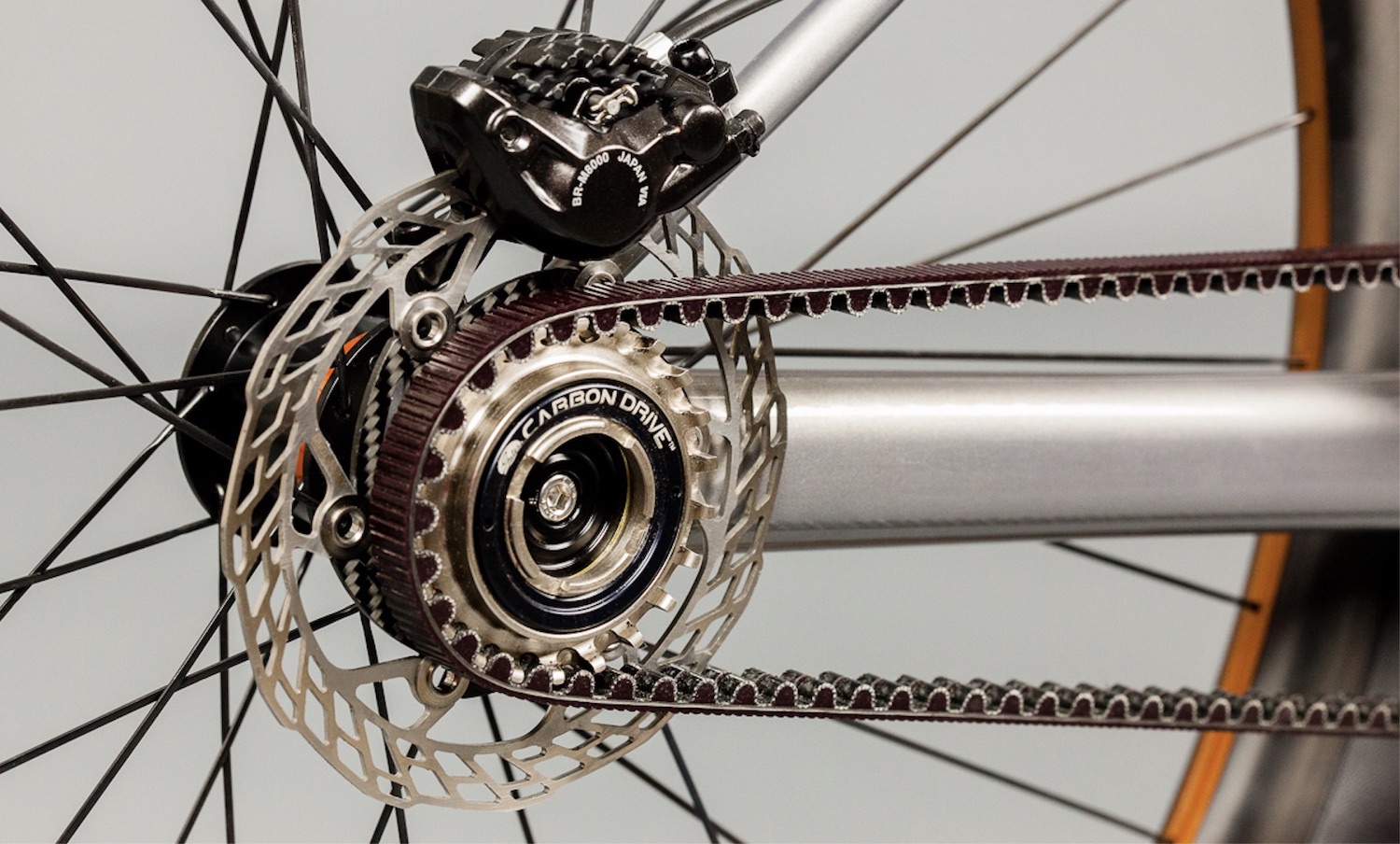
Firstly, belt drives are extremely long-lasting. Many riders go years without needing to replace a belt or sprocket. In my own experience, I’ve put over 35,000 km (22,000 mi) into a single belt drivetrain across steep climbs and a wide range of riding conditions, and others have reported exceeding 40,000 km. That’s often three to four times the lifespan of a typical chain setup.
Belts are also very low maintenance. They require no lubrication, no grease, and far less cleaning than chains. In many cases, a simple rinse with water is enough.
Because there is no oil or grease involved, belt drivetrains stay exceptionally clean. That means no black residue on your hands, clothing, or bike components.
They also run almost silently. In most conditions, the drivetrain produces little more than a faint hum.
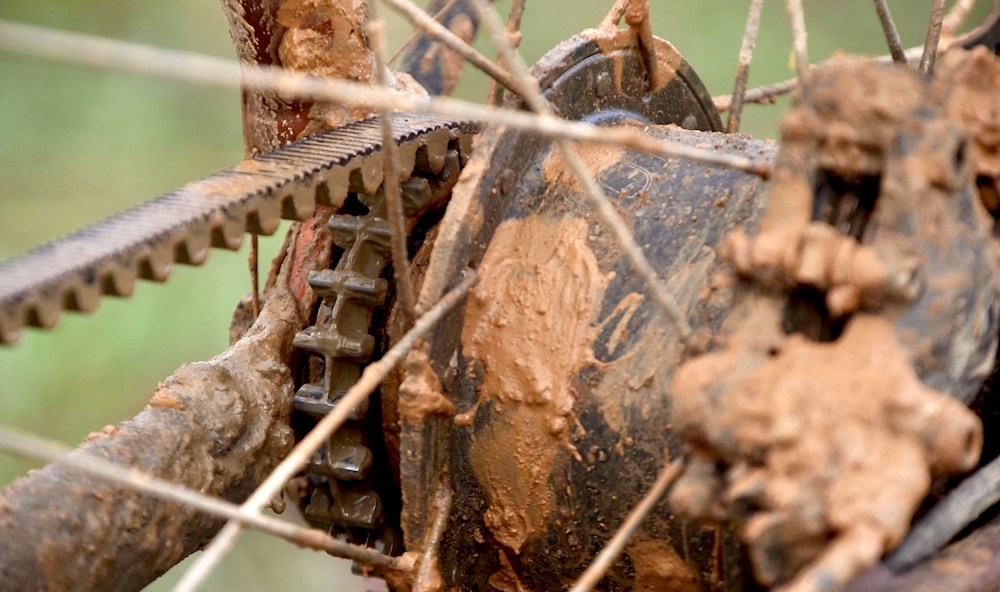
Belt systems perform particularly well in adverse environments. The tooth profile helps shed mud and debris effectively, and they are often paired with gearbox or internal gear hub systems, which keep the drivetrain components sealed away from dirt and water.
Belts also do not rust, making them especially well-suited for coastal environments or regions where salt is used on roads in winter.
Overall, belt drivetrains save a significant amount of time and effort by reducing maintenance, cleaning, and replacement needs, allowing riders to spend more time riding rather than servicing their bikes.
So if belt drives offer so many advantages, why aren’t they more widely used on bicycles?
Why Don’t We See Belt Drive On More Bikes?

The biggest limitation of belt drivetrains is that they are not compatible with derailleur gearing. This means they must be paired with either a gearbox or an internal gear hub.
Gearboxes, in my view, are an excellent solution for cargo bikes, commuters, and touring setups. They are robust, reliable, low-maintenance, resistant to damage, and allow shifting while stationary. However, they typically add around 1 kg of weight and can be roughly 5% less efficient than derailleur systems. They also tend to shift less smoothly under high load. As a result, if the goal is absolute minimum weight or maximum performance, a belt-driven system is unlikely to be the choice.
Belt drivetrains also require a dedicated frame design. These frames need a split rear triangle to install a one-piece belt, a tensioning system to maintain correct preload, and a very stiff rear end to prevent belt slip under load.
Availability can also be an issue. Belt components are not always stocked in local bike shops, meaning replacements are often ordered online, ideally before they are actually needed.

Cost is another consideration. A new Gates CDX drivetrain is typically around US $250 or €250 upfront. However, when spread over its longer service life, the cost per kilometre can be comparable to a high-quality chain system.
Finally, belts are not repairable. If a belt is damaged, it must be replaced. That said, failures are rare—I’ve only broken one myself. For long rides, carrying a spare belt is a sensible precaution. They coil down compactly and weigh under 100 grams, roughly similar to a chain tool, which you can then leave behind.
With that covered, let’s move on to the questions, which become progressively more technical from here.
General Belt Drive FAQ
How do belts feel to ride?

They feel like a very smooth, refined version of a well-lubricated chain. Despite their appearance, there is no noticeable “stretch” sensation thanks to the carbon fibre tensile cords embedded within the belt.
Why don’t they use belt drive bikes in the Tour de France?
At the highest level of road racing, riders prioritise absolute minimum weight and maximum drivetrain efficiency. Belt systems require a gearbox or internal gear hub, which adds weight and introduces a small efficiency penalty compared to a high-end derailleur system.
For that reason, belt drives are not competitive in WorldTour racing and won’t be seen in events like the Tour de France.
Don’t automotive timing chains last longer than timing belts?
That is often true in automotive applications. However, bicycle belt drives are a different technology and operate under very different loads and conditions. In cycling-specific testing and real-world use, belts have consistently demonstrated very long service lives compared to chains.
How expensive are belt drive bikes?
Entry-level belt drive bikes with a 3-speed internal hub start around US $599 (e.g. Priority Bicycles Classic Plus). Mid-range options with an 8-speed hub (such as the Cube Bikes Hyde) are typically just over €1,000. High-end belt-driven e-bikes can extend into the five-figure price range.
Can you use belt drive with e-Bikes?
Most belt systems are compatible with e-bikes, but within the Gates range, only CDC and CDX systems are approved for use with mid-drive motors. There are also torque limits to consider: CDC belts are typically rated up to 50 Nm, while CDX belts are rated up to around 90 Nm.
Can you use belt drive in the mud and snow?
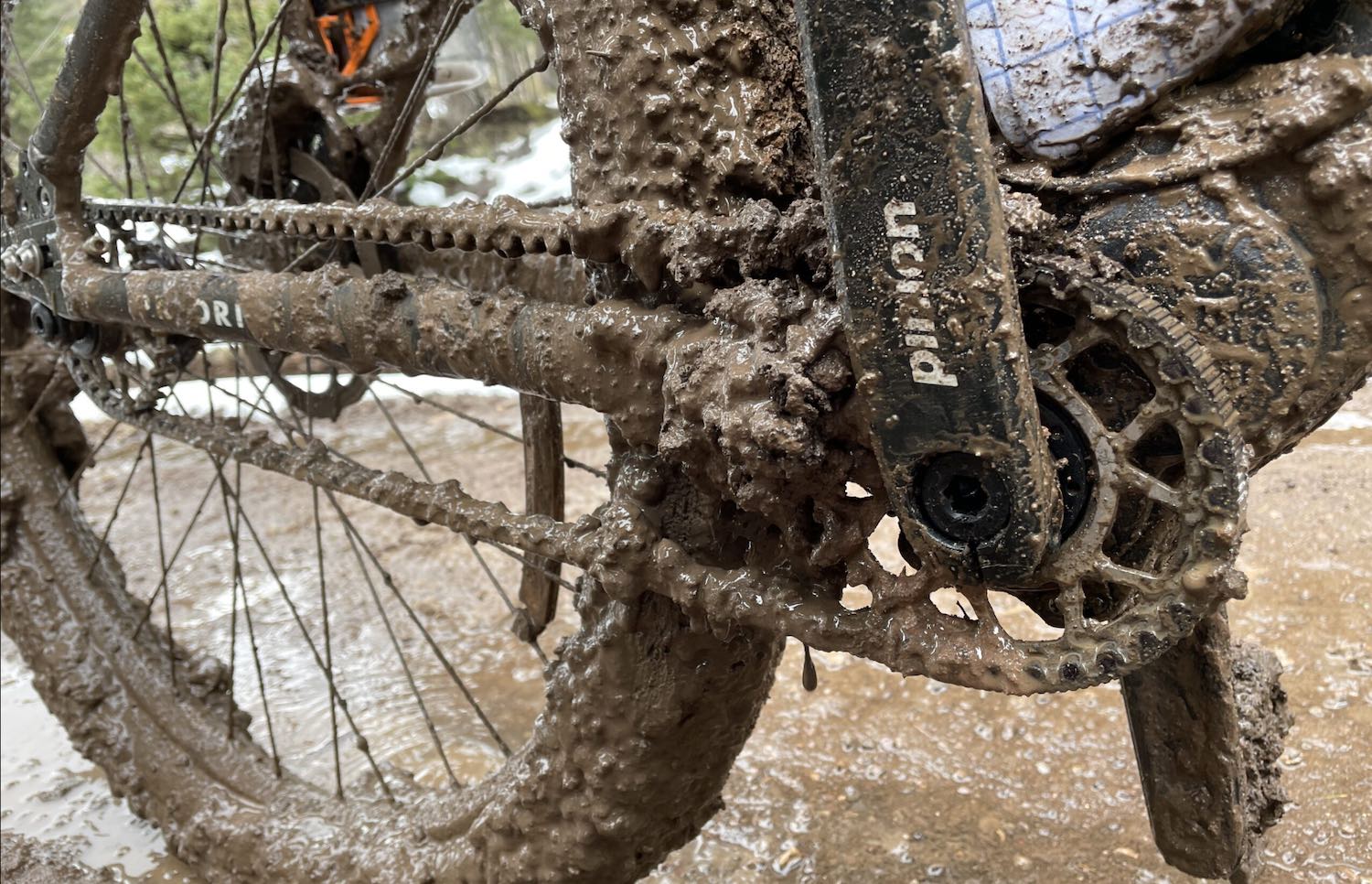
I’ve taken belt-driven bikes through thousands of kilometres of mud, snow, and mixed conditions. However, not all systems are equally suited for this. Within the Gates range, only CDX is officially rated for sustained muddy use. For snow and ice shedding performance, CDX, CDC, and CDN are all designed to cope with winter conditions.
Can you use belt drive on fixed gear bikes?
Yes, and it actually works surprisingly well.
Belt-driven fixed gear bikes exist and are known for their clean aesthetic and smooth operation. Examples can be found from manufacturers such as Schindelhauer Bikes and Priority Bicycles.
Can you use belt drive with full suspension bikes?
Yes. This is made possible using a spring-loaded tensioner, which compensates for changes in chainstay length as the suspension compresses through its travel. It’s a clever solution that allows full suspension frames to maintain correct belt tension throughout the stroke.
Notable examples include bikes from Zerode, Nicolai, Gamux, Riese & Müller, Aska Bikes, and Cavalerie.
Do belts ever snap?
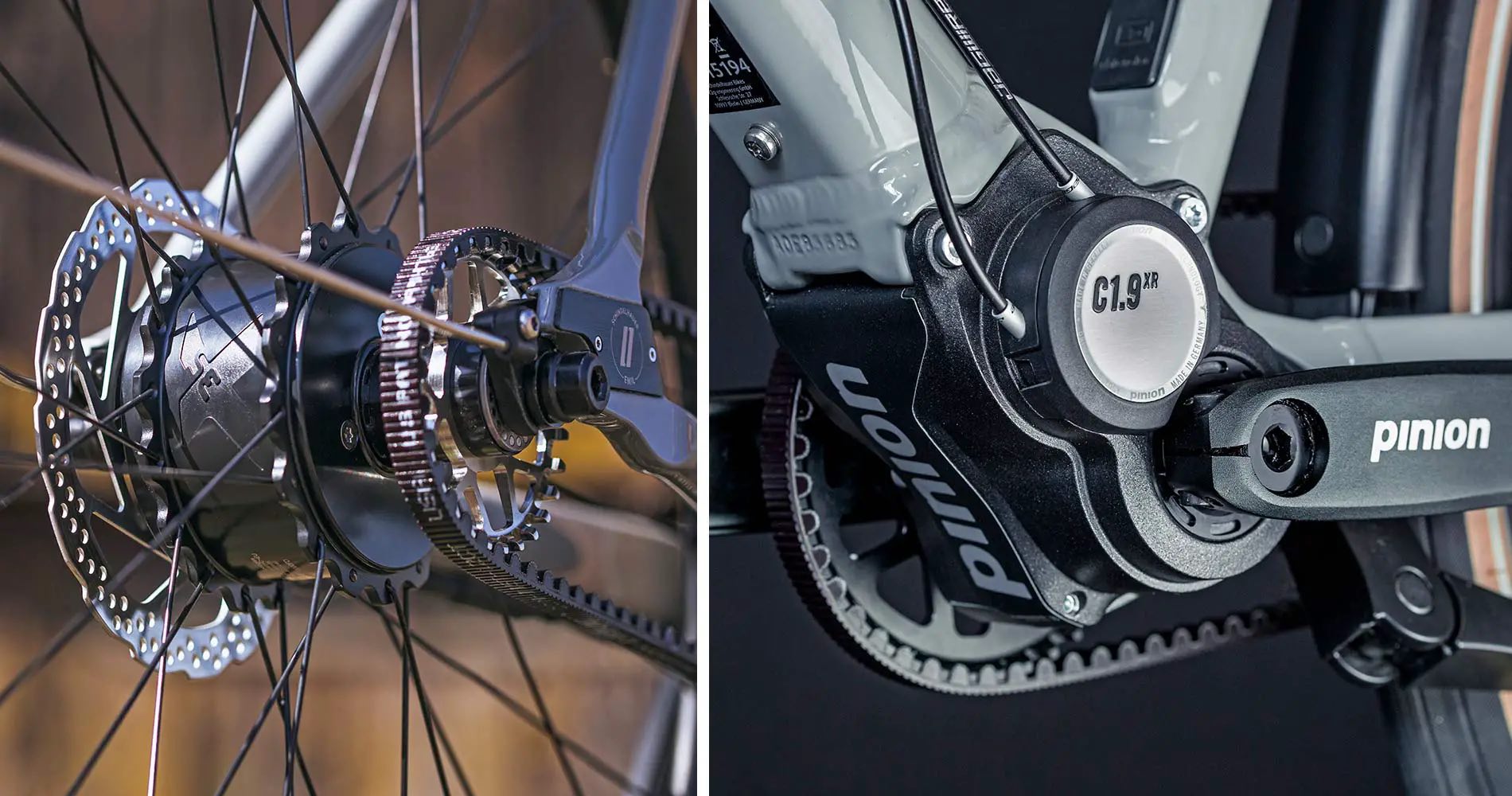
Yes, they can, but it is uncommon, and in most cases preventable. A broken belt is a rare failure mode in normal use. I’ll go into more detail on the causes later in the section “Why do belts break?”.
Do vandals cut belts?
In my experience, this has never happened, and I’m not aware of any reported cases. Belts are not a typical target for casual vandalism.
How expensive are belt drive components?
A full replacement drivetrain for my bike costs around US $250. While that may seem high, a well-used belt system can last over 35,000 km, which puts the cost per kilometre in line with high-end chain drivetrains.
That said, chains can still be cheaper in some configurations. For example, Shimano Alfine systems can work out to roughly half the cost per kilometre.
At the lower end, the entry-level Gates SideTrack system costs around US $100, but it typically lasts less than half the distance of CDX, resulting in similar long-term cost per kilometre.
Aren’t there limited gear ratios available on belt drive bikes?
Not anymore. The Gates CDX system now offers a wide range of options, including eight front sprockets, 13 rear sprockets, and 23 different belt lengths.
Can you modify a frame for belt drive?
It is possible, and I’ve personally modified several frames by adding belt splits over the years. Some robust frames can handle this well, but for best results, it’s strongly recommended to use a frame designed specifically for belt drivetrains.
If a modified frame lacks sufficient stiffness, it may flex enough to reduce belt tension and cause slippage on the rear sprocket. This can sometimes be compensated for with higher tension, but that increases friction and accelerates wear on the system.
Maintenance FAQ
What’s the belt maintenance like?
Belt drivetrains are often described as “zero maintenance”, but in practice, getting 35,000 km (22,000 mi) out of one requires a small amount of basic care.
Road and trail debris can accelerate sprocket wear, so it’s worth periodically cleaning the drivetrain with a toothbrush and a splash of water to remove grit buildup.
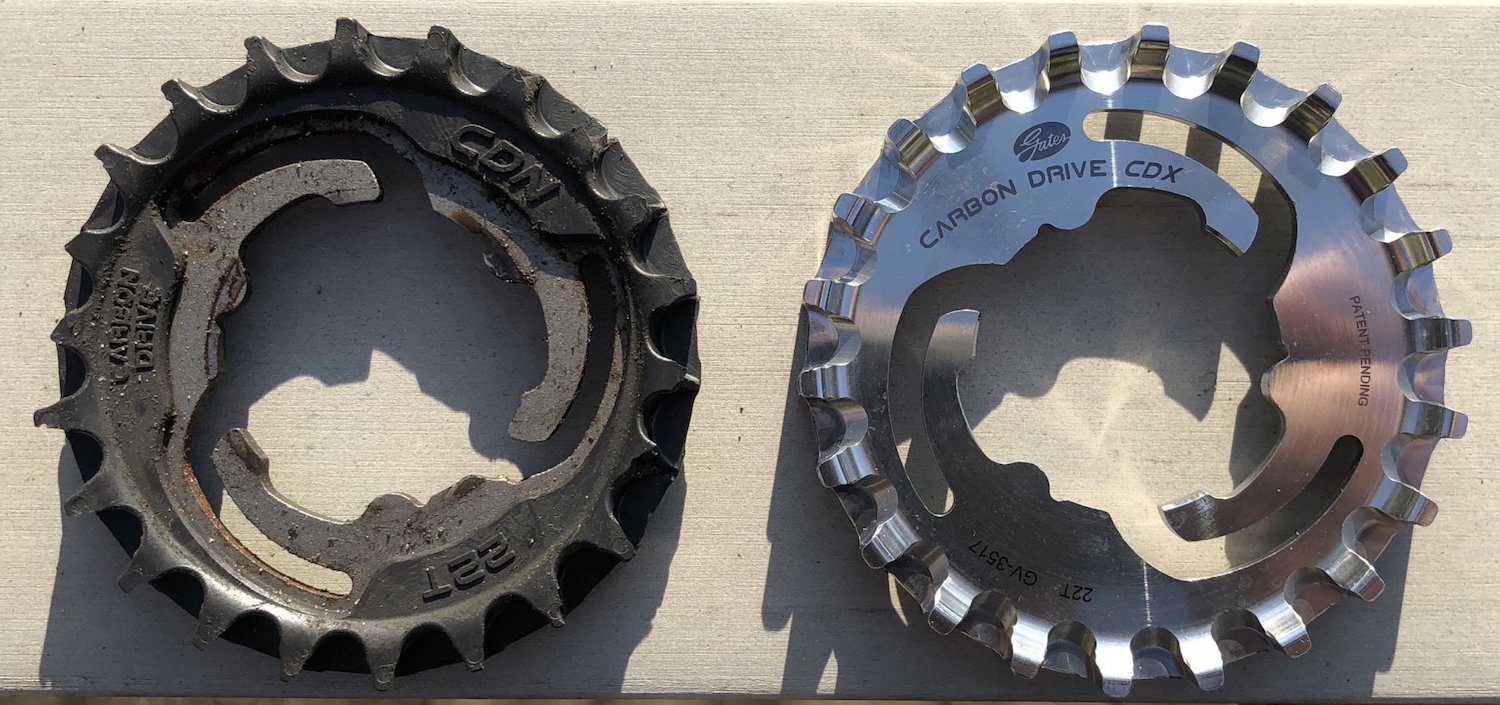
What does a belt drivetrain look like after 35,000km?
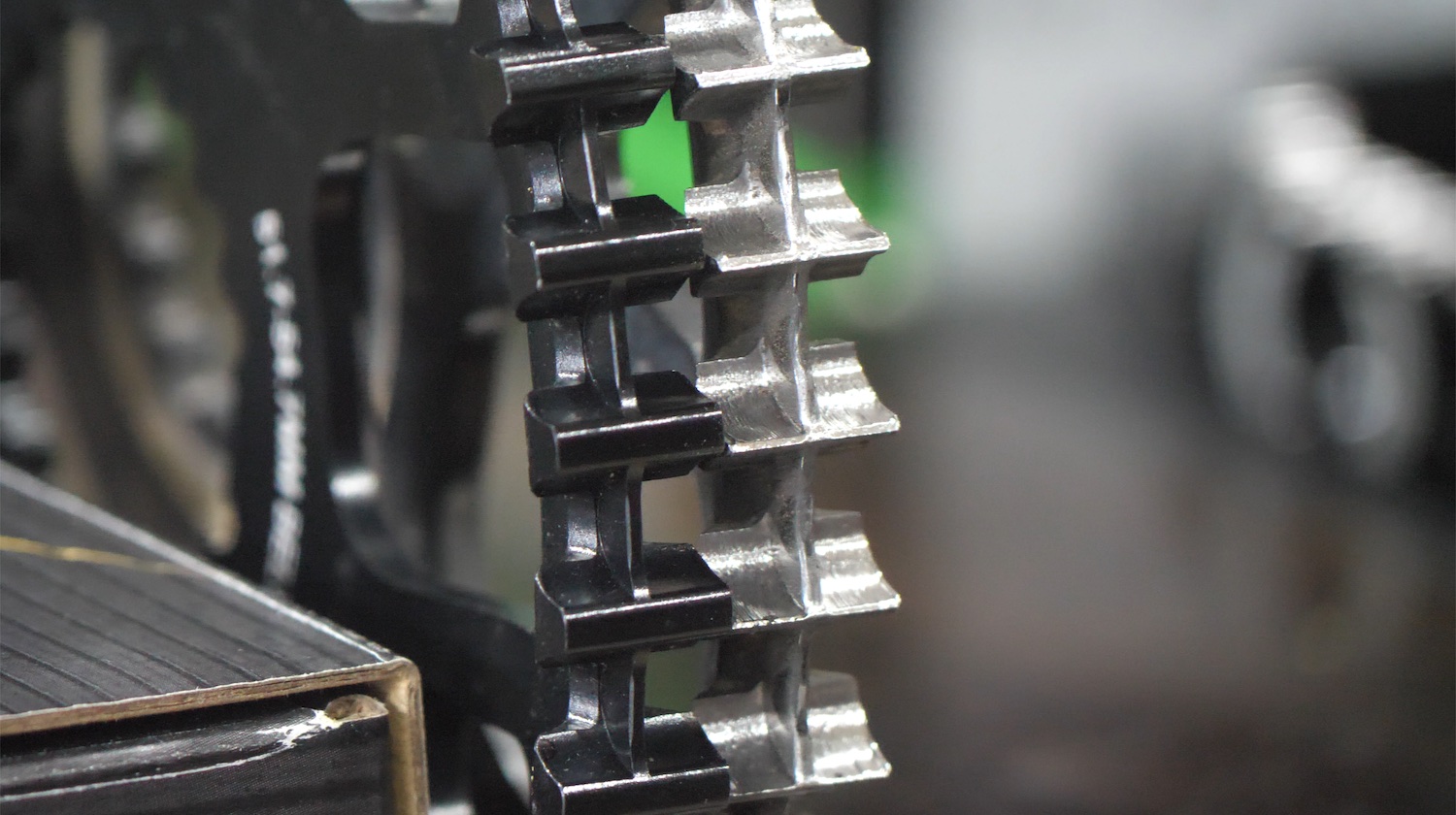
After this kind of mileage, the front and rear sprockets can wear down significantly, often to less than 1 mm (about 1/32″) thick and noticeably sharp to the touch. That’s roughly one-third of the thickness of a new sprocket, although in some cases wear can be even more severe depending on conditions and maintenance.
Do belts ever make noise?
In very dry environments with fine dust, belts can develop a squeak. To address this, I’ve used small amounts of treadmill-grade silicone lubricant applied sparingly. It’s non-aerosol, which makes it easy to carry in small bottles on longer trips.
There are also newer products emerging, such as coatings that dry into a film layer. I’ll be testing one from Universal Transmissions in the future. On the other hand, products like the Hanseline belt care stick are best avoided, as they tend to stay sticky and attract grit.
How do you set the belt tension?
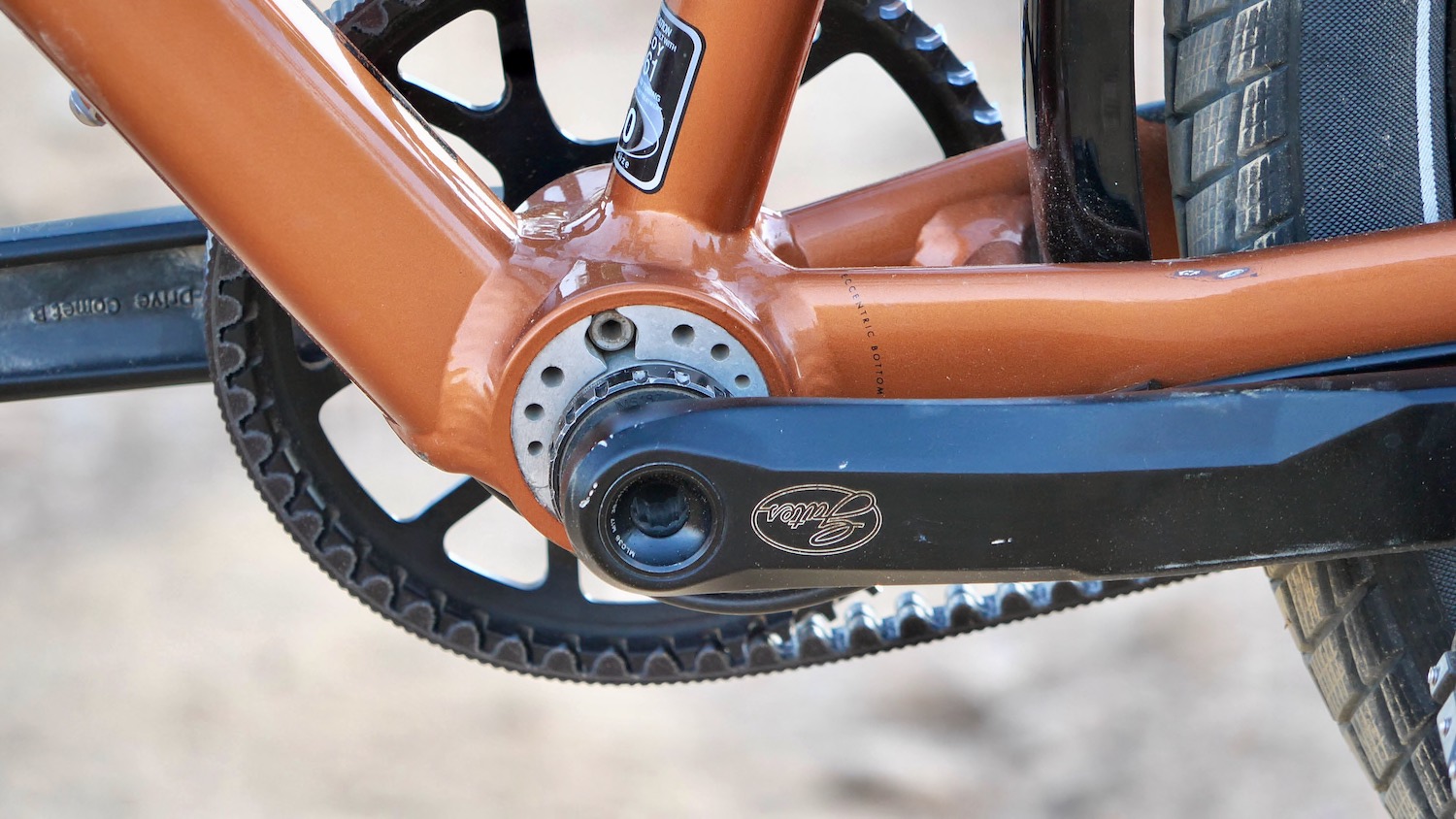
Unlike chains, belts do not elongate with use, so tension generally remains stable until sprocket wear becomes significant.
There are two common frame systems for setting tension: sliding rear dropouts or eccentric bottom bracket shells.
Tension can also be checked using a smartphone app that measures belt vibration frequency after plucking the belt.
However, in practice, especially stiff frames can often run lower-than-recommended belt tension without issues. In these setups, a belt snubber (which helps retain the belt on the rear sprocket) is important, and fine-tuning tension can improve efficiency and durability.
How do you find the right belt length?
Gates provides an online calculator where you can input your frame’s chainstay length and desired gear ratio. It then outputs compatible sprocket combinations and belt lengths for your setup.
Do belt drive bikes destroy hub and bottom bracket bearings?
It is possible that excessively high belt tension could increase bearing wear. However, on properly designed frames, real-world riding tension is typically comparable to that of a chain drivetrain, meaning bearing loads are generally not significantly different in practice.
Gates Carbon Drive Components
Are there any belt drive manufacturers other than Gates?
Yes, although Gates dominates the market by a wide margin and is fitted to well over 1,000 bicycle models worldwide.
There are a few alternative systems, including brands such as Veer, Optibelt, Advanced, Hutchinson, Accord, Driveline, and Continental (the latter now discontinued).
Veer is probably the most interesting alternative. It uses a split-belt design, allowing retrofit installation on bikes with adjustable dropouts. However, its gear ratio options are currently very limited, which restricts its real-world versatility.
Advanced claims that its system can operate with lower belt tension thanks to deeper tooth engagement, but there is very little publicly available testing or independent data on its performance or durability.
What are the products in the Gates Carbon Drive range?

The current range includes four main systems: SideTrack, CDN, CDC, and CDX. Generally, as you move up the range, materials, durability, and performance improve.
This is achieved through different material choices: belt teeth use different rubber compounds, carbon tensile cords vary in construction, and sprockets range from steel to aluminium and composite materials, depending on the system level.
The CDX system is the flagship option, offering the highest strength, durability, and weather resistance, and is compatible with the widest range of bicycles.
There are now two CDX variants:
CDX:Black – a newer version designed for increased durability. It uses chromoly steel sprockets and a revised fin-tooth profile intended to improve debris shedding and better suit high-torque mid-drive e-bikes.
Standard CDX – used for example on my KOGA WorldTraveller for over five years. It uses stainless steel rear sprockets and either stainless steel or aluminium front sprockets, depending on tooth count.
Are there any known Gates Carbon Drive problems?
There have been a few historical issues.
In 2015, first-generation CDN rear sprockets with a plastic coating were prone to tooth damage, leading Gates to replace affected units under warranty with stainless steel versions.
In 2016, some Rohloff hub belt sprockets developed creaking issues due to the original splined carrier design (part #8540). This was resolved in 2018 with an updated carrier (part #8540L), which eliminated the issue.
Belt Drive Performance
Why do some belts wear prematurely?
The biggest factor affecting belt wear is riding conditions. Grit, dust, and contamination significantly accelerate sprocket wear, so regular cleaning of the drivetrain is important for maximising lifespan.
High torque loads also increase wear on the rear sprocket, which means high-power mid-drive e-bikes typically see shorter component life. This effect can be reduced by riding at a higher cadence or choosing a higher gear ratio to lower peak torque at the drivetrain.
Rear sprocket size is another important factor. Smaller sprockets engage fewer teeth at once, which concentrates the load and causes faster wear. Larger sprockets distribute the load more evenly and generally last longer – one reason I’ve had good results with 22-tooth sprockets.
Belt tension also plays a role. Higher tension increases friction and accelerates wear, which is why dedicated belt frames are beneficial; they allow correct but not excessive tension.
Finally, alignment is critical. Even small misalignment between the front and rear sprockets can significantly increase wear rates.
Why do belts break?
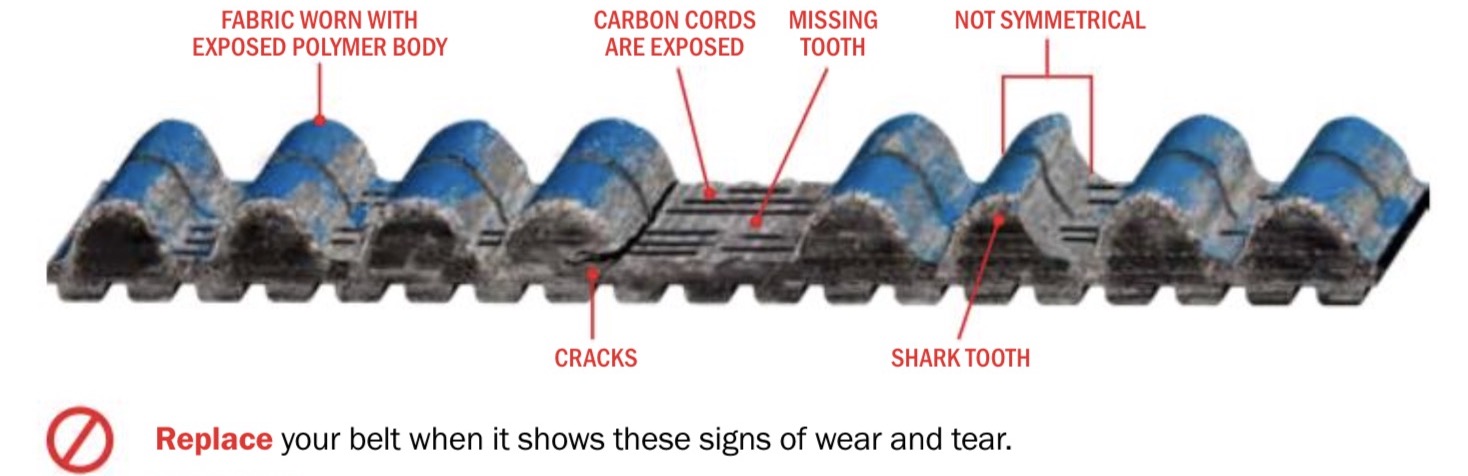
Belts can fail due to incorrect alignment, insufficient tension, or damage to the internal carbon tensile cords.
If the belt rides up over the teeth of the rear sprocket, it can damage both the tooth profile and the internal cords. This typically happens when tension is too low, the rear sprocket is not properly secured, or the drivetrain is misaligned.
For this reason, a belt snubber is strongly recommended. This small guide device helps prevent the belt from climbing off the rear sprocket under load.
Belts can also be damaged before installation if they are twisted, sharply bent backwards, or crimped, as this can compromise the internal reinforcing cords.
A well-known example of user-induced failure comes from Ryan Van Duzer, who demonstrated that improperly “rolling” a belt onto a sprocket can damage its internal structure. The correct method, if a belt comes off, is to remove the wheel, place the belt properly onto the sprocket, and then reinstall the wheel without forcing or twisting the belt.
Are chains or belts more efficient?
Belt drives are broadly comparable in efficiency to chain drives, but the relationship depends on the specific conditions and setup. In practice, either system can be slightly more or less efficient depending on power output, drivetrain configuration, and component choice.
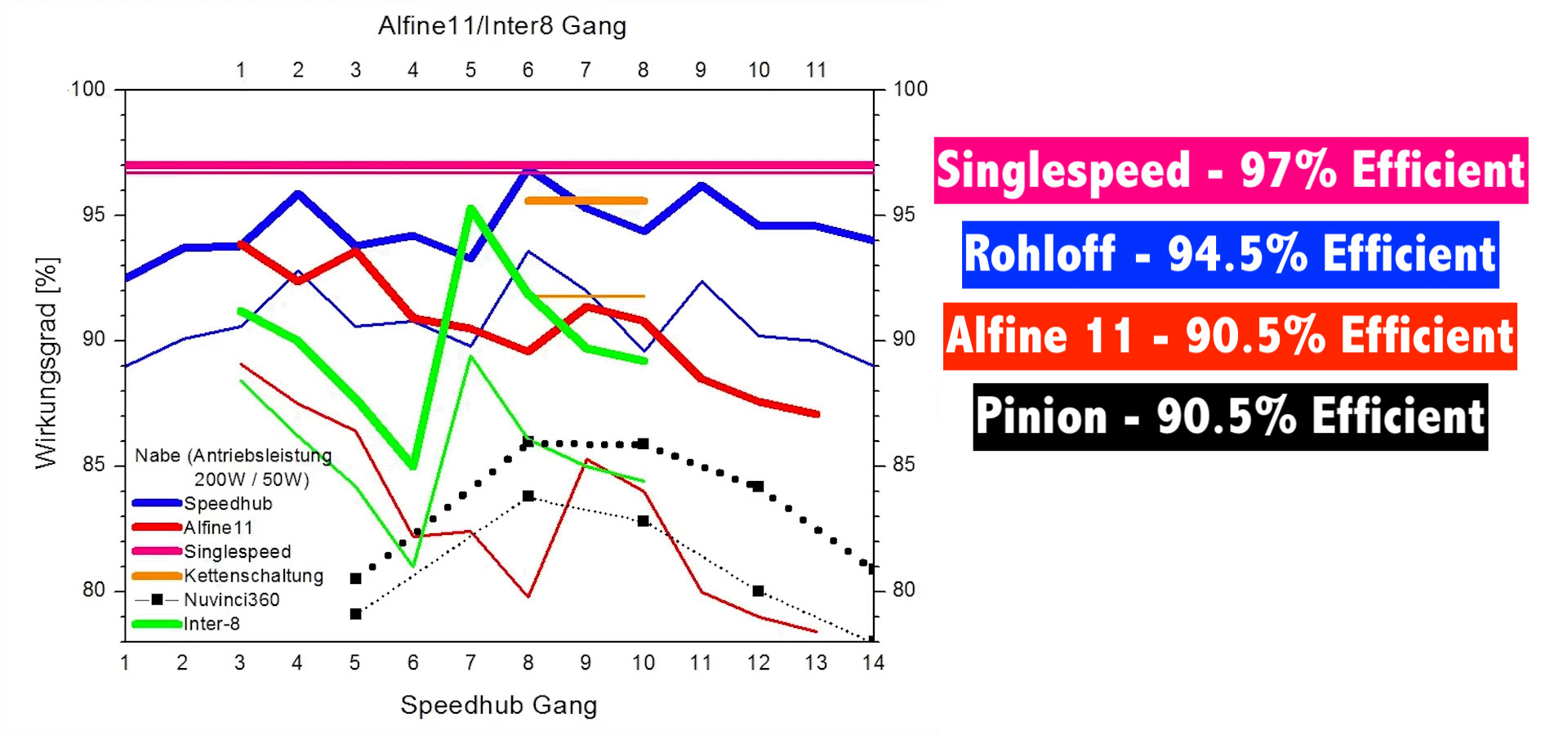
It’s worth noting that most of the efficiency difference riders feel or measure is not actually from the belt or chain itself, but from the gear system it’s paired with. In many belt drivetrains, the use of a gearbox or internal gear hub introduces the largest losses (typically in the range of 2–6%), which can translate to a small reduction in speed of roughly 0.25 to 0.75 km/h under controlled conditions (based on an 80 kg rider, 15 kg bike and gear, flat road, and 200 W output).
In real-world riding, especially in rough or dirty conditions, this difference can become less pronounced.
A common assumption is that belt drives are less efficient because they feel harder to turn by hand. However, this doesn’t capture the full picture of how they behave under load.
Across multiple independent lab tests, belt drivetrains tend to be slightly less efficient than chains at very low power outputs. This is largely due to the constant preload tension required in a belt system, whereas chains can operate with minimal slack resistance. As power output increases, however, belt efficiency improves and eventually converges with chain performance.
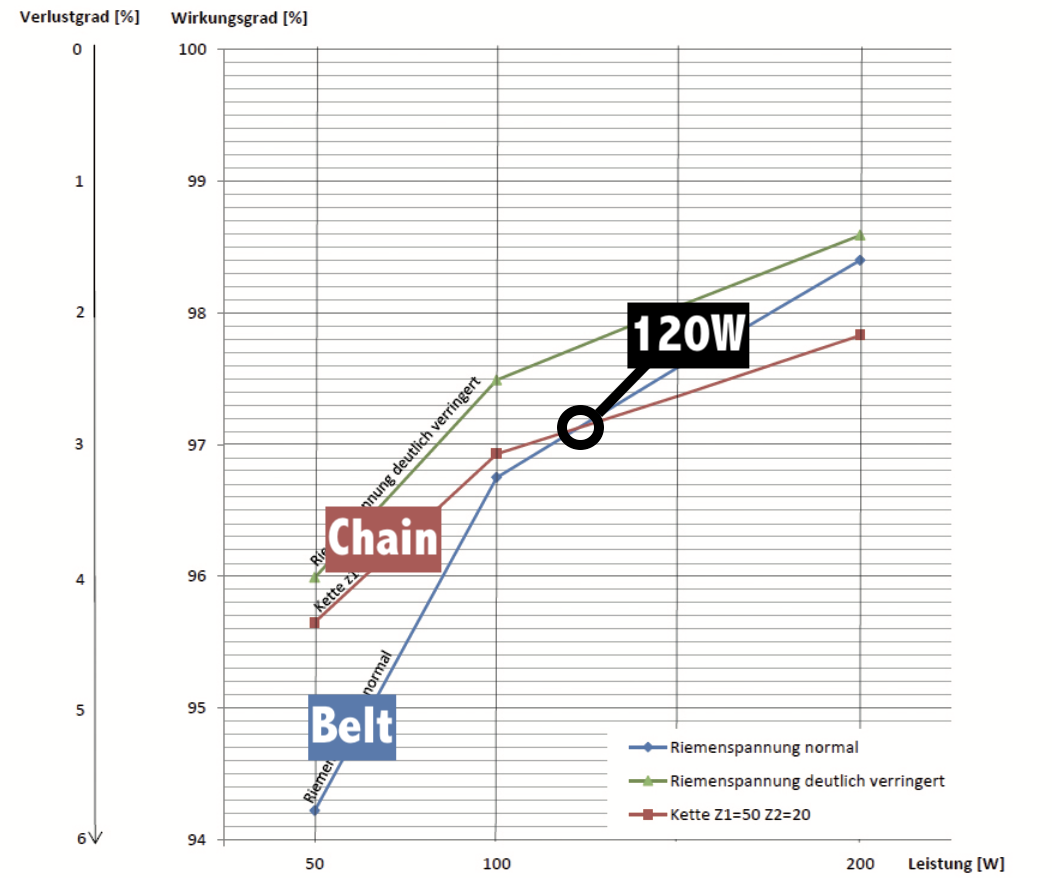
Different studies place this crossover point at different levels: around 120 watts in a Trier University test, above 200 watts in Friction Facts testing, and as low as 30 watts in data published by Universal Transmissions.
Regardless of the exact value, most cyclists regularly ride above these thresholds, meaning both systems operate in a similar efficiency range for typical use.
More recent data from Universal Transmissions (a Gates distributor in Europe and co-developer of early belt systems) also adds useful context, though its chain data should be interpreted carefully, given the variability in chain models and lubricants.
Alright, let’s get onto the interesting findings.

One interesting finding is how wear affects efficiency. Worn belts appear to maintain efficiency better than worn chains after both 5,000 km and 10,000 km of use.
In contrast, chains gradually lose efficiency as wear increases due to elongation and reduced meshing accuracy with the sprockets. Even a new chain running on worn sprockets can perform worse than a belt system over the same distance.

It’s also worth noting that chains are typically replaced multiple times over the lifespan of a single belt, meaning their efficiency fluctuates between roughly 96% and 98% depending on wear state, while belt efficiency tends to decline more gradually over time.
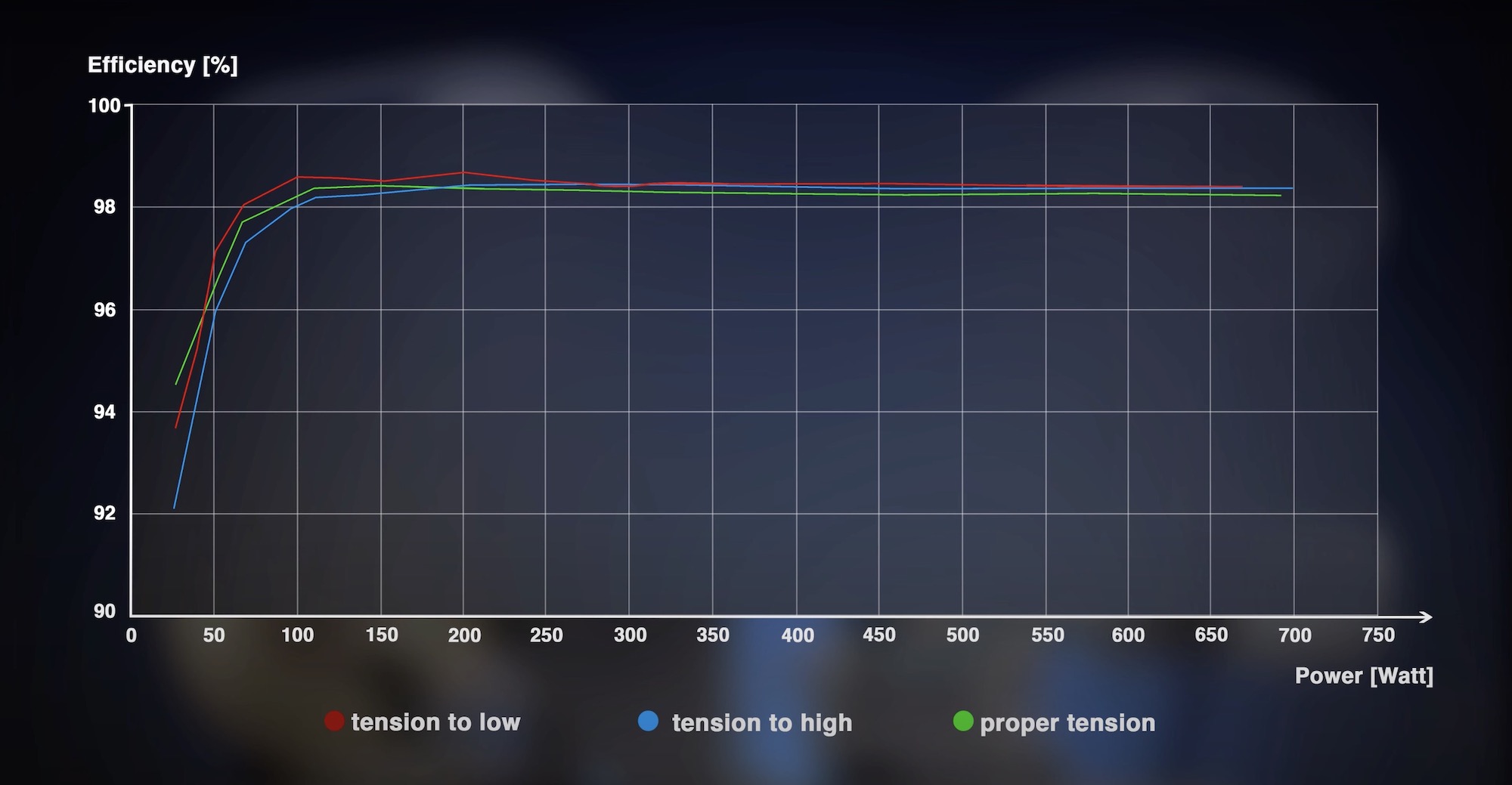
Finally, belt tension has been shown to have only a minor effect on overall efficiency.
Tests comparing low, medium, and high belt tensions indicate that lower tension performs best in most cases, but by around 50 watts of input power, all configurations converge within about 1% of each other. This suggests that tension plays a relatively small role in real-world riding efficiency compared to other factors.
Are belt drive bikes worth it?
If you’ve made it this far, you’ve basically earned an honorary PhD in belt drives. Congratulations!
Many long-distance bike travellers have now demonstrated, often in some of the harshest riding conditions imaginable, that belt drivetrains can be long-lasting, robust, and extremely low maintenance.
If your priority is durability, simplicity, and ease of use above all else, belt drive is one of the strongest drivetrain options available. It’s particularly well-suited to touring, commuting, bikepacking, cargo bikes, and general recreational riding.
That said, belt systems aren’t the best fit for every use case. If the goal is maximum speed, minimum weight, and peak performance, a traditional chain and derailleur drivetrain is still the better option.
To learn more about gearboxes, check out my articles on affordable Shimano internal gear hubs, as well as Rohloff hubs, Pinion gearboxes, and Effigear gearboxes. There are also a bunch of new gearboxes coming in for 2023.


